CORTENYS · THE ART OF CORTEN STEEL
Corten steel: the complete guide
Corten steel is a metal that protects itself: season after season, it cloaks itself in a dense patina that shields its core. Composition, data sheet, patina, pros and cons, lifespan, price, maintenance, coast and winter: here is the essential guide to Corten steel, told by a House that has made it a material of fine craftsmanship.
Choosing Corten steel pieces for strong sun, pools and the coast
By the hours you spend outside
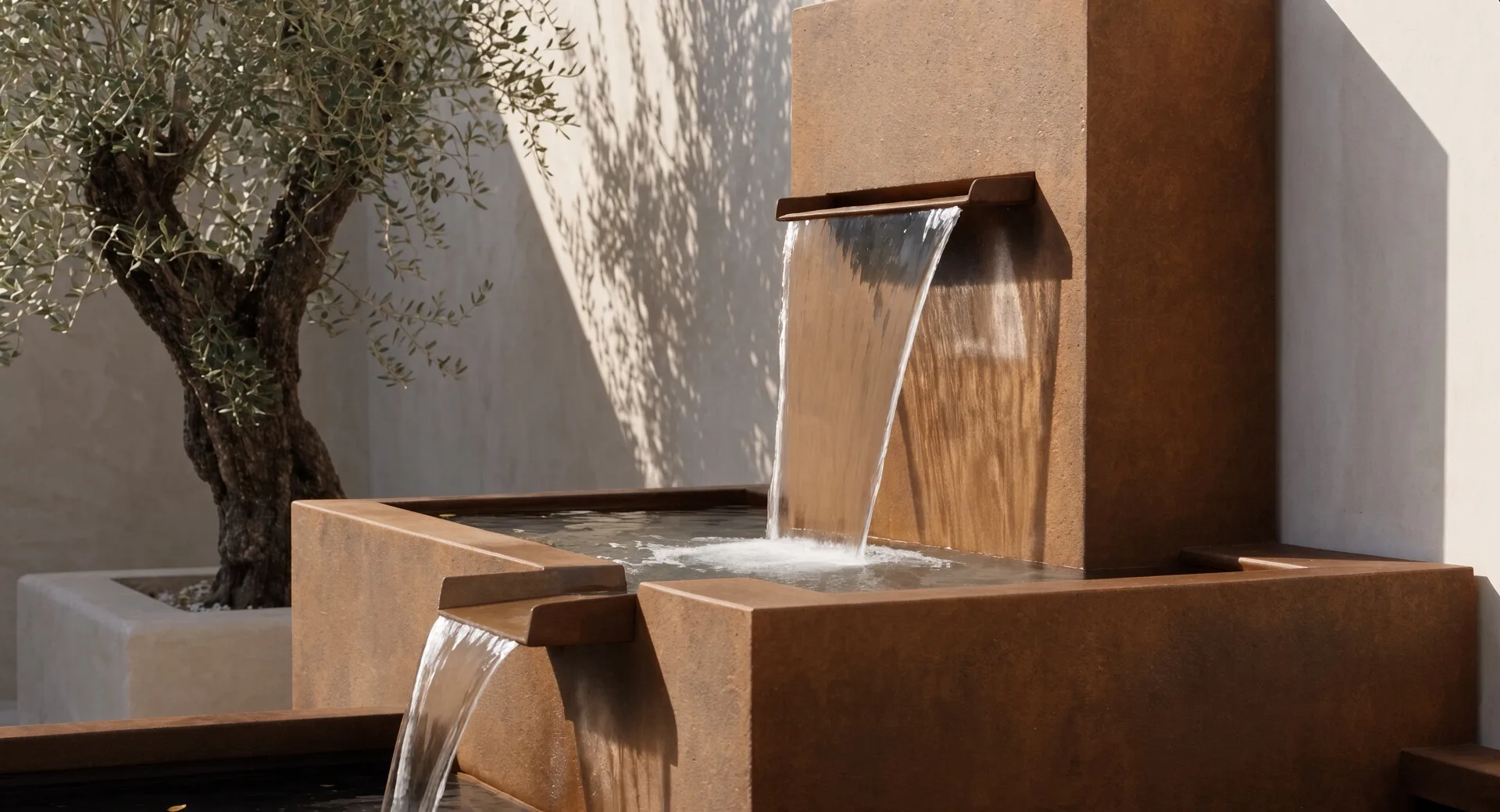
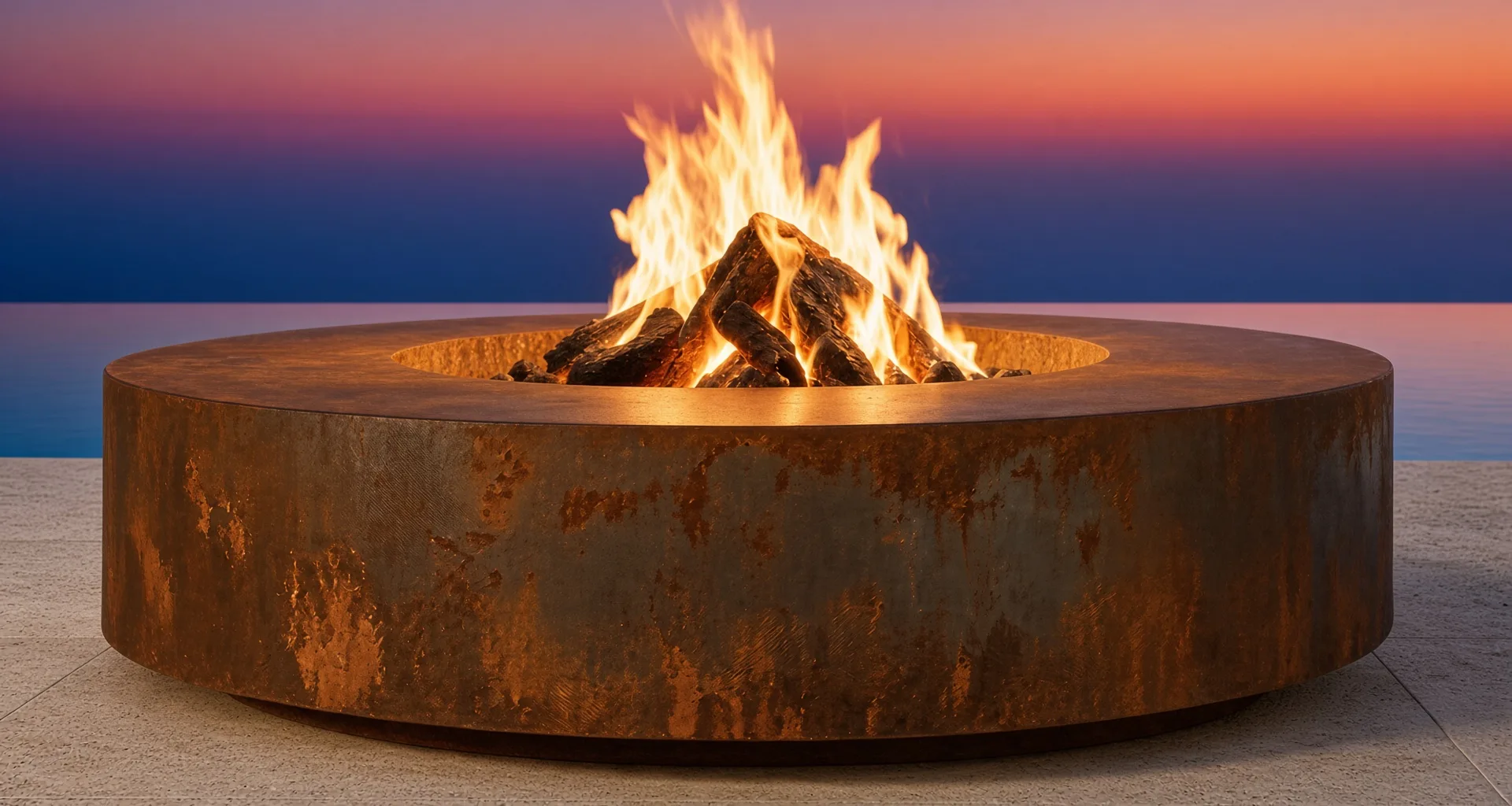
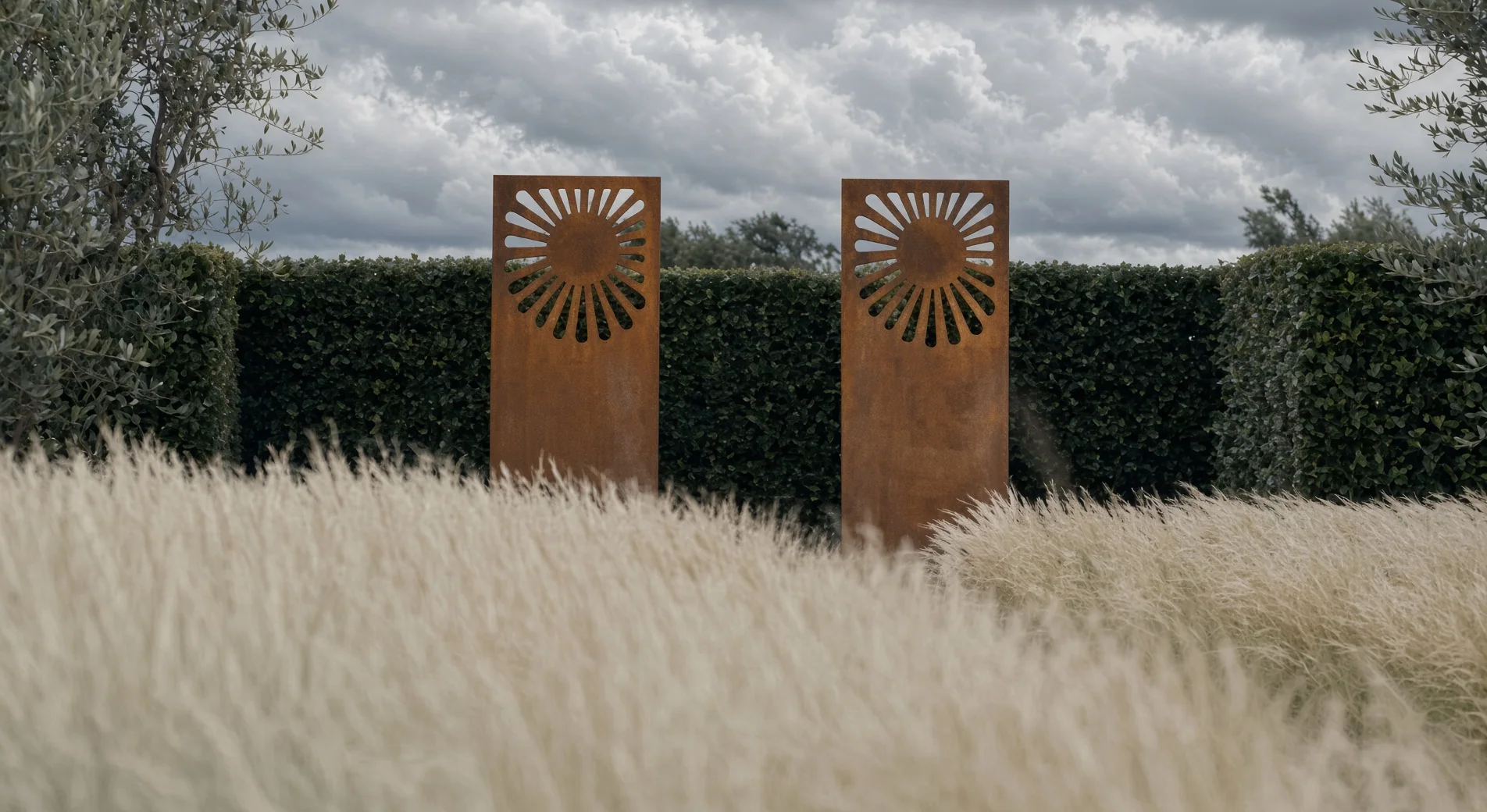
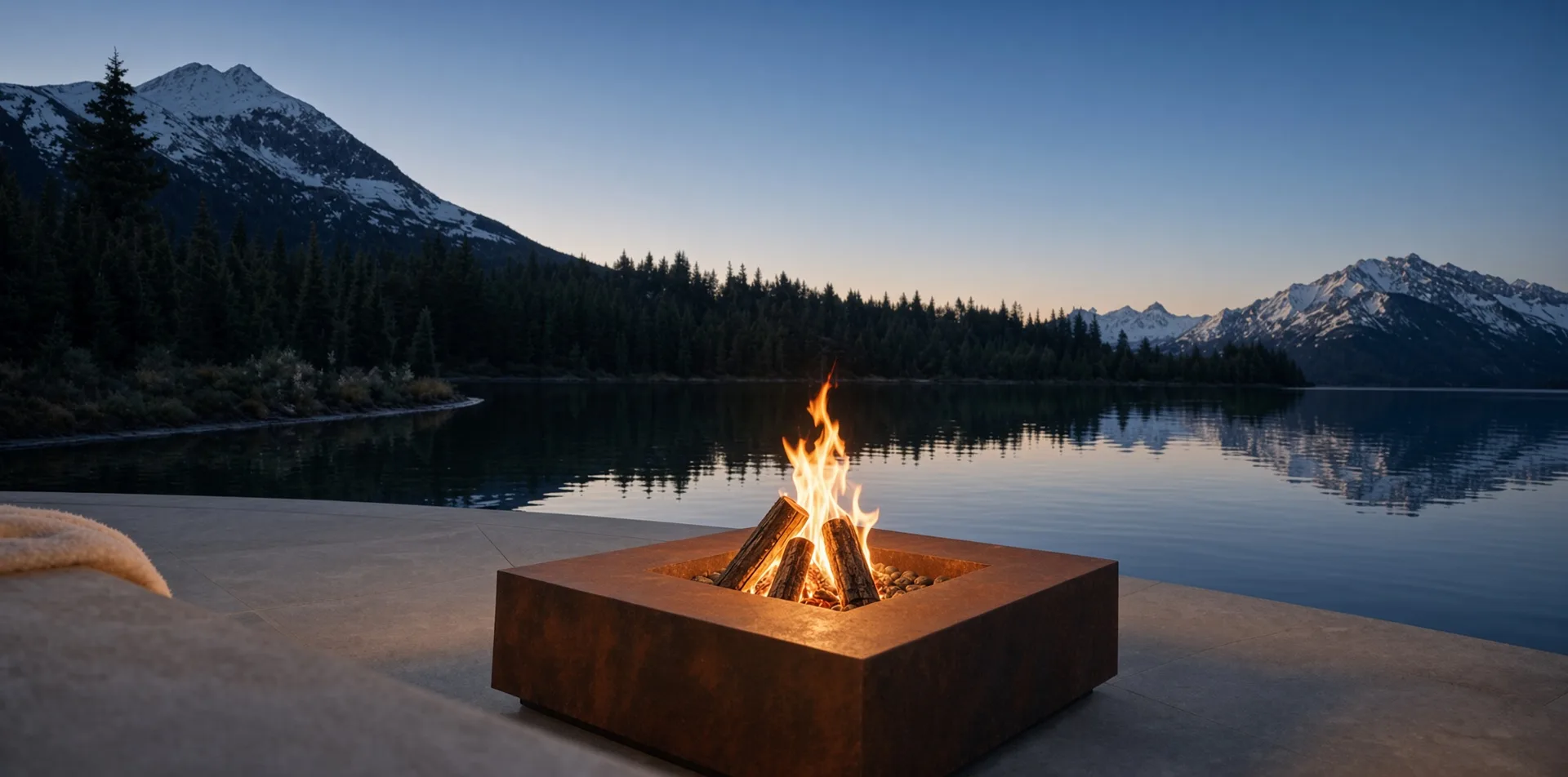
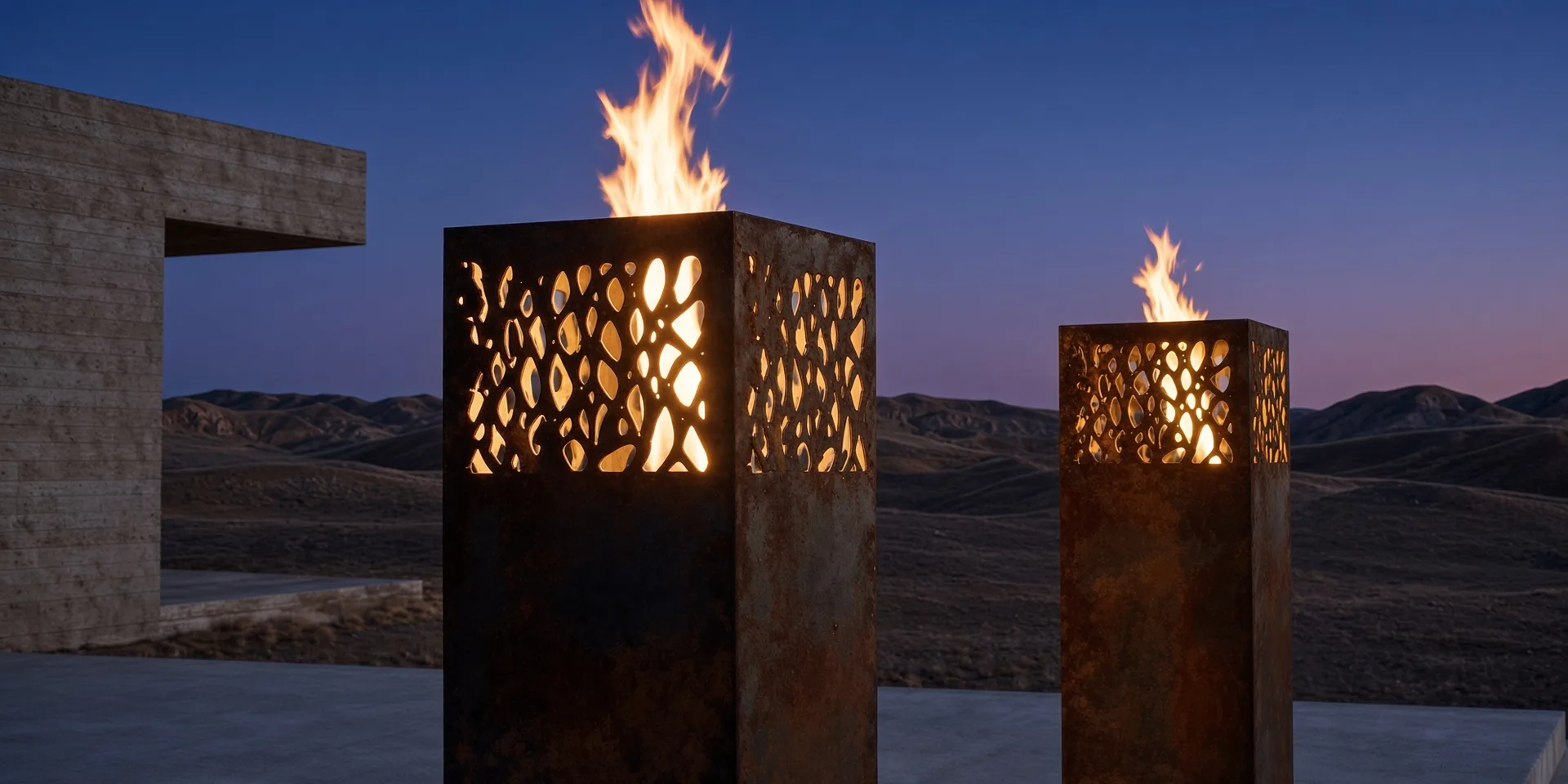
Before choosing a family, think about the hours when the terrace is really lived in. Steel that you touch, such as the top of a fire table or the rim of a water basin, warms up under a strong sun, so give it the shade of a wall or keep it for the end of the day. Pieces made to be looked at, a decorative panel or a tall pot, can stand in full light, and set against white render, the warm tones of their patina come forward. Once the light fades, Corten fire tables, fire pits and flame lanterns take over the terrace.
Water nearby: pools and the coast
Around a pool, Corten stays back from the splashes, varnished where the model allows (even varnished, it can still leave run-off on pale coping, so keep spacers beneath it), and anything that touches the water itself is better in powder-coated aluminium. Where sea spray reaches the terrace, our powder-coated aluminium range takes over, with most of our planting, water and firewood designs drawn to the same lines. Our fire pieces have no varnish option, so give them the most sheltered spot, behind a wall or a planted screen. For a garden set back from the shore, Corten steel near the sea explains how we assess each setting from a few photographs and the prevailing wind.
One patina, different finishes
Every Corten piece leaves our workshop with its signature patina already applied and checked; what changes from one family to another is the finish. All our fire pieces, from the fire pits to the outdoor fireplaces, keep the bare patina with no varnish on offer, as do the flame lanterns. Planters, pots, log stores, water pieces, decorative panels and the outdoor lights can take the clear protective varnish on selected models: chosen when you order, it fixes the colour and strongly reduces run-off on pale stone and pool copings, without ruling it out, so we still recommend protecting pale stone beneath each piece. Left raw, the patina goes on deepening outdoors. Indoors, varnish is compulsory, so our interior lights and the tables and seating always arrive varnished.
FAQ
Which Corten designs are also made in powder-coated aluminium?
Most of our planting and water designs: the Cybèle, Déméter, Maïa, Thalie and Iris planters, the bottomless Rhéa and Gaïa, the Callisto, Clio and Daphné pots, the Alban, Elio and Nereida fountains, the Célestin and Léandre water walls, a rectangular and a round water basin, and most log stores, in eight colours. Fire pieces, lights and decorative panels are made in Corten only.
Which Corten pieces suit a front entrance?
A pair of pots can frame the door, and the Limentis letterbox, engraved to order with your name and number, marks the approach. Solan wall lights, set in pairs, can flank the doorway, while Levant, a decorative panel drawn for entrances, sets the tone. Another panel can screen the bins or a meter from the path.
Can Cortenys design a piece for a specific setting?
Yes, through a bespoke application: describe the setting, its dimensions and your intention, with a plan or a sketch if you have one. We then review feasibility, proportions and the steel thickness the project calls for, and design the selected projects with you. Varnish is compulsory indoors; outdoors, the finish is decided with you, according to the setting and the surface beneath. Even varnished, Corten steel can still mark a light or porous floor, so we recommend protecting it.
THE ESSENTIALS
Corten steel in six answers
- A low-alloy steel that covers itself in a dense, protective oxide patina, with no paint and no galvanising.
- Small amounts of copper, chromium, nickel and phosphorus, governed in Europe by EN 10025-5 (grades S355J0W, S355J2W, S355J0WP, S355J2WP) and in the United States by ASTM A588 and A242.
- More expensive than ordinary steel: dated price readings for raw sheet in the chapter on price.
- Several decades outdoors, provided the piece can dry: exposure measurements in the chapter on lifespan.
- Its limits: chlorides (sea, swimming pool, de-icing salt), standing water, and the run-off of a raw sheet in its first months.
- At Cortenys: signature patina applied in the workshop, protective varnish as an option, powder-coated aluminium for the coast.
THE MATERIAL
What is Corten steel?
Corten steel is a low-alloy steel designed to withstand the weather without paint or galvanising. Exposed to rain, air and sun, it develops a dense, tightly bonded oxide patina of deep orange-brown that greatly slows the progress of corrosion into the core of the metal. Rust eats away at ordinary steel; the Corten patina protects it. The whole paradox of this material, and all of its beauty, lies in that reversal.
Corten goes by several names. COR-TEN is the historic trademark registered by the American steelmaker US Steel; it gave the material its everyday name, written Corten steel, Cor-Ten steel or simply Corten. Engineers call it weathering steel, and sometimes self-weathering or self-protecting steel. The name itself holds two promises: CORrosion resistance and TENsile strength, the steel’s resistance to being pulled apart.
In Europe, Corten steel falls under the EN 10025-5 standard, which governs structural steels with improved atmospheric corrosion resistance. The most widely used grades are S355J0W and S355J2W, close to COR-TEN B, along with their phosphorus-enriched variants, S355J0WP and S355J2WP, close to COR-TEN A. In the United States, the ASTM A242 and A588 standards designate steels of the same family: A242 corresponds to COR-TEN A, A588 to COR-TEN B.
Its composition explains everything. The base is that of a structural steel, iron and a little carbon, to which small amounts of copper, chromium, nickel, phosphorus and silicon are added. These alloying elements change the very nature of the rust: instead of a porous layer that flakes away and keeps laying the metal bare, they encourage a thin, compact oxide bonded to the surface, which water and oxygen find harder and harder to pass through.
Ordinary steel: porous rust, flaking, metal laid bare again
Corten steel: dense, bonded patina, core of the metal protected
This is what sets Corten steel apart from ordinary steel. Mild steel left outdoors has to be painted, galvanised or powder coated, or it will eventually corrode right through. Corten needs no coating at all: its protection comes from its own surface, and its colour is not paint but a record of its exposure to the elements. For a piece of Corten steel furniture, that honesty of material is already a luxury.
THE DEFINITION IN THE STANDARD
The EN 10025-5 standard (NF EN 10025-5:2005, the French transposition of EN 10025-5:2004, as cited by the French Wikipedia) defines weathering steel as a steel to which phosphorus, copper, chromium, nickel or molybdenum have been added to increase its resistance to atmospheric corrosion, through a ‘self-protecting layer of oxides on the base metal’ formed under the influence of atmospheric conditions.
What is Corten steel used for? Edging, planters, fire pits, façades
In the garden, Corten steel serves first as edging: a blade of sheet steel that separates a bed from a path and holds back the soil without buckling. Then come planters and bottomless planters, fire pits and fire tables, fountains, screens and decorative walls. Beyond the garden, it clads façades, carries bridges, lines major roads and serves sculpture. Its warm tones sit naturally with planting, and it outlasts timber in a suitable setting. Nine ways to use it are gathered in Corten steel garden ideas.
Cortenys
Find the right piece
Planting brings structure, water creates calm and fire draws people together. Explore Corten steel pieces by the role they will play in your garden.
Start with the purpose: planting, water, fire, log storage or screening. Product pages list dimensions, options and equipment. Our material guide explains weathering steel and its patina.
THE COMPOSITION
What is the composition of Corten steel?
The composition of Corten steel comes down to a few tenths of a percent. On a base of iron and carbon identical to that of a structural steel, EN 10025-5 sets ranges for copper, chromium, nickel and, for the grades known as WP, phosphorus. These additions, minute at the scale of a sheet, decide the nature of the rust and the hold of the Corten patina. The table gathers the ranges of the four most common grades, maximum values unless a range is shown; they describe the standard, not a Cortenys piece, and the exact composition of a sheet appears on its inspection certificate.
Composition of Corten steel by grade, in % by mass (maximum values, unless a range is shown)
Sources: EN 10025-5:2004 as reproduced in the thyssenkrupp Christon brochure Tôles d’acier Cor-Ten; S355J2WP data sheet from metonorm (number 1.8946); nickel of the European grades from the note to the composition table of EN 10025-5:2004 (‘the steels may show a Ni content of max. 0.65 %’), as reproduced in the Steel Number S355J2WP data sheet.
The role of each alloying element
- Copper and phosphorus encourage a thin, adherent oxide in place of the porous rust of ordinary steel.
- Chromium and nickel densify that layer and help it stay stable through the wet and dry cycles.
- Silicon and manganese are those of any structural steel; carbon stays low, which preserves weldability and folding.
- Vanadium, which thyssenkrupp lists only for COR-TEN B, is a common micro-alloying element in structural steels.
Corten A or Corten B: what is the difference?
Corten A corresponds to the WP type of the standard, S355J0WP and S355J2WP: a phosphorus content of 0.06 to 0.15 %, flat products of small thickness, an even patina sought in architecture, and particular care in welding. Corten B corresponds to the W type, S355J0W and S355J2W: ordinary phosphorus, guaranteed impact toughness at 0 °C (J0) or at -20 °C (J2, K2), a calling for structures and loaded works. Both weather in the same way; the letter says nothing about the colour. A common confusion swaps the two: it is the WP type, and so Corten A, that is enriched with phosphorus.
THE DATA SHEET
Corten steel data sheet: properties and specification
A Corten steel data sheet is read in two stages: what the standard guarantees for the grade, and what the maker chooses for the piece, starting with the thickness. The table gathers the values of EN 10025-5 for the S355 weathering grades, each with its source, alongside their equivalents under the American standards ASTM A242 and A588; they apply to the sheet, never to a Cortenys model.
Corten steel data sheet (S355 weathering grades of EN 10025-5)
Sources: thyssenkrupp Christon brochure Tôles d’acier Cor-Ten; S355J2WP data sheet from metonorm; SteelConstruction.info, ‘Weathering steel’; French Wikipedia, ‘Acier Corten’. Values of the standard, given for information; they do not describe any particular Cortenys piece.
Two useful readings for the garden. A yield strength of 355 MPa is that of a structural steel: a 2 or 3 mm sheet keeps flat faces and taut edges. And the material loss after ten years, a few tens of micrometres, is read against a thickness of 2,000 to 3,000 micrometres.
What thickness of Corten steel for which use?
A thin sheet folds more finely and weighs less; a thick sheet takes the push of roots, the heat of a hearth and knocks without deforming. At Cortenys, the thickness is chosen model by model, from 1.5 to 3 mm, and always shown on the page of each piece.
Guide to Corten steel thicknesses for furniture
Sources: Cortenys product pages and the Journal articles How to choose a Corten steel planter and Corten steel fire pit or fire table. The thickness of the other models is shown on their product page.
How to recognise genuine Corten steel
The grade appears on the quotation and the invoice of a serious maker, and the sheet travels with a type 3.1 inspection certificate to EN 10204, which attests its composition. A magnet proves nothing: Corten steel is ferromagnetic like any carbon steel. A chemical bath proves nothing either: the oxidation of Corten comes from its composition, and an ordinary sheet rusted artificially is no substitute. In use, the patina of genuine Corten steel tightens, darkens and evens out; the rust of ordinary steel flakes and peels.
CORTENYS
Corten has made its way from the railway to the gallery. We raise it to the rank of a collector’s piece.
THE HISTORY
From railways to luxury furniture: the history of Corten
The history of Corten steel begins in the United States in 1933. US Steel developed it for railway wagons: a steel able to face rain and frost without maintenance. For nearly three decades, Corten remained an engineer’s metal, devoted to rolling stock and industrial structures. It was asked to be tough; nobody yet thought of looking at it.
In the early 1960s, architects seized on it. The John Deere headquarters, designed by Eero Saarinen and completed in 1964 in Moline, Illinois, was one of the first buildings to leave the metal bare: rust became the façade. Sculptors followed. Chicago’s monumental Picasso, unveiled in 1967, is made of COR-TEN; Richard Serra made weathering steel his material of choice; Antony Gormley’s Angel of the North has stood on a hill in Gateshead, England, since 1998. In France, the Musée Soulages in Rodez, designed by RCR Arquitectes, clads its volumes in Corten steel.
From railway lines to museums, Corten won over architecture and art. What remained was to bring it into the garden and the home with the same exacting standards. Too often, Corten steel garden furniture still amounts to little more than a folded sheet, delivered grey and left to the whims of the seasons. Cortenys chose the opposite course: treating Corten as a noble material, with the design, precision and finishing expected of luxury furniture. A different idea of Corten steel furniture.
TIME
How does Corten steel age?
Corten steel grows more beautiful with age, provided it can breathe. Its patina builds up in cycles: rain or dew moistens the surface, sun and wind dry it, and each alternation tightens the oxide layer a little further. It is this succession of wetting and drying that makes the patina protective. Corten kept permanently damp, buried or sitting in standing water never forms that stable layer, and goes on corroding.
In the open air, raw Corten steel moves from the grey of bare steel to a vivid orange within a few days or weeks, then darkens through rust and burnt sienna to a deep, velvety matt brown. The patina reaches equilibrium within a few months to a few years, depending on the climate, the orientation and how often it rains: a garden in a maritime climate matures it faster than a sheltered patio under dry skies.
Once stabilised, the Corten patina never stops living. It heals over a scratch of its own accord, shifts in tone with the seasons and slowly gains in depth. That is why Corten structures exposed for several decades are still admired today. A piece in Corten steel never goes out of fashion: it weathers, wearing the passing years rather than enduring them.
Does Corten steel really rust?
Yes, and that is its strength. The Corten patina is rust, but a stable, thin rust bonded to the metal, which protects the core of the steel instead of eating it away. As long as the piece can dry between two showers, this layer renews itself and closes over small scratches. It therefore needs neither paint nor rust treatment.
This protection has one condition, which the engineering guides repeat: the alternation of wet and dry. A surface that stays wet forms no adherent patina and corrodes at the rate of ordinary steel; a patina damaged again and again, by knocks or harsh cleaning, ends up shortening the life of the piece.
THE CORTEN PATINA
From steel grey to deep brown, stage by stage
- 01
The grey of steel
Indicative durationStarting point of a raw sheet
Fresh from the rolling mill, Corten steel is grey, smooth, almost cold. This is how most sheets are sold; no Cortenys piece is ever delivered to you in this state.
- 02
Awakening
Indicative durationA few days to a few weeks
In contact with air and water, orange-gold tones rise to the surface. The colour is vivid, sometimes uneven, and this is the run-off period: the signature patina, applied before delivery, spares you most of this stage.
- 03
Depth
Indicative durationA few months, about six according to the sources
The nuances deepen: rust, burnt sienna, amber. Each climate writes a surface of its own, and no two pieces ever look quite alike.
- 04
Balance
Indicative durationOne to five years depending on climate and exposure
The patina settles into a dense, velvety copper-brown. It forms the natural shield that protects the core of the metal for the long term, then goes on deepening, very slowly, over the years.
The stages of the patina on a raw Corten steel sheet, in a temperate climate
Sources: French Wikipedia, ‘Acier Corten’ (a few days to a few months, stabilisation over several years, a stabilised patina that no longer stains clothes); Wikipedia, ‘Weathering steel’ (about six months); SteelConstruction.info (uniform dark brown in two to five years).
These durations apply to a raw sheet. Cortenys pieces arrive already patinated: most of stages 01 and 02 has taken place in the workshop.
Can you speed up the Corten patina?
Many pages promise a patina in a few hours, with salt water, vinegar or an activator. The French Wikipedia points out that a rust accelerator often works against the long-term stabilisation of the material, and the chlorides of salt water are exactly what the patina fears. The healthy accelerator is nature’s own: frank cycles of wetting and drying, rain rather than shelter. At Cortenys the question does not arise: the signature patina is initiated and guided in the workshop, then inspected piece by piece before delivery. And never a pressure washer on a young patina.
THE ADVANTAGES
What are the advantages of Corten steel?
Seven reasons carried Corten steel from the railway lines to the gardens of architects. At Cortenys, the signature patina is applied in the workshop: the piece arrives already patinated.
- 01
It protects itself
Its dense, adherent oxide patina does the work that paint or galvanising do elsewhere. No coating to apply or renew: the protection is born of the surface of the Corten steel itself.
- 02
Almost no maintenance
Remove whatever holds water against the metal, rinse with clean water now and then, let it dry. A varnished piece asks for no more than a damp sponge, though the floor beneath it is still best protected. No paint, no rust treatment.
- 03
A lifespan of several decades
Well placed, ventilated and drained, Corten steel passes several decades outdoors. The exposure measurements and the engineers’ rules are in the chapter on lifespan.
- 04
A structural steel
With a yield strength of at least 355 MPa, Corten steel is a structural steel: sheets of 1.5 to 3 mm are enough to hold taut volumes and crisp edges.
- 05
A living aesthetic
The patina changes with the light and the seasons, and no two pieces ever look quite alike. Its warm tones, rust, sienna, amber, sit naturally with planting, stone, wood and concrete.
- 06
Its behaviour in fire
Used for fire pits and fireplaces, as the French Wikipedia points out, Corten steel withstands the heat of a hearth: the flame does not harm it, and the heat merely shades the patina around the hearth, a living trace of evenings past.
- 07
A recyclable steel
Like any steel, Corten is recycled at the end of its life, and a piece that passes the decades without paint or solvent spares the successive treatments of ordinary steel.
IN ALL HONESTY
What are the disadvantages of Corten steel?
A guide worthy of the name must also address the limitations. Corten steel has its own, and they are well known. It is precisely in the way they are handled that an exceptional piece stands apart from a mere sheet of rusted steel. Here are the disadvantages of Corten, and how the House answers each one.
- 01
Rust run-off
During the first months, rain carries away oxide particles that can stain a pale terrace, limestone, concrete or porous grouting. Cortenys pieces leave the workshop already dressed in their signature patina, which markedly reduces the effect. For the first seasons, a bed of gravel, a dark slab or a tray does the rest; for fine paving, the protective varnish fixes the patina and greatly reduces run-off without ruling it out: we recommend adding small feet, spacers or a drip tray.
- 02
Standing water
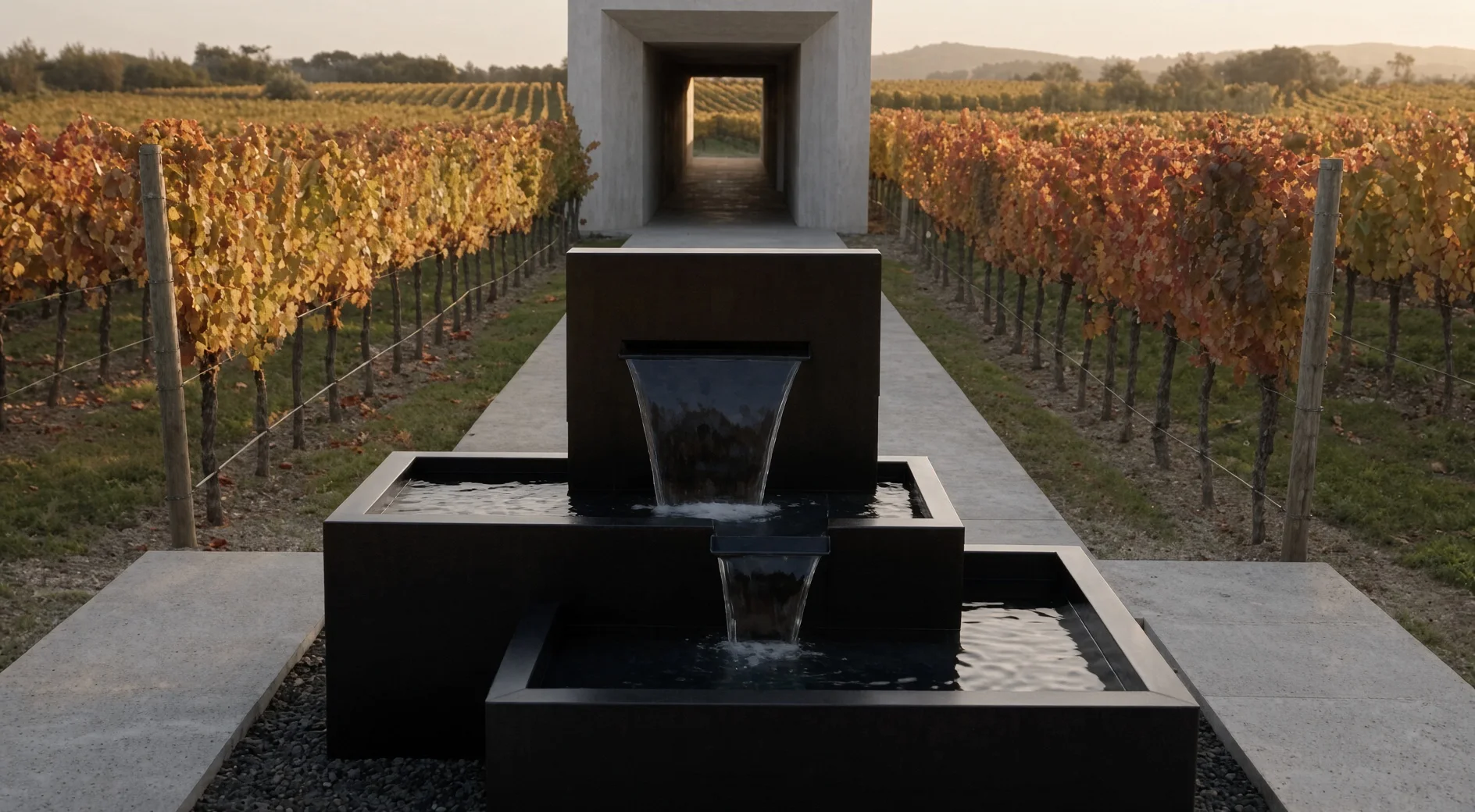
Corten needs to dry: a puddle trapped in a corner, a heap of wet leaves or soil packed against a side wall sustains corrosion that never stops. Our pieces are designed so that rain runs off rather than lingering, and our installation advice follows the same logic: raise the piece slightly, ensure drainage, let the air circulate. Fountains and water basins, where water is part of the design, follow another rule: several models also exist in powder-coated aluminium, and a Corten water feature is looked after like a pond, with clear, regularly renewed water, never left to stagnate.
- 03
Salt and chlorine
Sea spray, de-icing salts and swimming pool water bring chlorides that prevent the patina from stabilising. On the coast, the House will steer you towards its pieces in powder-coated aluminium, designed in the same spirit; further back from the shoreline, a varnished Corten piece, rinsed with fresh water from time to time, can be considered once we have discussed your setting together. Even varnished, it can still leave rust run-off on pale paving or coping.
- 04
An uneven patina at first
Delivered raw, a Corten sheet becomes mottled in its first weeks, with light and dark patches, handling marks and sometimes traces of mill scale. At Cortenys, the patina is applied and inspected piece by piece: the colour is deep and even from the day of delivery, without losing any of the living nuances that give each piece its character.
- 05
Heat and price
Like any dark metal, Corten heats up in full sun: something to bear in mind for a south-facing seat, and the usual precautions apply around a fire pit or fire table. Finally, Corten steel costs more than ordinary steel, and a finished piece far more than a sheet. That premium pays for what the eye does not see at first: the thickness, the precision of the welds, the mastery of the patina, and years without paint or treatment.
Each limit has its chapter: sea, pool and winter, wood, stone and other metals, maintenance. The protective varnish answers most of them; it greatly reduces run-off without ruling it out, so a light or porous floor is still best protected.
THE LIFESPAN
How long does Corten steel last?
Few answers start from a measurement. Here is one. After ten years of exposure, the brochure of the steelmaker thyssenkrupp records a material loss of 30 to 75 µm for COR-TEN A and 75 to 100 µm for COR-TEN B, against 150 to 200 µm for a carbon steel: a tenth of a millimetre at most, where ordinary steel loses twice as much.
Engineers draw rules from this. For a bridge designed to last one hundred and twenty years, the British guidance provides a corrosion allowance of 0.5 mm per exposed face in an atmosphere of low corrosivity (category C2 to EN ISO 9223), 1.0 mm in medium corrosivity (C3) and 1.5 mm in high corrosivity (C4); none for very aggressive environments (C5), where weathering steel has no place.
Translated cautiously to furniture of 2 or 3 mm: a piece of Corten steel keeps most of its thickness after several decades, on three conditions: drying between two showers, not sitting in water, receiving no chlorides. This is an order of magnitude drawn from civil engineering, not a guarantee. The John Deere headquarters of 1964, the Chicago Picasso of 1967 and the Angel of the North of 1998 bear witness, still in place.
Well placed, meaning ventilated, drained and sheltered from chlorides, Corten passes several decades outdoors: once stabilised, the patina protects the core of the metal and greatly slows corrosion. Its longevity depends on the climate, the thickness and the design of the piece. Cortenys pieces are guaranteed for two years, and designed to stay with you long beyond.
Lifespan of Corten steel by environment (EN ISO 9223 corrosivity categories)
Sources: SteelConstruction.info, ‘Weathering steel’ (corrosion allowances, marine environments, permanently wet conditions); thyssenkrupp brochure. The allowances are civil-engineering rules, quoted as a reference point, never as a Cortenys promise.
Varnished Corten: the varnish slows the effects of the environment but does not seal the piece off from it. Even varnished, Corten steel can still leave run-off and stain pale terraces, paving or coping, so keep small feet, spacers or a tray beneath it.
THE PRICE
How much does Corten steel cost?
The price of Corten steel is read at two levels that have almost nothing in common: raw sheet, sold by the square metre or by the kilo by steel suppliers, and the finished piece, which pays for the design, the fabrication and the patina. Here are both reference points.
Price of raw Corten sheet per m² (dated readings)
Prices read on 27 September 2026 on the websites of three French steel suppliers and cutting services, for bare sheet. They move with the price of steel, the format and the quantity: they set an order of magnitude, nothing more.
Prices of raw Corten steel sheet, readings of 27 September 2026
Sources: maisondufer.com, Laserkit, Bricofer, pages consulted on 27 September 2026.
Prices of bare sheet, excluding cutting, folding, welding, patina, inspection and transport. Read on 27 September 2026, indicative, current at that date.
From sheet to finished piece: what you pay for
The price of Corten steel depends on the thickness of the sheet, the dimensions, the complexity of the cutting, folding and welding, the patina finish, any varnish and any bespoke work. Varnish adds a step, not a guarantee: even varnished, Corten steel can still mark a pale floor. Raw sheet sold by the square metre has nothing in common with a finished piece of furniture: design, fabrication, applied patina and inspection make up most of its value. The price of each Cortenys piece is shown on its product page or given on request; bespoke work is quoted individually.
Why more expensive than ordinary steel? Copper, chromium and nickel have a price, and the welds call for a matching filler metal. The engineering guides speak of a slightly more expensive steel, whose premium is offset by the absence of a paint system. Our article Corten steel price sets out, item by item, what you pay for; bespoke work is quoted individually, and professionals have a dedicated contact.
THE COMPARISON
What is the difference between Corten steel and ordinary steel?
Ordinary steel rusts in depth: its rust is porous, flakes away and keeps exposing fresh metal, hence the need to paint or galvanise it. Corten steel, by contrast, forms a compact patina that slows corrosion and does away with any coating. It is also more expensive, and its welds call for a matching filler metal so that the patina stays even.
The difference lies neither in mechanical strength, comparable to that of an ordinary S355 steel, nor in weight, which is identical, but in the chemistry of the surface. Against galvanised steel, stainless steel or aluminium, Corten steel stands apart by a protection born of itself and a colour that is not a coating.
Corten, galvanised steel, stainless steel or aluminium: the comparison
Corten, galvanised steel, stainless steel or aluminium: the comparison
Qualitative comparison. Lifespans and prices per material depend too much on exposure and the market to be quantified here; the densities are general values.
Corten or powder-coated aluminium for garden furniture?
The House offers both materials to the same design. At equal thickness, aluminium is about three times lighter than steel, which counts on a terrace or a balcony. Powder coated in a RAL colour, it keeps a stable colour, never runs onto pale ground and fears neither sea spray nor pool water: it is the House’s answer for the coast and for direct contact with water. Corten steel offers what aluminium does not have: a living patina, a depth that changes with the light, a presence of raw material among planting and stone. The Nereida cascade fountain and the Elio round fountain exist in both versions; planters, fountains, water basins and log stores in aluminium are gathered on the luxury aluminium outdoor furniture page.
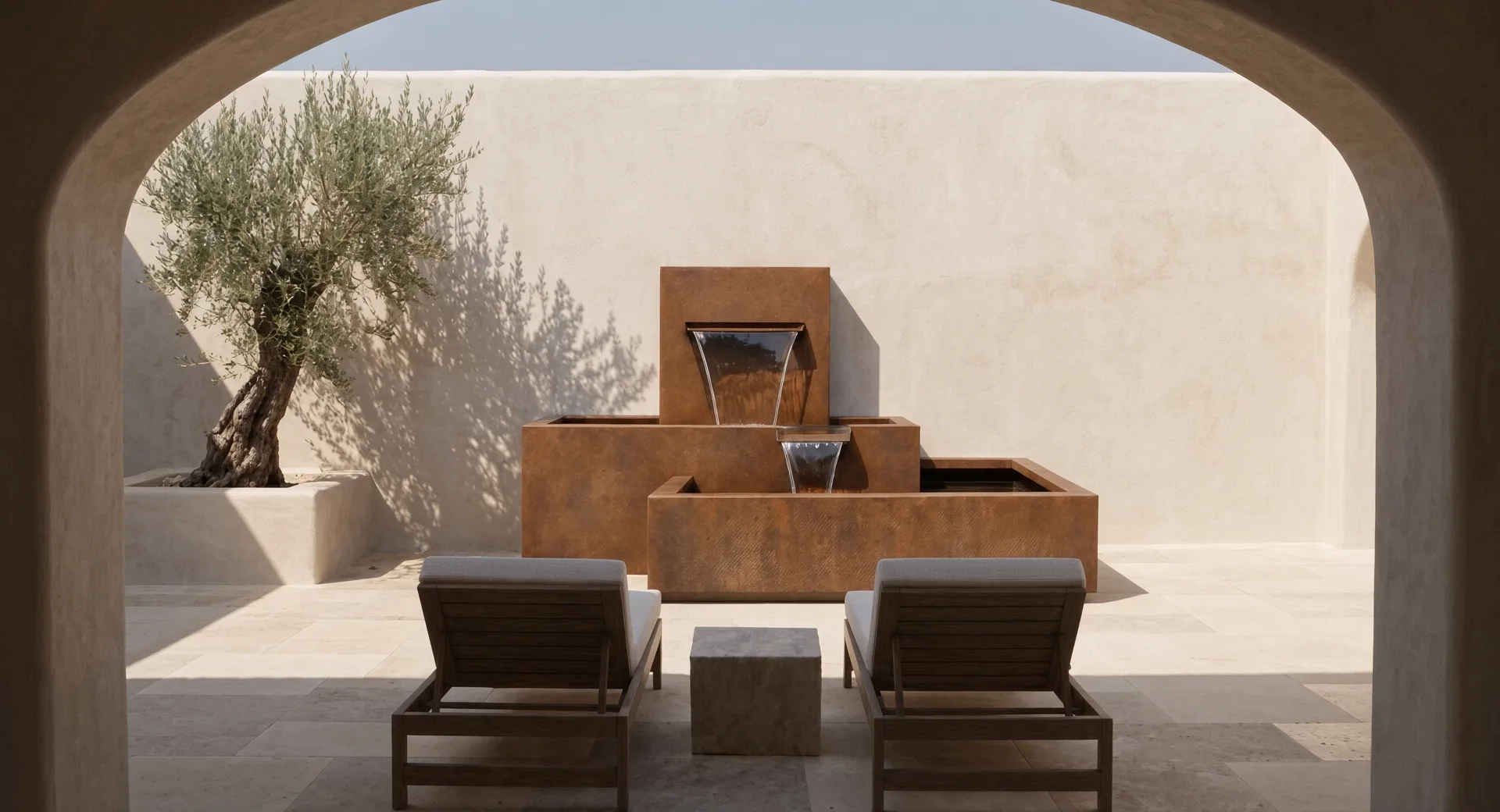
PLACE BY PLACE
Corten steel place by place: sea, pool, winter, garden
Corten steel near the sea
With caution. Sea spray deposits chlorides that prevent the Corten patina from stabilising and keep corrosion going. Right on the coast, the House recommends its powder-coated aluminium pieces, which do not rust. Further back, a varnished piece, rinsed regularly with fresh water, can be considered: we assess it with you, case by case, knowing that even varnished it can still leave rust stains on a pale terrace.
An engineer’s reference point sets the risk: the British guidance advises against weathering steel for bridges within 2 km of the coast, unless the salinity of the air stays below class S2, that is, under 300 mg of chlorides per square metre per day to EN ISO 9223. In a garden, there is no single distance: the prevailing wind, the lie of the land, the height and the vegetation count as much as the metres. Our article Corten steel near the sea helps you place your terrace.
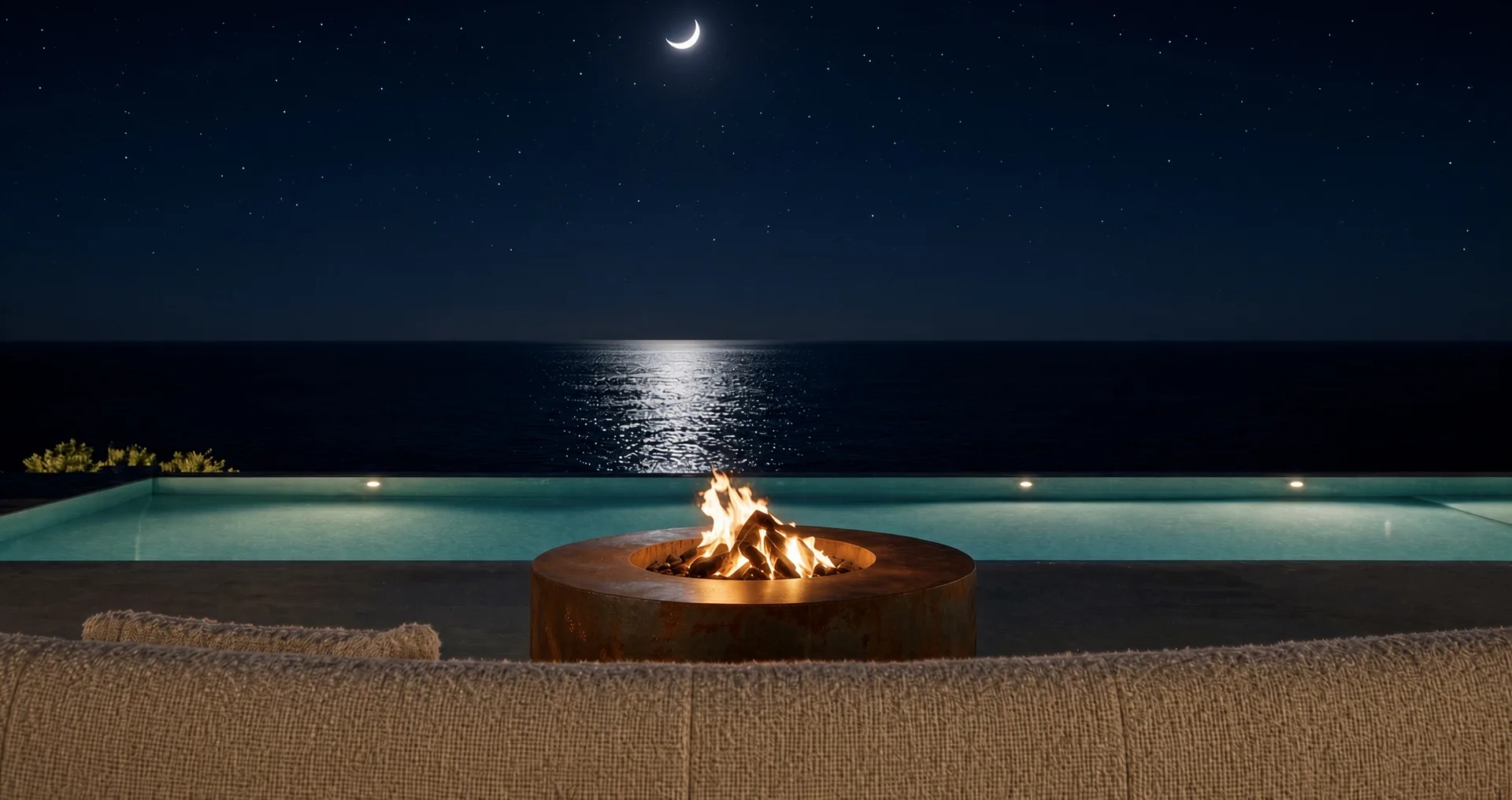
Corten steel beside a swimming pool
Yes, provided you follow two rules. Chlorinated or salt water must not regularly splash the piece, and pale coping stones must be protected from run-off. So set the piece back from the pool, on small feet or a tray, and prefer a varnished finish, which greatly reduces run-off without ruling it out. For a piece in direct contact with pool water, powder-coated aluminium remains the more serene choice.
A salt-water pool changes nothing: its water is chlorinated water, produced from the salt, and the mechanism is that of sea spray. Rinse the piece with fresh water after a splash.

Corten steel in winter: frost, snow, de-icing salt
Frost does not reach the patina: it does not swell, split or lift, and the standard even guarantees, for the J2 grades, impact toughness at -20 °C. Snow that melts and then dries is just one more wet and dry cycle, of the kind that makes the patina. What matters is what stays in contact with the metal: wet leaves, damp ashes at the bottom of a hearth, water held in a tray. Remove them, and Corten steel spends the winter outdoors without being put away. De-icing salts are chlorides: rinse any splashes with clean water as soon as it thaws.
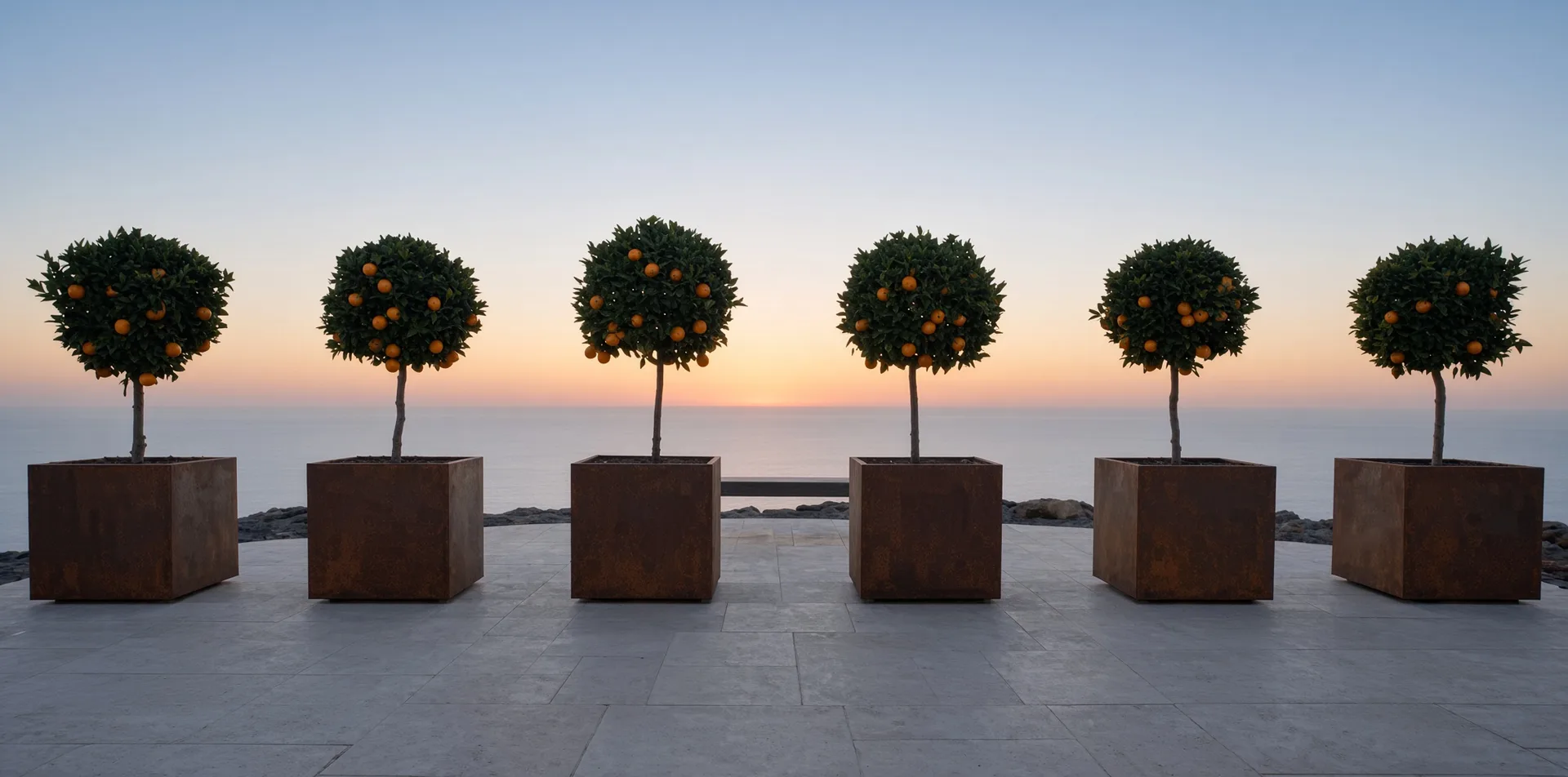
Corten steel, plants and the kitchen garden
The iron oxides of a patina are no poison to plants: iron is a natural element of the soil. What calls for attention is permanent damp against the wall. A drainage layer of clay pebbles or gravel, under a geotextile fleece, keeps wet soil from staying packed against the steel and protects the roots from suffocating; in full sun, a thick geotextile keeps the roots cool. For a tree, a bottomless planter such as Rhéa lets the roots go down into open ground; a herb garden in a compartment planter such as Maïa is a common use. Shapes, thicknesses and planting are detailed in How to choose a Corten steel planter, and the planters and pots are gathered by family.
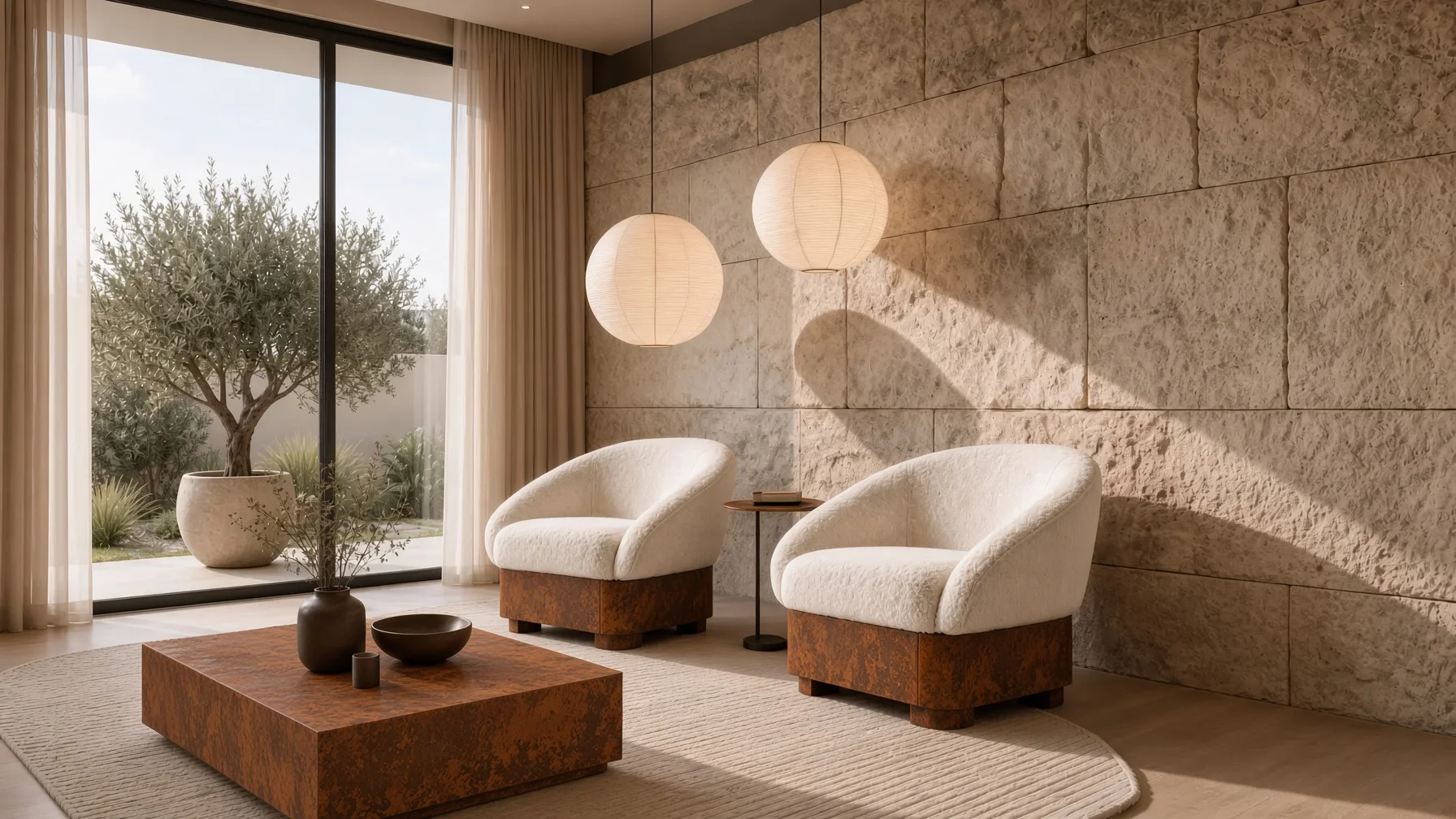
Corten steel indoors
Yes, on one condition: varnish. Unprotected, the patina could mark a floor, a wall or a textile. At Cortenys, every piece intended for indoor use receives the protective varnish in the workshop. Our lighting and our interior furniture thus bring the warmth of the patina into the home. The varnish strongly reduces rust transfer but does not rule it out: we recommend protecting the floor (felt pads, a saucer or a tray) and avoiding direct contact with light or porous surfaces. The protective varnish page describes the finish; the House’s lighting and tables and seating show it in use.
THE MATERIALS
Corten steel and other materials
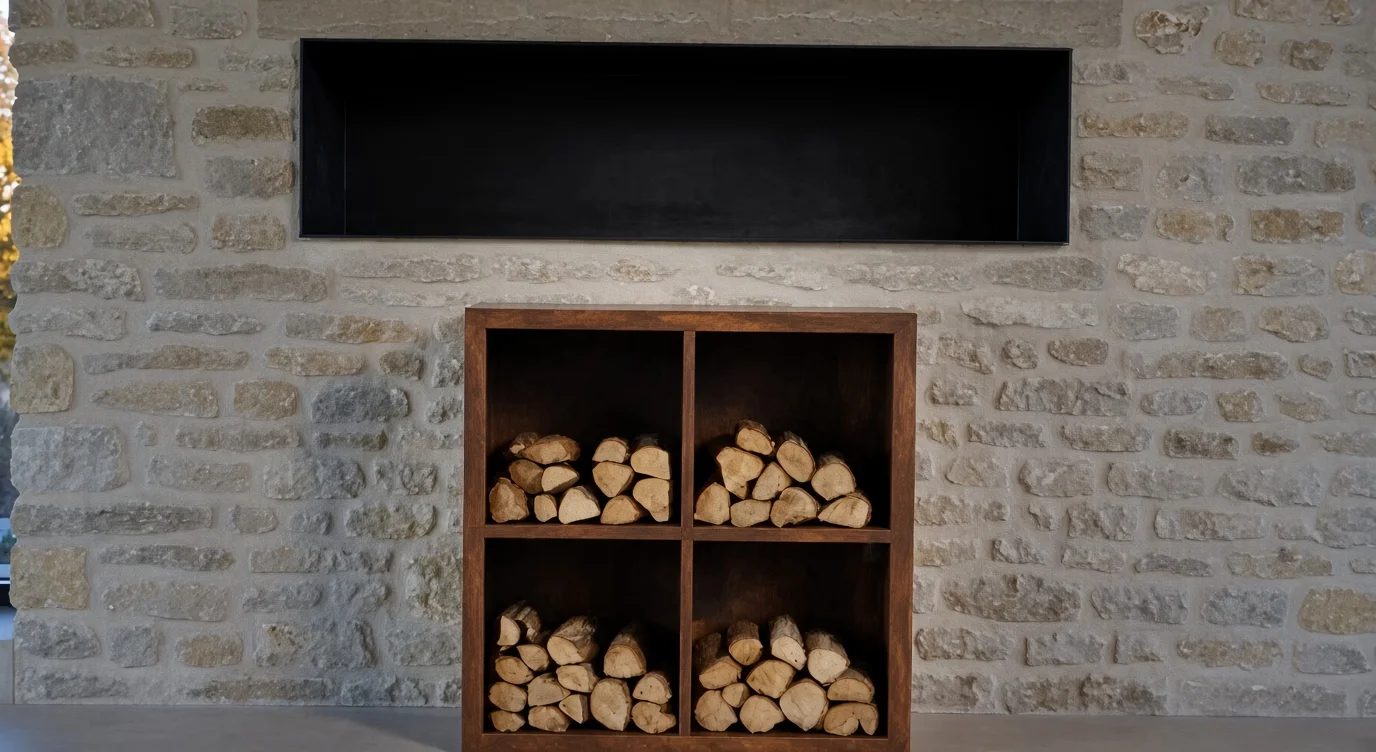
Corten and wood
Wood is the classic partner of Corten steel, with stone and planting: decking, a fence, a bench in pale wood bring out the warmth of the patina. Two precautions. Pale timber decking can receive run-off in the first seasons of a raw piece: a spacer, a tray or a bed of gravel settles the matter; the varnished finish greatly reduces run-off without ruling it out. And damp wood in permanent contact holds water against the sheet: leave an air gap. The logs in a log store are dry and ventilated: that is the intended use.
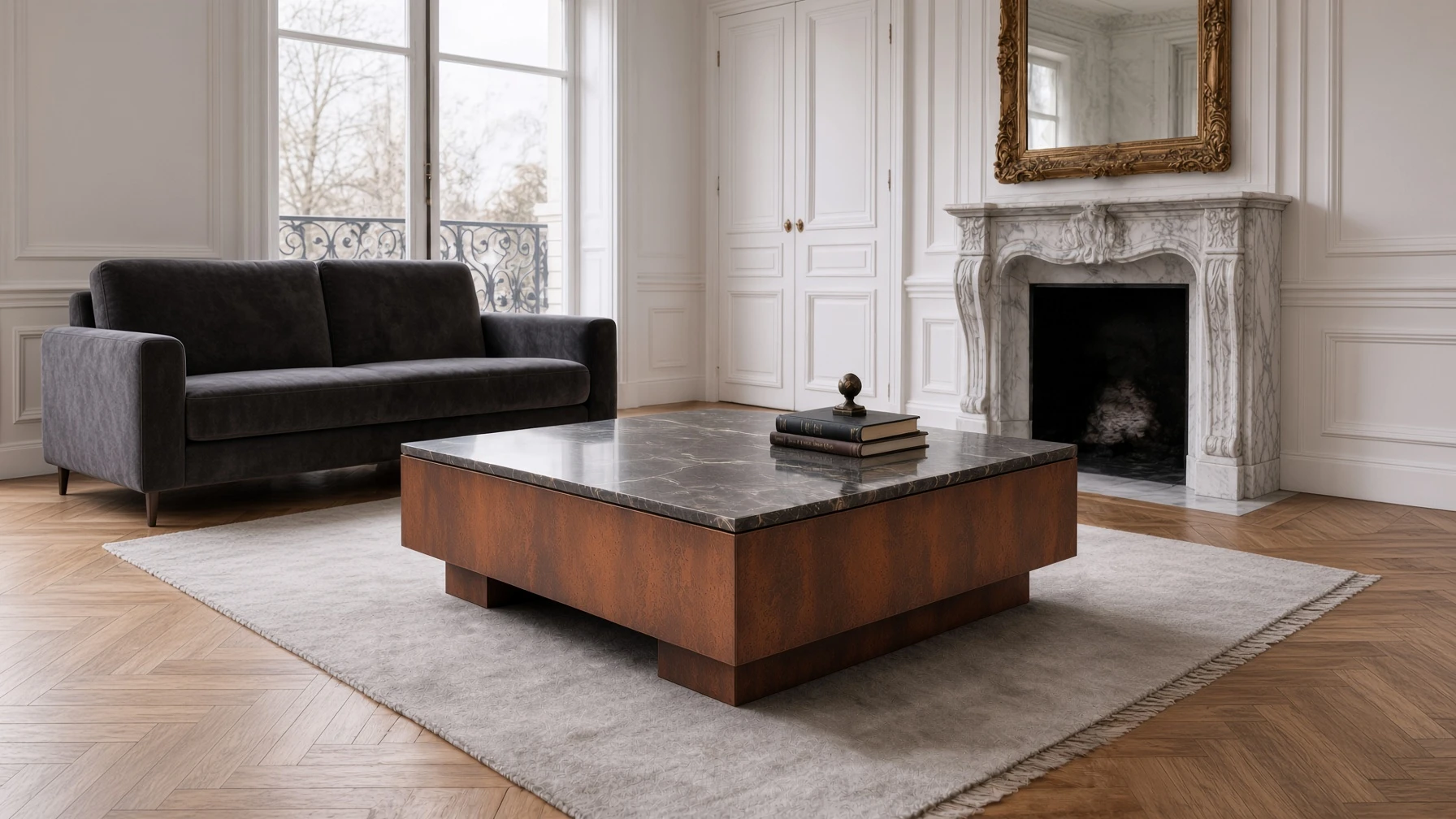
Corten, stone and concrete: preventing and removing a stain
Run-off from a young sheet stains concrete, stone and paving, and the risk is highest in the first months, when corrosion is most active. Prevent first: a bed of gravel, a dark slab, a tray, and above a precious stone the protective varnish, which greatly reduces run-off without ruling it out. Then remove, quickly: scrub with clean water and a soft brush; if the mark persists, a stain remover based on oxalic acid, sold for stone and concrete, tested on a discreet area and rinsed thoroughly. Marble and limestone fear acids: entrust them to a professional. Never bleach, which does not dissolve rust and can spread the stain. Corten also meets stone by choice, like a marble top on a patinated plinth.
Corten and other metals: galvanic contact
Two different metals in contact, in rainwater, form a battery: that is galvanic corrosion. The civil-engineering guides recommend avoiding connections with galvanically dissimilar components, such as zinc-plated screws or galvanised parts, and specifying weathering-grade bolts. In furniture, stainless steel fasteners are common practice; aluminium is isolated from Corten steel by a gasket or a spacer wherever there is water. At Cortenys, the fasteners and fittings of each model are chosen piece by piece.
Welding Corten steel
Corten steel is welded with the ordinary processes, MIG/MAG or TIG, like a carbon steel. For the weld to weather like the sheet, the filler metal must resemble it: the guides recommend a filler with at least 0.4 % copper, together with other alloying elements, or chosen to EN 1090-2; a single-run fillet weld, up to 8 mm leg length, can be made with an ordinary carbon-manganese filler, dilution being enough to match it. The treatment of the welds at Cortenys is described in the chapter on the craft.
LIVING WITH IT
Living with Corten steel: fire, cooking, children, pets
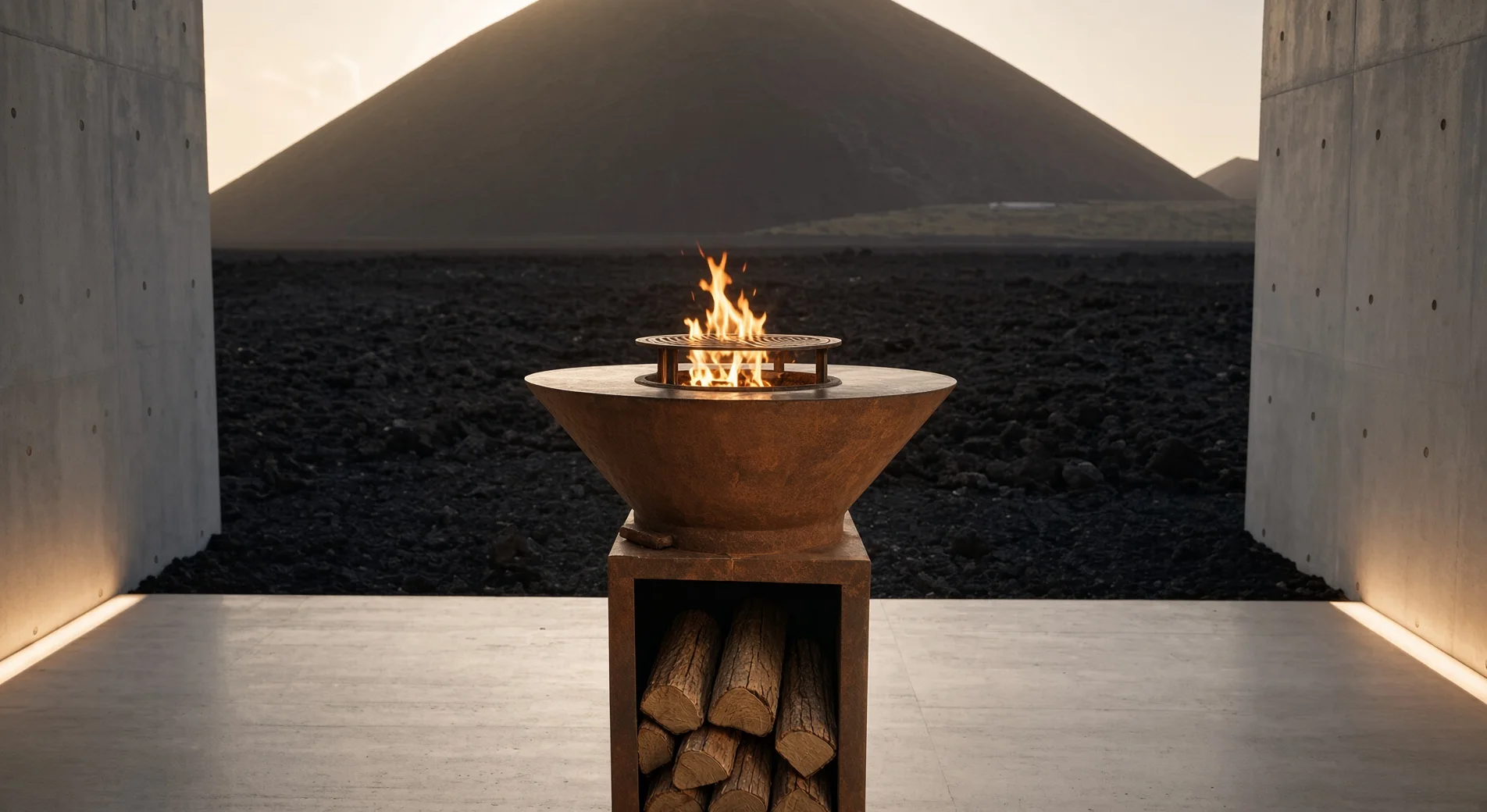
Fire pit, fire table and heat
The French Wikipedia describes Corten steel as a refractory material, in the everyday sense of a material that withstands fire, which explains its place in fire pits and fireplaces; the thyssenkrupp brochure states that COR-TEN A keeps its strength and stiffness up to 540 °C, against 400 °C for a carbon steel (a manufacturer’s brochure value, not a standard requirement). In contact with heat, the patina may shade around the hearth: that is the living trace of evenings past, with no effect on the hold of the piece. A hearth stands on a stable, non-combustible surface, with the clearances and instructions specific to the model; wet ashes are removed once everything has cooled. Our Hélios and Héphaïstos fire tables are crafted from 3 mm Corten steel. To choose, read Corten steel fire pit or fire table, then the fire pits, fire tables and outdoor fireplaces families.
Can you cook on Corten steel?
Corten steel is a structural steel, not a steel designed for food contact, and a patina is not a cooking surface. In a piece designed for cooking, the Corten hearth takes the fire, and the cooking is done on the elements designed for it. The Cortenys Vulcain BBQ pairs a wood fire with a cooking ring. Our fire tables are designed for the flame and for gathering, not as cooking surfaces. The uses of each model are shown on its product page.
Children, pets, hands and clothes
A stabilised patina does not stain clothes: the oxide layer is resistant enough for that, and Corten street furniture proves it every day. A young raw sheet, on the other hand, can mark hands and pale clothing, especially when damp. Cortenys pieces arrive patinated, and varnished they mark far less, though transfer is not ruled out; their edges are crisp and finished. Around a hearth, children and pets keep their distance until the piece has cooled; in full sun, like any dark metal, Corten gets hot.
MAINTENANCE
How do you maintain Corten steel?
Very simply. An unvarnished piece needs no paint and no treatment: just remove the leaves, soil or debris that would hold moisture, and rinse with clean water if needed. Avoid wire brushes, as well as abrasive, chlorinated or rust-removing products. A varnished piece is cleaned with a simple wipe of a damp sponge; even varnished, it can still mark a light or porous floor, so protect the floor beneath it.
The maintenance calendar
The table sums up, for a raw piece and for a varnished piece, the steps published in our article Corten steel care.
The maintenance calendar of a Corten steel piece
Source: the Journal article Corten steel care; for water pieces, Installing a Corten steel fountain.
Pressure washer: a gentle jet, never at close range, never on a young patina.
Should you seal or varnish Corten steel? Raw or varnished
Outdoors, it is not necessary: the patina protects the metal on its own. Varnish is a choice. It fixes the colour, gives it a light satin sheen and greatly reduces marks on the ground without ruling them out: on a pale terrace or beside a swimming pool, we recommend adding small feet, spacers or a drip tray. Indoors, it is mandatory at Cortenys: the protective varnish is applied in the workshop to every piece intended for the home.
Raw, meaning without varnish but always delivered with the Cortenys signature patina, Corten steel keeps on living: its colour deepens and tells the story of your garden’s climate. Varnished, it stays fixed in the state chosen in the workshop, denser, with run-off greatly reduced. Choose raw for a bed, gravel or a lawn; varnished for a pale stone terrace, a poolside or an interior, always with the floor protected, since even varnished Corten steel can still stain it. The protective varnish page details the finish.
THE CRAFT
What Corten steel becomes in exacting hands
At Cortenys, every detail of Corten steel furniture has been rethought: the thickness, the weld, the patina. Sheet thickness is chosen model by model, from 1.5 to 3 mm, always shown on the product page, according to what the piece must carry and the line it must hold, so that volumes stay taut and edges crisp. Welds are treated as part of the design, clean and discreet. Nothing is produced in advance: every piece is made to order, then inspected before it leaves the workshop.
Designed in France and crafted in Europe by a partner manufacturer, our pieces carry no logo, no plate and no signature: the House is recognised by its lines and its patina. Where the market sells sheet metal, Cortenys composes pieces, gathered into two collections: the Classics and the Cortenys Creations. Every piece is guaranteed for two years. Delivery is free, to your door; pieces arrive ready to install, and the House does not provide on-site installation.
From garden to home, Corten at Cortenys takes the form of luxury furniture: Corten steel planters and bottomless planters for open ground, fountains, water walls and water bowls, water basins and reflecting pools, fire pits, fire tables, outdoor fireplaces and a BBQ, log stores, decorative walls, lanterns, light bollards and letterboxes. Lighting, tables and an armchair carry the same design language into the home, where every piece receives the protective varnish; even so, we recommend protecting the floor beneath it.
Architects, landscape designers and interior designers find in Cortenys a partner for bespoke work and Corten steel street furniture: dimensions, thicknesses and finishes are studied project by project. For those who recognise an exceptional piece at first glance, this is Corten as it should always have been.
The Cortenys signature patina: what a workshop patina is
The Cortenys signature patina lies at the heart of that standard. Applied in the workshop to every piece, it guides the oxidation towards our reference tones, rust, sienna and amber, deep and warm. A Cortenys piece delivered raw is a piece without varnish, never a piece without patina. On request, the protective varnish fixes that colour at its finest moment; it is applied as standard to every piece intended for indoor use. It greatly reduces rust transfer without ruling it out: a light or porous floor still calls for felt pads, small feet or a saucer.
A workshop patina is neither a paint nor a tint laid over the metal. It is the oxidation proper to Corten steel, the one its composition produces of itself, initiated and guided in the workshop instead of being left to the chance of the seasons, then inspected piece by piece before it leaves. The French Wikipedia makes the point: Corten’s ability to weather comes from the nature of the steel; the workshop triggers and guides what the material carries within it.
CORTEN STEEL IN SITU
One material, four expressions
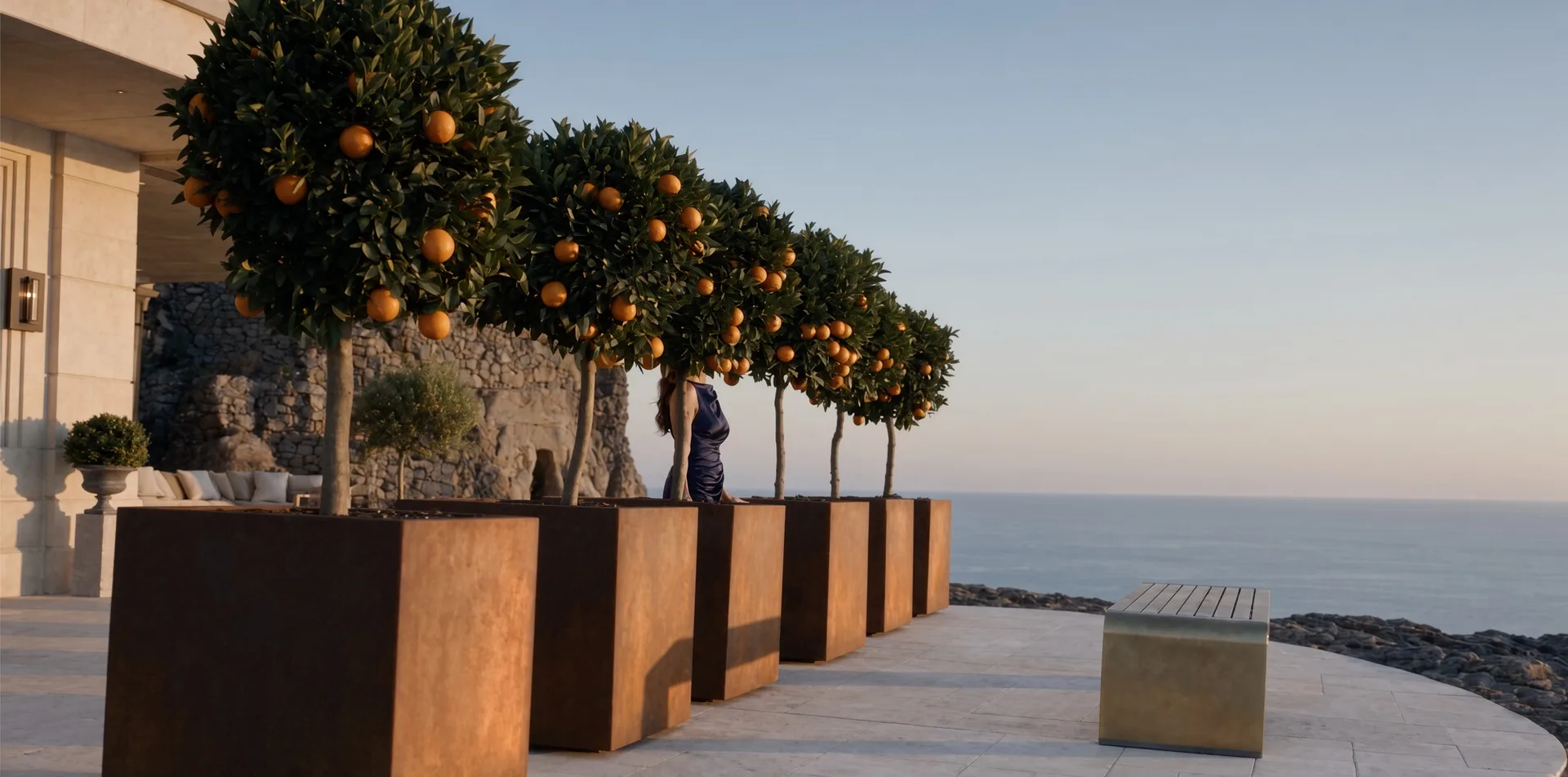
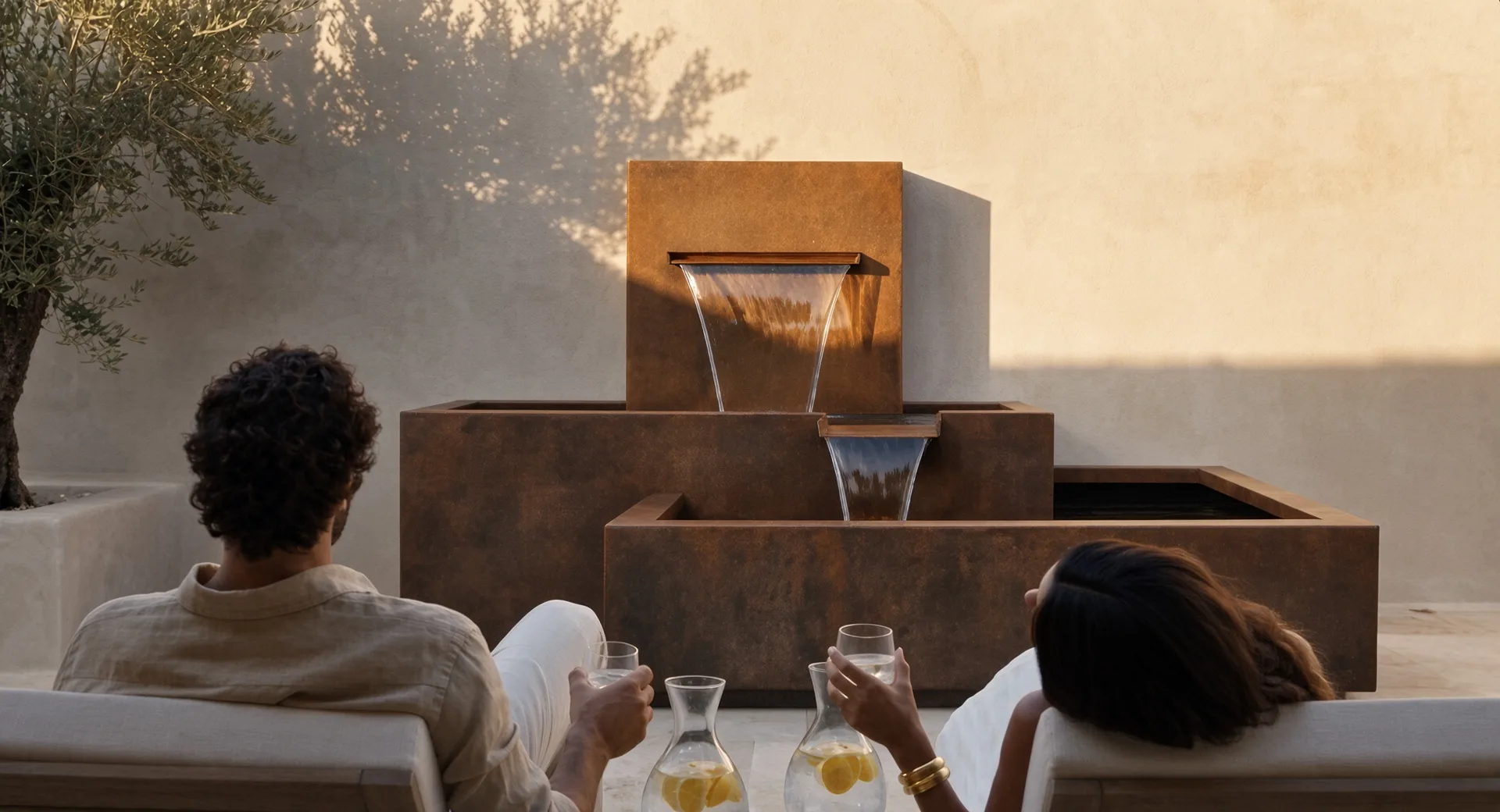
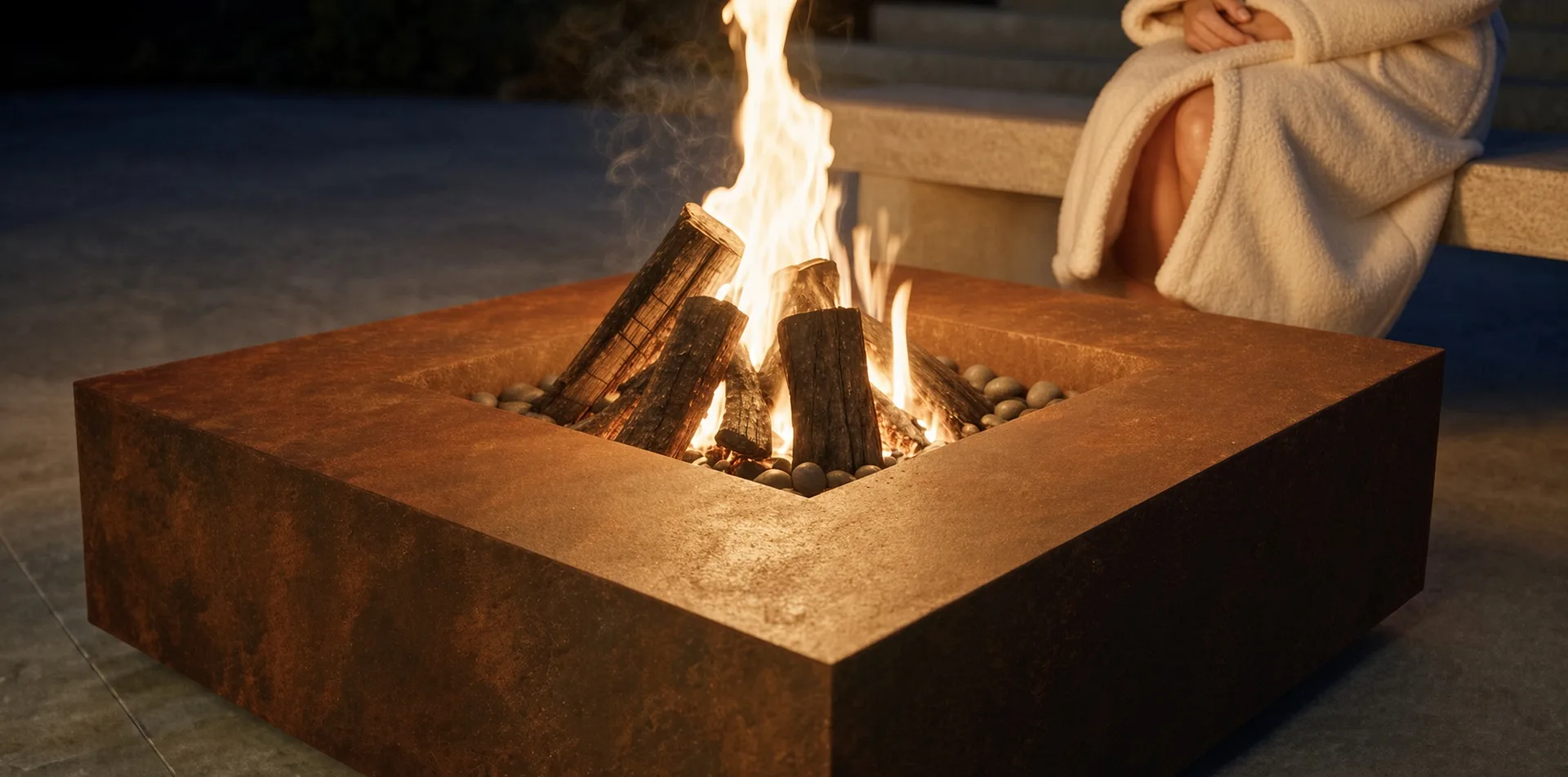
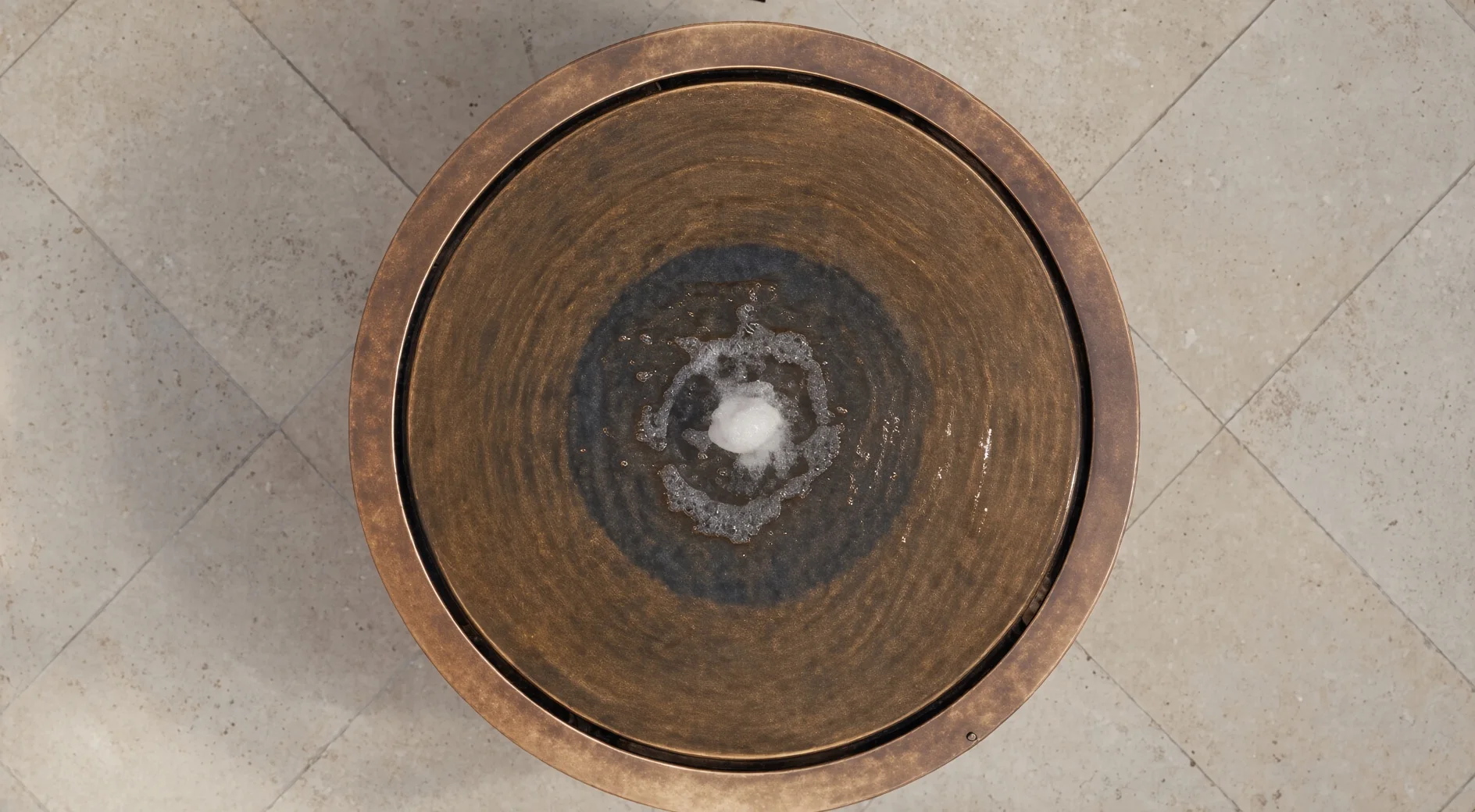
Swipe to explore
THE CORTENYS COLLECTIONS
Choosing your Corten steel piece
Designed in France and crafted to order in Europe, our Corten steel pieces reach you with their signature patina: luxury outdoor furniture, conceived to inhabit the garden.
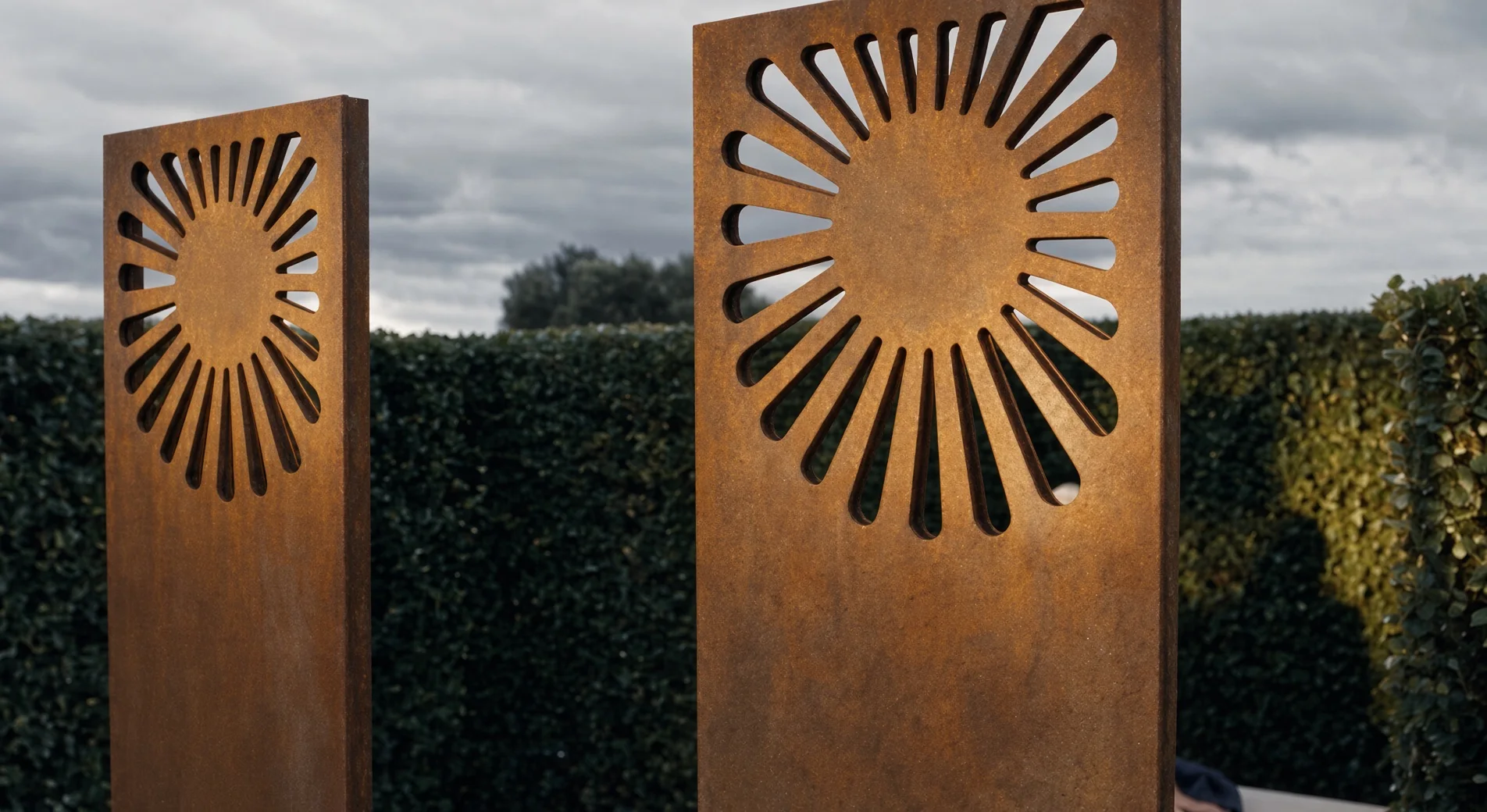
Planters & furniture
Corten steel planters, bottomless planters, log stores, decorative walls and lighting: architectural lines that give the garden its structure.
Discover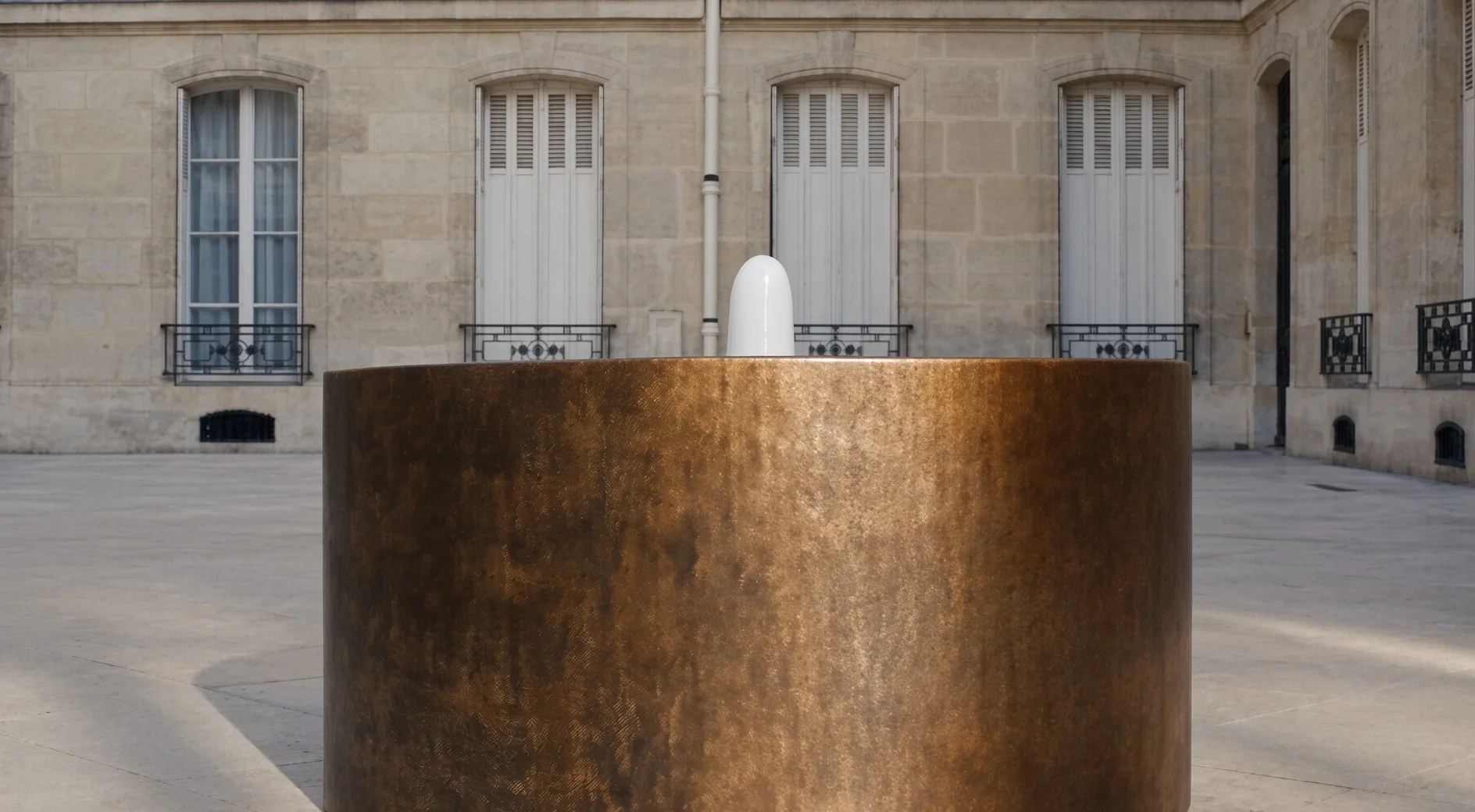
Fountains & basins
The warmth of the Corten patina meets the movement and the mirror of water: fountains, water bowls and water basins.
Discover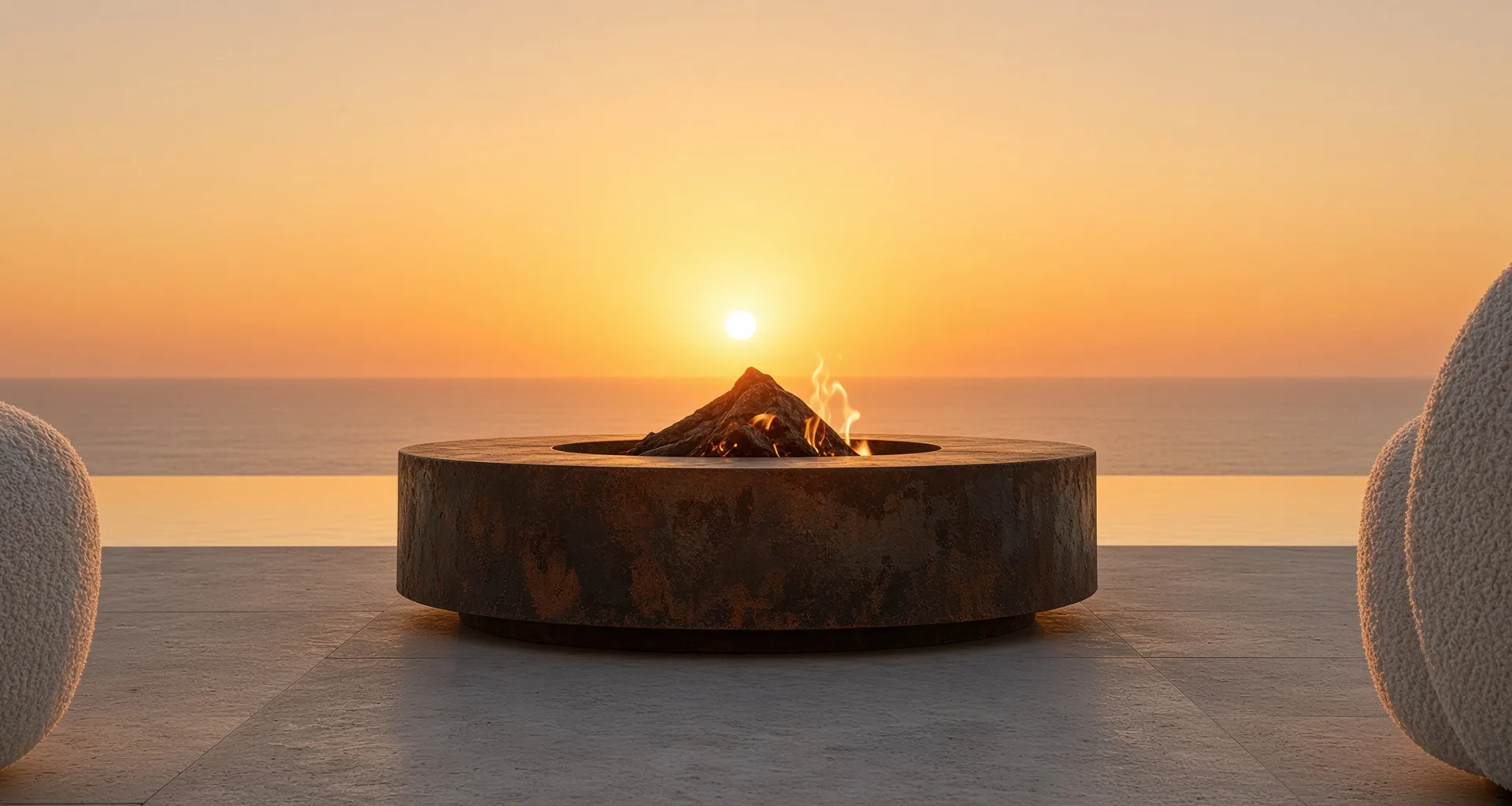
Fire pits & fire tables
Around a Corten steel fire pit, fire table or BBQ, evenings in the garden last a little longer.
DiscoverAll the families
Corten steel furniture · planters · bottomless planters · pots · fountains · water walls · water basins · fire pits · fire tables · outdoor fireplaces · log stores · decorative walls · lighting · letterboxes · tables and seating · luxury aluminium outdoor furniture
FREQUENTLY ASKED QUESTIONS
Everything you need to know about Corten steel
01What are the advantages of Corten steel?
Corten protects itself: its stable patina shields the core of the metal, with no paint or galvanising. It lasts for decades outdoors, asks for very little maintenance, and its warm colour shifts with the light and the seasons, so that each piece settles into the architecture and the garden. It is also a recyclable steel. At Cortenys, the signature patina is applied in the workshop: the piece arrives already patinated.
02What is the composition of Corten steel?
Corten is a low-alloy structural steel: iron, a little carbon and manganese, with small additions of copper, chromium, nickel, phosphorus and silicon. These alloying elements make the oxide layer dense and tightly bonded rather than porous. In Europe, its composition is governed by the EN 10025-5 standard, notably for the S355J0W and S355J2W grades. The ranges for each grade appear in the composition table of this guide.
03What are the disadvantages of Corten steel?
Run-off in the first months on pale surfaces, standing water, the chlorides of the sea, of swimming pools and of de-icing salt, an uneven patina at first, a surface that gets hot in full sun, a higher price than ordinary steel. To each, the House answers: patina applied in the workshop, protective varnish, a design that lets the water run off, powder-coated aluminium for the coast.
04What is the difference between Corten steel and ordinary steel?
Ordinary steel rusts in depth: its porous rust flakes away and keeps exposing fresh metal, hence paint or galvanising. Corten steel forms a compact patina that slows corrosion and does away with any coating. The comparison with galvanised steel, stainless steel and aluminium appears in this guide.
05Does Corten steel really rust?
Yes, and that is its strength: the Corten patina is a stable, thin rust bonded to the metal, which protects the core of the steel instead of eating it away. It needs to dry between two showers; then it renews itself and closes over small scratches, with no paint and no rust treatment.
06How much does Corten steel cost?
It depends on the thickness, the dimensions, the complexity of the cutting, folding and welding, the patina, any varnish and any bespoke work; even varnished, a piece can still leave rust marks on pale paving. Raw sheet sold by the square metre has nothing in common with a finished piece. The price of each Cortenys piece is shown on its product page; dated readings of sheet prices appear in the chapter on price.
07How long does Corten steel last?
Well placed, meaning ventilated, drained and sheltered from chlorides, Corten passes several decades outdoors. Measured in exposure, the material loss of a weathering steel is of the order of a few tens of micrometres per decade, against 150 to 200 µm for a carbon steel (thyssenkrupp). Cortenys pieces are guaranteed for two years, and designed to stay with you long beyond.
08Corten A or Corten B: what is the difference?
Corten A corresponds to the WP type of EN 10025-5 (S355J0WP, S355J2WP): enriched with phosphorus, reserved for flat products of small thickness. Corten B corresponds to the W type (S355J0W, S355J2W): ordinary phosphorus, guaranteed impact toughness at 0 °C or at -20 °C, a calling for structures. In the United States, ASTM A242 matches Corten A and A588 Corten B. Both weather in the same way.
09What thickness of Corten steel should you choose?
For furniture, 1.5 to 3 mm depending on the piece: 1.5 mm for planters of everyday volume, 2 mm for large formats, bottomless planters and log stores, 3 mm for fire tables and pieces exposed to heat. At Cortenys, the thickness is chosen model by model and shown on each product page.
10How long does the Corten patina take to form?
On raw Corten steel, the first orange tones appear within a few days or weeks, and the patina stabilises over a few months to a few years depending on the climate and exposure. Cortenys pieces spare you the wait: they arrive already dressed in their signature patina, which then continues to deepen if the piece is not varnished.
11How do you maintain Corten steel?
Very simply: remove the leaves, soil or debris that would hold moisture, rinse with clean water if needed, let it dry. No wire brush, no abrasive, chlorinated or rust-removing product. A varnished piece is cleaned with a wipe of a damp sponge; even varnished, it can still mark a pale floor, so set it on small feet or a tray. The maintenance calendar details the steps.
12Should you seal or varnish Corten steel, and how do you choose between raw and varnished?
Outdoors, varnish is a choice: it fixes the colour, gives it a light satin sheen and greatly reduces marks on the ground without ruling them out: on a pale terrace or beside a swimming pool, add small feet, spacers or a drip tray. Indoors, it is mandatory at Cortenys. Raw, meaning without varnish but always delivered with the signature patina, Corten steel keeps on living; varnished, it stays fixed in the state chosen in the workshop, with run-off greatly reduced.
13Can Corten steel be used indoors?
Yes, on one condition: varnish. Unprotected, the patina could mark a floor, a wall or a textile. At Cortenys, every piece intended for indoor use receives the protective varnish in the workshop, and our lighting and interior furniture bring the warmth of the patina into the home. The varnish strongly reduces rust transfer but does not rule it out: we recommend protecting the floor (felt pads, a saucer or a tray) and avoiding direct contact with light or porous surfaces.
14Is Corten steel suitable near the sea?
With caution. Sea spray deposits chlorides that prevent the Corten patina from stabilising. Right on the coast, the House recommends its powder-coated aluminium pieces; further back, a varnished piece, rinsed regularly with fresh water, is assessed case by case, as it can still leave run-off on pale paving. See the chapter on the coast.
15Can you install Corten steel beside a swimming pool?
Yes, provided you follow two rules: chlorinated or salt water must not regularly splash the piece, and pale coping stones must be protected from run-off. Set the piece back from the pool, on small feet or a tray, and prefer the varnished finish, which greatly reduces run-off without ruling it out; for direct contact with the water, powder-coated aluminium remains the more serene choice.
16Does Corten steel withstand frost and snow?
Yes. Frost does not reach the patina, and snow that melts and then dries is just one more wet and dry cycle. A Corten steel piece spends the winter outdoors without being put away: remove wet leaves and damp ashes, empty the water from a tray, rinse off splashes of de-icing salt as soon as it thaws.
17Does Corten steel stain patios and terraces?
A new Corten steel sheet can leave orange streaks on pale, porous paving while it matures. The signature patina that every Cortenys piece wears on delivery markedly reduces the effect; for the first months, stand the piece on gravel, a dark slab or a tray. For a pale stone terrace, the protective varnish strongly reduces the risk without ruling it out: add small feet, spacers or a drip tray, and wipe away any run-off promptly. A fresh stain comes off with a brush and clean water, then with a stone stain remover based on oxalic acid, tested on a discreet area.
18Can you cook on Corten steel?
No: Corten steel is a structural steel, not a steel intended for food contact, and cooking is done on the elements designed for it. The Cortenys Vulcain BBQ pairs a wood fire with a cooking ring; our fire tables are designed for the flame and for gathering, not as cooking surfaces.
19Corten steel or powder-coated aluminium: which should you choose?
Corten steel for the living patina and the depth of the material, away from sea spray; powder-coated aluminium, about three times lighter at equal thickness, in a stable RAL colour and free of run-off, for the coast, a raised terrace or direct contact with water. Several pieces of the House exist in both materials, to the same design.
20Why choose Corten steel furniture by Cortenys?
Because the House refuses to treat Corten as mere sheet metal. Every piece is designed in France, crafted to order in Europe, delivered with its signature patina and guaranteed for two years. Thickness, welds, proportions, patina: nothing is left to chance. A standard usually found only in fine cabinetmaking, placed at the service of Corten steel furniture.
Further reading
- Corten steel price: what goes into the cost of a piece
- Corten steel care: patina, varnish and rust stains
- Corten steel near the sea: what you need to know
- How to choose a Corten steel planter
- Installing a Corten steel fountain or water feature
- Corten steel fire pit or fire table: which to choose?
- Corten steel garden ideas: 9 ways to shape a garden or terrace
- All the advice and guides of the Journal
SOURCES
Sources and references
The figures in this guide are given with their source.
- AFNOR, NF EN 10025-5, structural steels with improved atmospheric corrosion resistance
- thyssenkrupp Christon, brochure ‘Tôles d’acier Cor-Ten’ (composition, mechanical properties, material loss after 10 years)
- metonorm, S355J2WP data sheet (1.8946)
- Steel Number, S355J2WP (1.8946) data sheet, composition according to EN 10025-5:2004
- Modulus Metal, guide to the EN 10025-5 standard
- SteelConstruction.info, ‘Weathering steel’ (wet and dry cycles, run-off, coast, corrosion allowances, fasteners, welding)
- French Wikipedia, ‘Acier Corten’ (AFNOR definition, history, patina, uses)
- Wikipedia, ‘Weathering steel’, ‘John Deere World Headquarters’, ‘Chicago Picasso’, ‘Angel of the North’
- Raw sheet price readings of 27 September 2026: maisondufer.com, Laserkit, Bricofer
Technical figures are given for the grades of the standard, for information; they do not describe any particular Cortenys piece. Sheet prices are those displayed by the sites cited on the date of the reading.
A particular project in mind?
A dimension, a finish, a word of advice. The House is by your side, with the care it brings to every one of its pieces.
Corten steel, revealed by time, reinvented by the House.
Delivery to the United Arab Emirates
Our retail prices in UAE dirhams include delivery to the United Arab Emirates, VAT, customs duties and import taxes. Each piece is made to order and reaches you within 6 to 12 weeks.