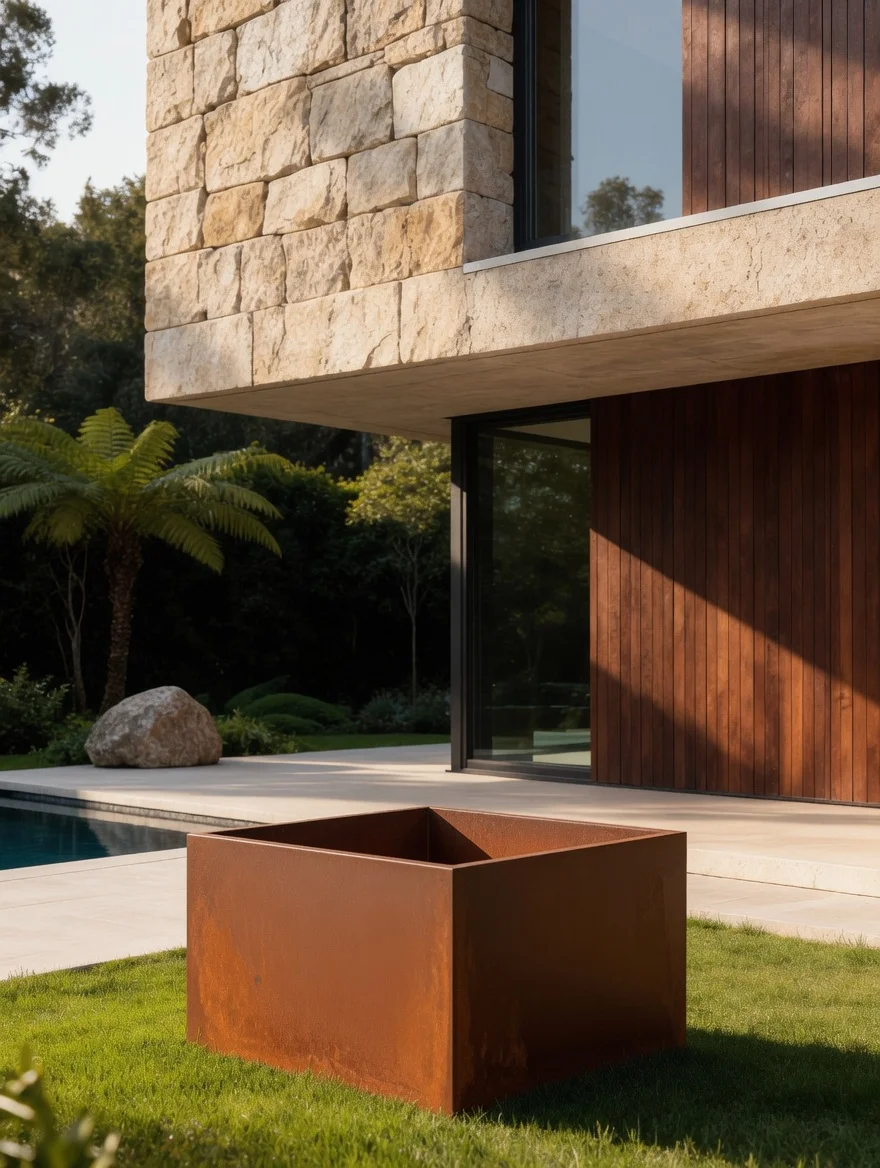
Two frames, two metals
Metal raised garden beds: Corten steel or aluminum, no bottom
Our metal raised garden beds are bottomless frames: you set them right on the soil in your yard, they edge and lift the bed, and the roots grow straight down into the ground. We make them in two metals: 2 mm Corten steel, patinated in our workshop, and 3 mm powder-coated aluminum, about half the weight and offered in eight colors. The square Rhéa and the rectangular Gaïa keep the same design from one metal to the other, so you choose the material, not the shape.
A bottomless raised bed that sits right on the soil
A metal raised garden bed is not a planter box: it has no bottom. You place it on the ground, fill it, and the planting stays in contact with the soil underneath. Roots go as deep as they want, rain drains into the ground instead of pooling in the frame, and the steel or aluminum sides give you a clean, raised bed that the lawn mower and passing feet leave alone.
That design comes with one simple rule: a bottomless bed only goes on permeable ground. On a patio, a concrete slab, a deck, a balcony or a rooftop, there would be nothing to hold the soil in. There you need a planter with a base, such as Thalie on legs, raised on four corner legs: 23 sizes in Corten steel from $3,210, and 5 sizes in aluminum from $3,840. Our guide on how to choose a Corten steel planter helps you match the planter to the surface.
We do not sell galvanized steel: our raised beds come in Corten steel or in powder-coated aluminum, the two metals compared on this page.
Raised bed sizes in both metals: soil volume, weight and US prices
We took from our product pages every size offered in both materials: length × width × height, in millimeters with the inch equivalent. The volume shown is the gross volume of the frame, worked out from its outside dimensions, to give you an idea of how much soil to buy; since bagged soil in the US is sold by the cubic foot, we list it in liters and cubic feet. Weights are the empty weights published on each product page, and prices are US prices: our signature patina for Corten steel, any of the eight colors for aluminum, all at the same price.
| Design | Size | Gross volume | Corten steel | Powder-coated aluminum |
|---|---|---|---|---|
| Rhéa | 400 × 400 × 400 mm (16 × 16 × 16 in) | 64 L (2.3 cu ft) | 11.9 kg (26 lb), $2,680 | 6.2 kg (14 lb), $2,830 |
| Rhéa | 500 × 500 × 500 mm (20 × 20 × 20 in) | 125 L (4.4 cu ft) | 18.1 kg (40 lb), $2,960 | 9.4 kg (21 lb), $3,200 |
| Rhéa | 600 × 600 × 600 mm (24 × 24 × 24 in) | 216 L (7.6 cu ft) | 25.6 kg (56 lb), $3,340 | 13.3 kg (29 lb), $3,670 |
| Rhéa | 700 × 700 × 700 mm (28 × 28 × 28 in) | 343 L (12.1 cu ft) | 34.2 kg (75 lb), $3,830 | 20.2 kg (45 lb), $4,390 |
| Rhéa | 800 × 800 × 600 mm (31 × 31 × 24 in) | 384 L (13.6 cu ft) | 34.2 kg (75 lb), $3,950 | 20.3 kg (45 lb), $4,520 |
| Rhéa | 800 × 800 × 800 mm (31 × 31 × 31 in) | 512 L (18.1 cu ft) | 50.2 kg (111 lb), $4,520 | 26 kg (57 lb), $5,160 |
| Rhéa | 1000 × 1000 × 600 mm (39 × 39 × 24 in) | 600 L (21.2 cu ft) | 49.2 kg (108 lb), $4,770 | 25.1 kg (55 lb), $5,390 |
| Rhéa | 1000 × 1000 × 800 mm (39 × 39 × 31 in) | 800 L (28.3 cu ft) | 62.6 kg (138 lb), $5,480 | 32.1 kg (71 lb), $6,270 |
| Rhéa | 1200 × 1200 × 800 mm (47 × 47 × 31 in) | 1,152 L (40.7 cu ft) | 76.2 kg (168 lb), $6,620 | 39.5 kg (87 lb), $7,610 |
| Rhéa | 1400 × 1400 × 800 mm (55 × 55 × 31 in) | 1,568 L (55.4 cu ft) | 87.8 kg (194 lb), $7,900 | 45.8 kg (101 lb), $9,050 |
| Gaïa | 1200 × 500 × 600 mm (47 × 20 × 24 in) | 360 L (12.7 cu ft) | 38.7 kg (85 lb), $3,960 | 20 kg (44 lb), $4,460 |
| Gaïa | 1500 × 500 × 600 mm (59 × 20 × 24 in) | 450 L (15.9 cu ft) | 45.3 kg (100 lb), $4,330 | 23.5 kg (52 lb), $4,910 |
| Gaïa | 2000 × 500 × 600 mm (79 × 20 × 24 in) | 600 L (21.2 cu ft) | 58.2 kg (128 lb), $4,960 | 30.2 kg (67 lb), $5,720 |
Metal raised garden beds
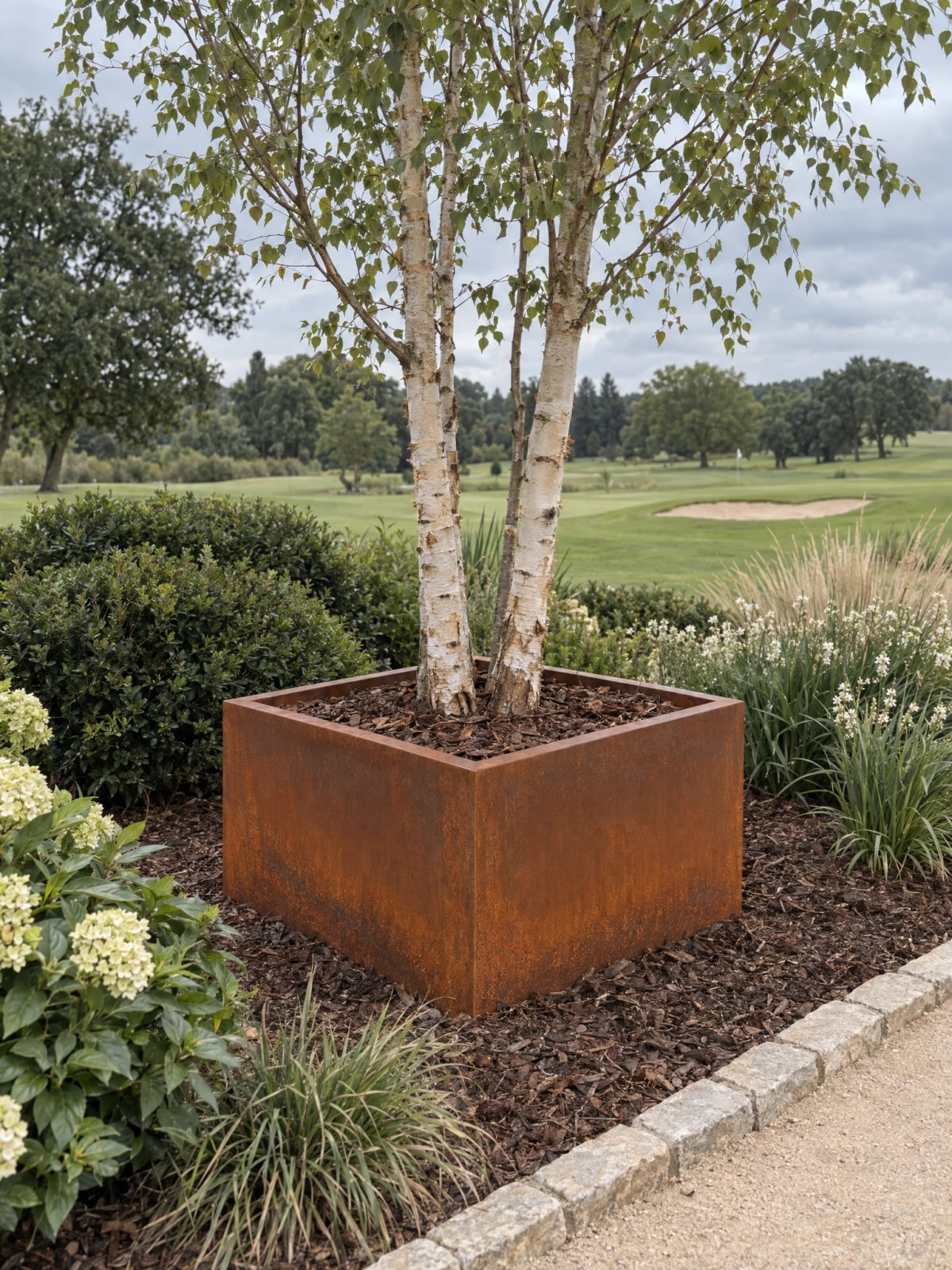
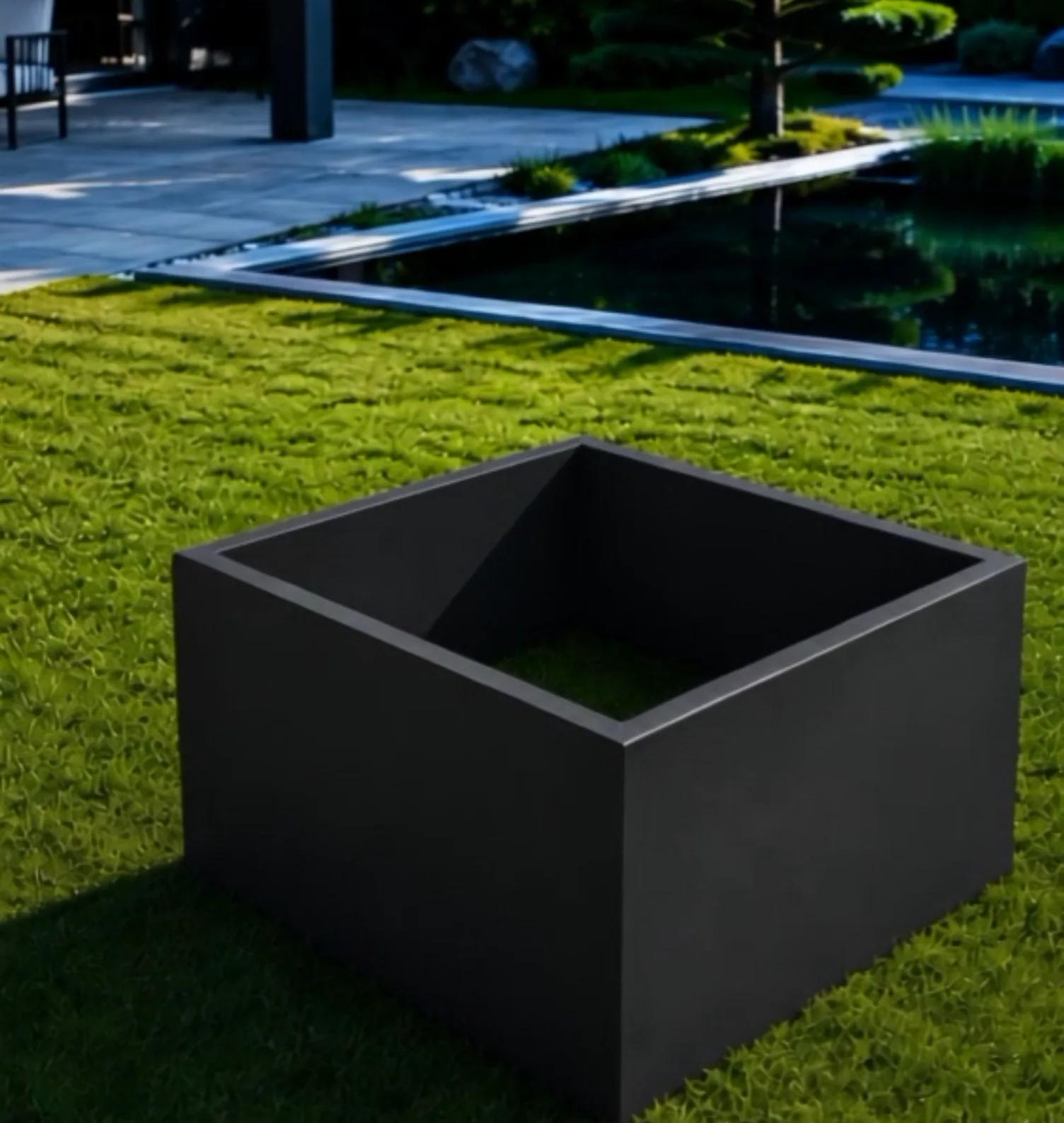
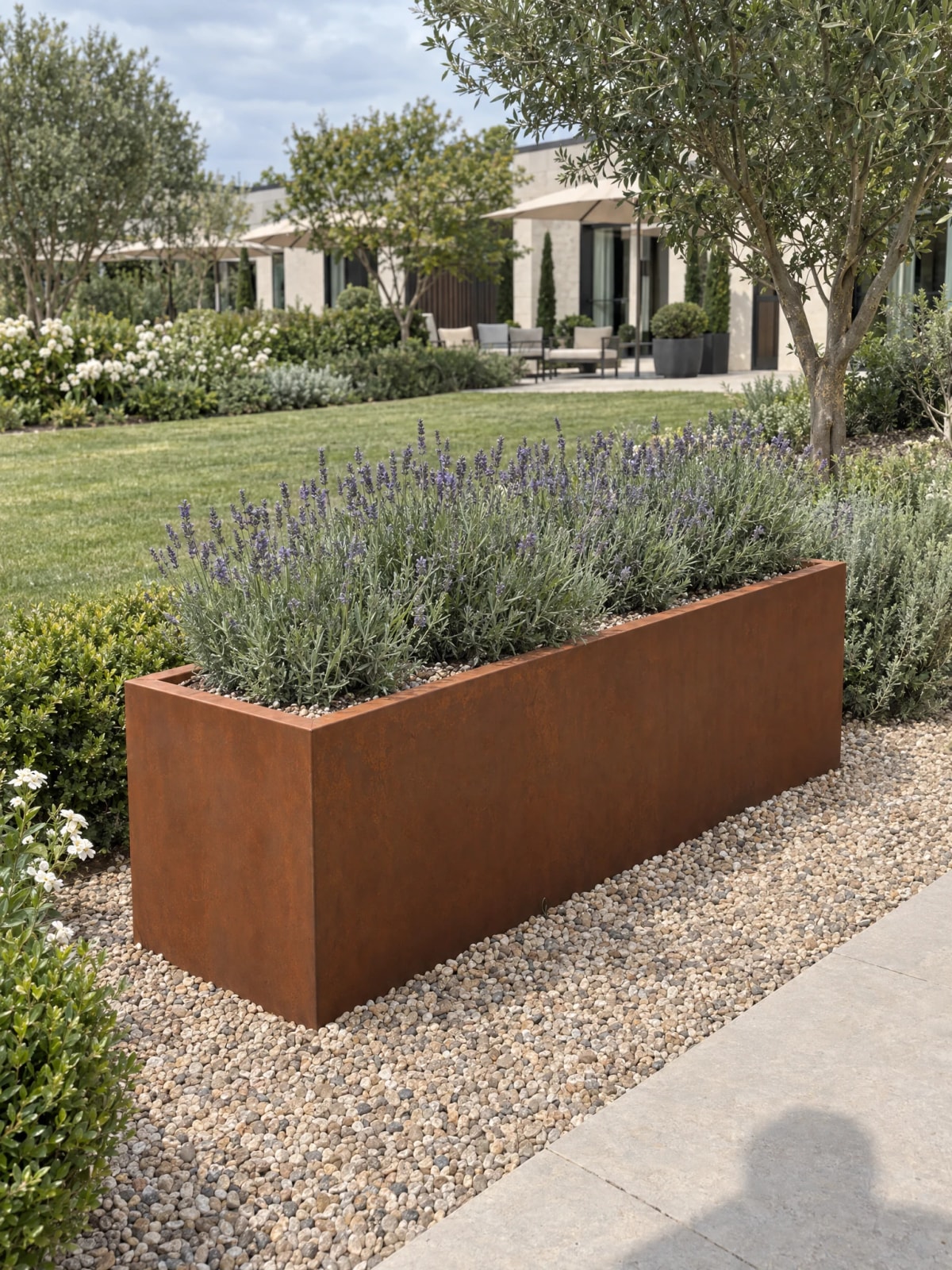
Rhéa and Gaïa in Corten steel, and their aluminum twins
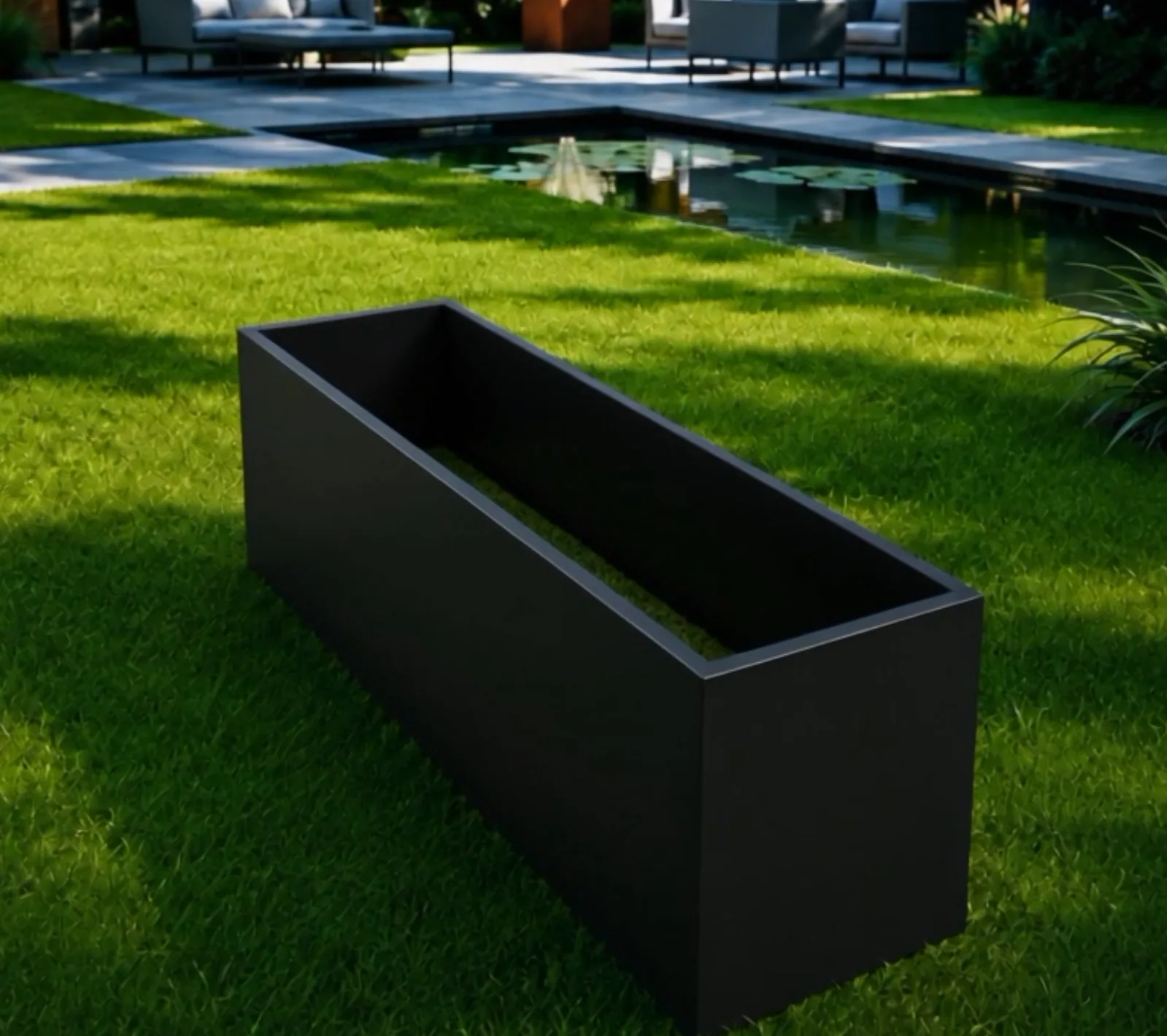
Each design appears twice: the square Rhéa in Corten steel, then in aluminum, and the rectangular Gaïa in Corten steel, then in aluminum. None of them has a bottom; all four sit directly on open ground.
About half the weight for 6% to 15% more, but far fewer sizes
Size for size, an aluminum raised bed weighs 1.7 to 2 times less than its Corten steel twin, even though its 3 mm wall is thicker than the 2 mm of the Corten: a 1200 × 1200 × 800 mm (47 × 47 × 31 in) Rhéa drops from 76.2 kg (168 lb) to 39.5 kg (87 lb). If you plan to carry the frame to the back of the yard on your own, or move it one day, that difference matters.
In our US prices, aluminum costs only 6% to 15% more, depending on the size: $2,830 against $2,680 for the small 400 mm (16 in) cube, $9,050 against $7,900 for the large 1400 mm (55 in) square. Across the three Gaïa lengths, the gap stays between 13% and 15%. With so little between them on price, the choice in the US really comes down to weight, color and whether the bed sits next to a surface you want to keep free of rust stains.
The real difference is the range of sizes. We offer our bottomless frames in Corten steel in far more sizes:
- Rhéa: 27 sizes in Corten steel, from 400 to 1400 mm (16 to 55 in) square and 400 to 1000 mm (16 to 39 in) tall; 10 sizes in aluminum, up to 800 mm (31 in) tall, all of them in the table above.
- Gaïa: 21 sizes in Corten steel, 900 to 2000 mm (35 to 79 in) long, 300 to 600 mm (12 to 24 in) wide and 400 to 1000 mm (16 to 39 in) tall; 3 lengths in aluminum, 1200, 1500 and 2000 mm (47, 59 and 79 in), all 500 mm (20 in) wide and 600 mm (24 in) tall.
- A large low bed, 600 to 1400 mm (24 to 55 in) square and 400 mm (16 in) tall, a narrow 300 mm (12 in) strip along a wall, or a 1000 mm (39 in) tall frame: these sizes only exist in Corten steel.
How tall and how wide to make a raised vegetable bed
Height sets how comfortable the bed is to work. A 400 mm (16 in) frame lifts the bed, keeps seedlings out of the path and is plenty for herbs; at 600 or 800 mm (24 or 31 in), you sow, weed and harvest with far less bending; the 1000 mm (39 in) frame, offered in Corten steel, brings the soil even closer to your hands. Think about filling, too: the gross volume in the table gives you the order of magnitude, and a large 1200 mm (47 in) square at 800 mm (31 in) tall already takes over 40 cubic feet, about one and a half cubic yards.
Width sets how easily you reach the middle. A square of 1000 or 1200 mm (39 or 47 in) can be worked from all four sides; any wider and the center becomes hard to reach. Against a wall or a fence, where you only get at it from one side, the rectangular Gaïa is more practical: 500 mm (20 in) wide in both metals, and as narrow as 300 mm (12 in) in Corten steel.
Get the ground ready before delivery: a clear, level spot that drains well. If moles or voles visit your yard, lay wire mesh directly on the ground before you fill the frame.
Vegetables, herbs and berries: what we claim and what we do not
In a bottomless frame, you grow in your own garden soil, which the frame borders and raises. The iron oxides in a Corten patina are not a poison for plants: iron is a natural element of the soil. Our Corten steel page covers what is known about Corten steel, plants and vegetable gardens.
What we do not claim is any particular food suitability, for Corten steel or for powder-coated aluminum: our raised beds are planting frames, not containers certified for food contact. For a vegetable garden, choose the metal for how it holds up, how much it weighs and how it looks, and pick your soil the way you would for an in-ground bed.
Patina, rust runoff and color: living with each metal
Corten steel gives the bed a frame in shades of burnt sienna and amber, and the tone keeps changing with rain and sun. Its wall needs to be able to dry out: well-draining soil and no standing water at the foot of the frame keep it in good shape. Next to a light walkway, pavers or a stone edging, rain running down the steel can leave rust stains. The protective varnish we offer as an option on Rhéa and Gaïa in Corten steel greatly reduces that runoff without ruling it out: even varnished, Corten steel can still stain the ground next to it. Leave a strip of gravel between the bed and the paving, and read our guide to Corten steel care and rust stains.
Powder-coated aluminum does not rust and does not mark the ground. You can order it in white RAL 9016, anthracite gray 7016, black 9005, blue 5001, yellow 1005, green 6018, red 3020 or orange 2004. By a pool, on the coast or against a very light patio, it is the worry-free choice; our guide to Corten steel near the sea explains why. A black or anthracite gray frame sets off green foliage, while white brightens a shady corner of the yard.
For more ways to work raised beds into a landscape, see our Corten steel garden ideas.
Which metal raised garden bed should you buy?
Start with the ground, then look at the space and the style of your yard.
- A vegetable bed in the middle of the yard, worked from all four sides: the square Rhéa, 1000 or 1200 mm (39 or 47 in) on a side.
- A growing strip along a wall, a fence or a path: the rectangular Gaïa, up to 2000 mm (79 in) long.
- A large low bed 400 mm (16 in) tall, a 1000 mm (39 in) tall frame or a narrow 300 mm (12 in) strip: Corten steel, the only metal we offer in those sizes.
- A frame you can carry on your own, a specific color, a light surface to protect or a coastal yard: aluminum, for only 6% to 15% more.
- A patio, a slab, a deck or a balcony: not a bottomless bed, but Thalie on legs or one of our planters with a base, compared in both metals on our metal planters page.
- A tall planter with a base for standing-height gardening: see our tall Corten steel planters.
Cortenys
Frequently asked questions
Can I grow vegetables in a metal raised garden bed?
Yes, Rhéa and Gaïa work for a vegetable garden in the ground: you grow in your own garden soil, which the frame borders and raises. We do not claim any particular food suitability, for Corten steel or for aluminum: they are planting frames, not containers certified for food contact.
What is your most affordable metal raised garden bed?
In the US, Rhéa in Corten steel, from $2,680 for the 400 × 400 × 400 mm (16 × 16 × 16 in) size. In aluminum, the most affordable is the same Rhéa size at $2,830. The rectangular Gaïa starts at $3,300 in Corten steel and $4,460 in aluminum.
Corten steel or aluminum: which metal is better for a raised vegetable bed?
Corten steel comes in far more sizes, from 400 to 1000 mm (16 to 39 in) tall, costs a little less and brings its patina. Powder-coated aluminum is about half the weight, comes in eight colors, does not stain and costs only 6% to 15% more in the US. Even with the optional varnish, a Corten steel bed can still stain a light walkway, so leave a strip of gravel between the bed and the walkway.
Can a bottomless raised bed go on a patio or a deck?
No: with no bottom, only the ground holds the soil in. On a patio, a slab, a deck or a balcony, choose a planter with a base, such as Thalie on legs, offered in Corten steel and in aluminum, or one of our other planters.
How many cubic feet of soil does it take to fill a raised garden bed?
Work out the volume of the frame: length × width × height. A 600 × 600 × 600 mm (24 × 24 × 24 in) Rhéa holds about 7.6 cubic feet (216 liters), a 1200 × 1200 × 800 mm (47 × 47 × 31 in) Rhéa about 40.7 cubic feet (1,152 liters), and a 2000 × 500 × 600 mm (79 × 20 × 24 in) Gaïa about 21.2 cubic feet (600 liters). Our table gives the gross volume of every size offered in both metals.
How much does a metal raised garden bed weigh empty?
From 6.2 kg (14 lb) for a 400 × 400 × 400 mm (16 × 16 × 16 in) Rhéa in aluminum to 107.1 kg (236 lb) for a 1400 × 1400 × 1000 mm (55 × 55 × 39 in) Rhéa in Corten steel. Once filled, the soil makes up most of the weight, so set the frame in its final spot before you fill it.
A particular project in mind?
A dimension, a finish, a word of advice. The House is by your side, with the care it brings to every one of its pieces.