Two metals, one design
Metal planters: Corten steel or aluminum
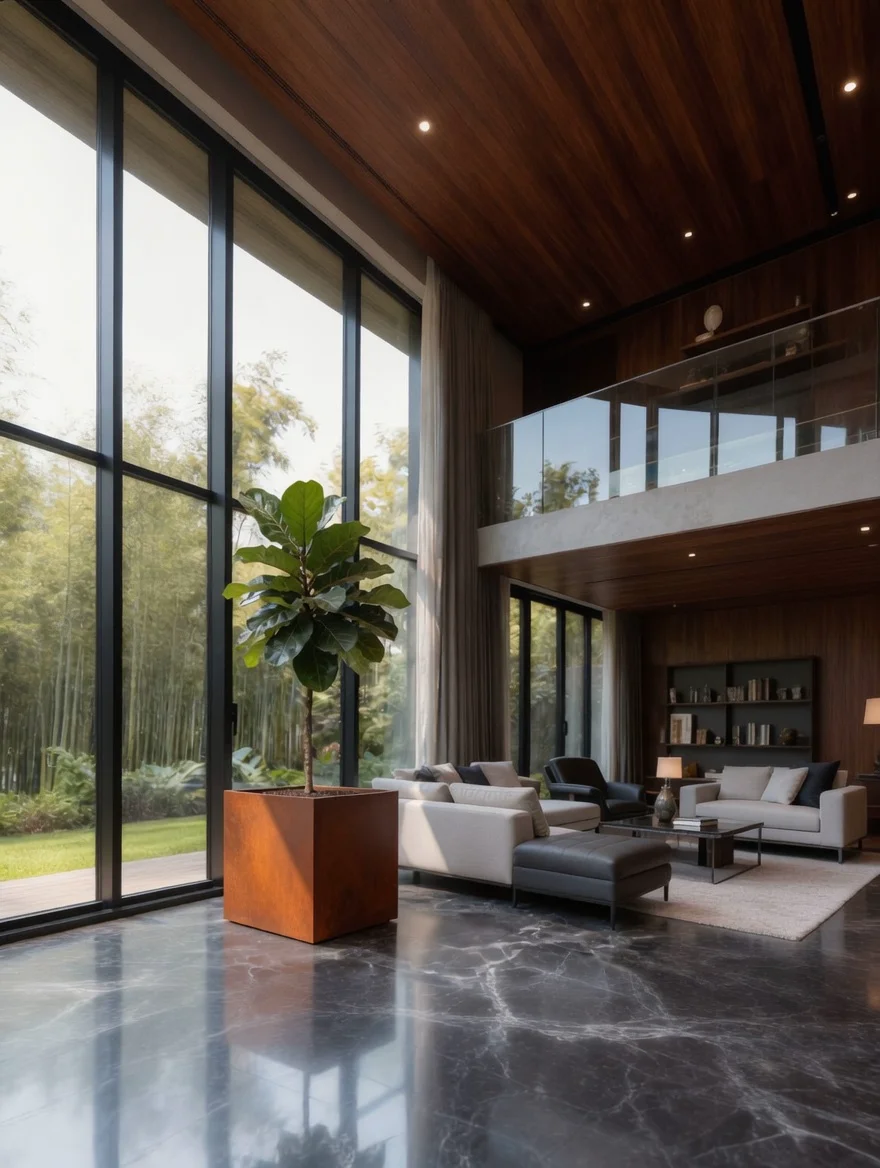
We offer our planters in two metals: Corten steel, with its living patina, and powder-coated aluminum, lighter and available in color. Cybèle, Déméter, Thalie, Iris and Maïa come in both, to the same design, so you can pick the metal for the spot on the deck or in the yard without changing the look.
One planter, two metals: sizes, weights and US prices
To compare like with like, we took from our product pages the sizes offered in both materials. Dimensions are in millimeters with the inch equivalent rounded to the nearest inch, weights are the empty weights shown on each product page, and prices are US prices in the base finish: our signature patina for Corten, black RAL 9005 for aluminum, which costs the same as its seven other colors. Cybèle, Déméter, Thalie and Iris are made from 3 mm aluminum. For Iris, the size reads long side / equal sides × height.
| Design | Size | Corten steel | Powder-coated aluminum |
|---|---|---|---|
| Cybèle | 400 × 400 × 400 mm (16 × 16 × 16 in) | 2 mm, 13.7 kg (30 lb), $2,700 | 3 mm, 7 kg (15 lb), $2,870 |
| Cybèle | 600 × 600 × 600 mm (24 × 24 × 24 in) | 2 mm, 29.6 kg (65 lb), $3,390 | 3 mm, 15.4 kg (34 lb), $3,780 |
| Cybèle | 800 × 800 × 800 mm (31 × 31 × 31 in) | 2 mm, 52 kg (115 lb), $4,460 | 3 mm, 29 kg (64 lb), $5,320 |
| Cybèle | 1400 × 1400 × 800 mm (55 × 55 × 31 in) | 2 mm, 102.2 kg (225 lb), $8,080 | 3 mm, 56.4 kg (124 lb), $9,580 |
| Déméter | 1200 × 500 × 600 mm (47 × 20 × 24 in) | 2 mm, 44.7 kg (99 lb), $4,040 | 3 mm, 23.8 kg (52 lb), $4,640 |
| Déméter | 2000 × 500 × 600 mm (79 × 20 × 24 in) | 2 mm, 68.5 kg (151 lb), $5,090 | 3 mm, 35.5 kg (78 lb), $5,980 |
| Thalie on legs | 600 × 600 × 600 mm (24 × 24 × 24 in) | 2 mm, 29.7 kg (65 lb), $3,480 | 3 mm, 15.3 kg (34 lb), $3,840 |
| Thalie on legs | 800 × 800 × 800 mm (31 × 31 × 31 in) | 2 mm, 54.7 kg (121 lb), $4,630 | 3 mm, 26.5 kg (58 lb), $5,300 |
| Iris | 800 / 565 × 300 mm (31 / 22 × 12 in) | 1.5 mm, 11.5 kg (25 lb), $2,950 | 3 mm, 5.9 kg (13 lb), $3,280 |
| Iris | 1400 / 990 × 500 mm (55 / 39 × 20 in) | 1.5 mm, 31.1 kg (69 lb), $4,950 | 3 mm, 16 kg (35 lb), $6,100 |
| Maïa | 800 × 800 × 300 mm (31 × 31 × 12 in) | 33.5 kg (74 lb), $3,400 | 17.5 kg (39 lb), $4,270 |
| Maïa | 1200 × 1200 × 300 mm (47 × 47 × 12 in) | 60.1 kg (132 lb), $4,530 | 31 kg (68 lb), $5,060 |
What the side-by-side comparison shows
The big difference is weight. Size for size, the aluminum version is 1.8 to 2.1 times lighter than its Corten steel twin, even though its 3 mm sheet is thicker than the 1.5 or 2 mm of the Corten. The price difference, on the other hand, is modest in our US prices: aluminum costs 6% to 26% more across all twelve sizes, from $2,870 against $2,700 for the smallest Cybèle to $4,270 against $3,400 for the smaller Maïa.
The other difference is the range: across these five designs we offer Corten steel in far more sizes than aluminum, and taller ones.
- Cybèle: 27 sizes in 2 mm Corten and 7 in 1.5 mm, from 400 to 1400 mm (16 to 55 in) square and up to 1000 mm (39 in) tall; 10 sizes in aluminum, up to 800 mm (31 in) tall.
- Déméter: 21 sizes in 2 mm Corten, 900 to 2000 mm (35 to 79 in) long and 300 to 600 mm (12 to 24 in) wide, plus 6 in 1.5 mm; in aluminum, 3 lengths (1200, 1500 and 2000 mm, or 47, 59 and 79 in), 500 mm (20 in) wide and 600 mm (24 in) tall.
- Thalie: 23 sizes in Corten, 3 of them rectangular; 5 square sizes in aluminum, from 600 to 1400 mm (24 to 55 in).
- Iris and Maïa: the same sizes in both metals, 8 for Iris and 2 for Maïa (see the page for Maïa in aluminum).
Metal planters
Five designs, each in Corten steel and in aluminum
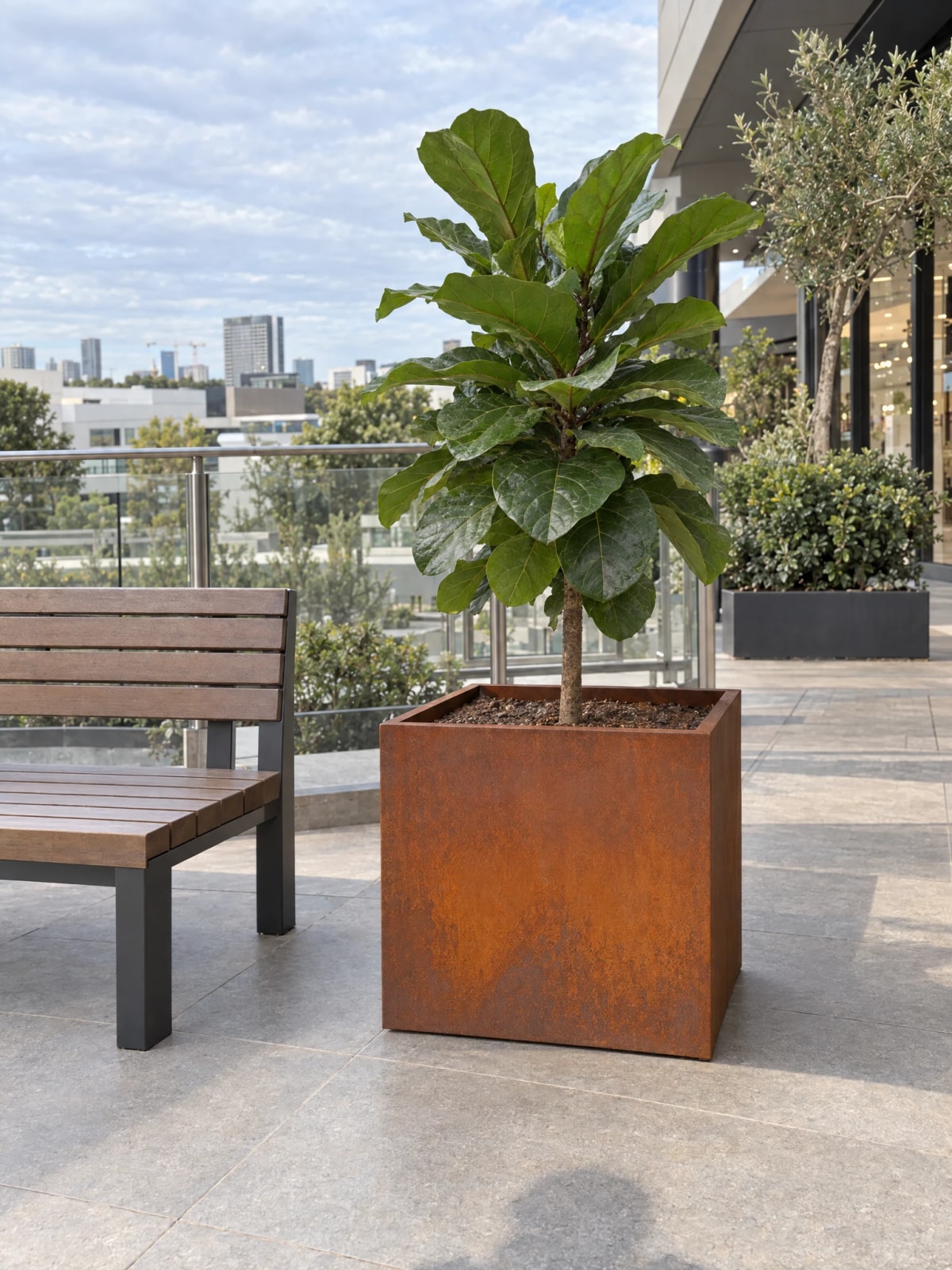
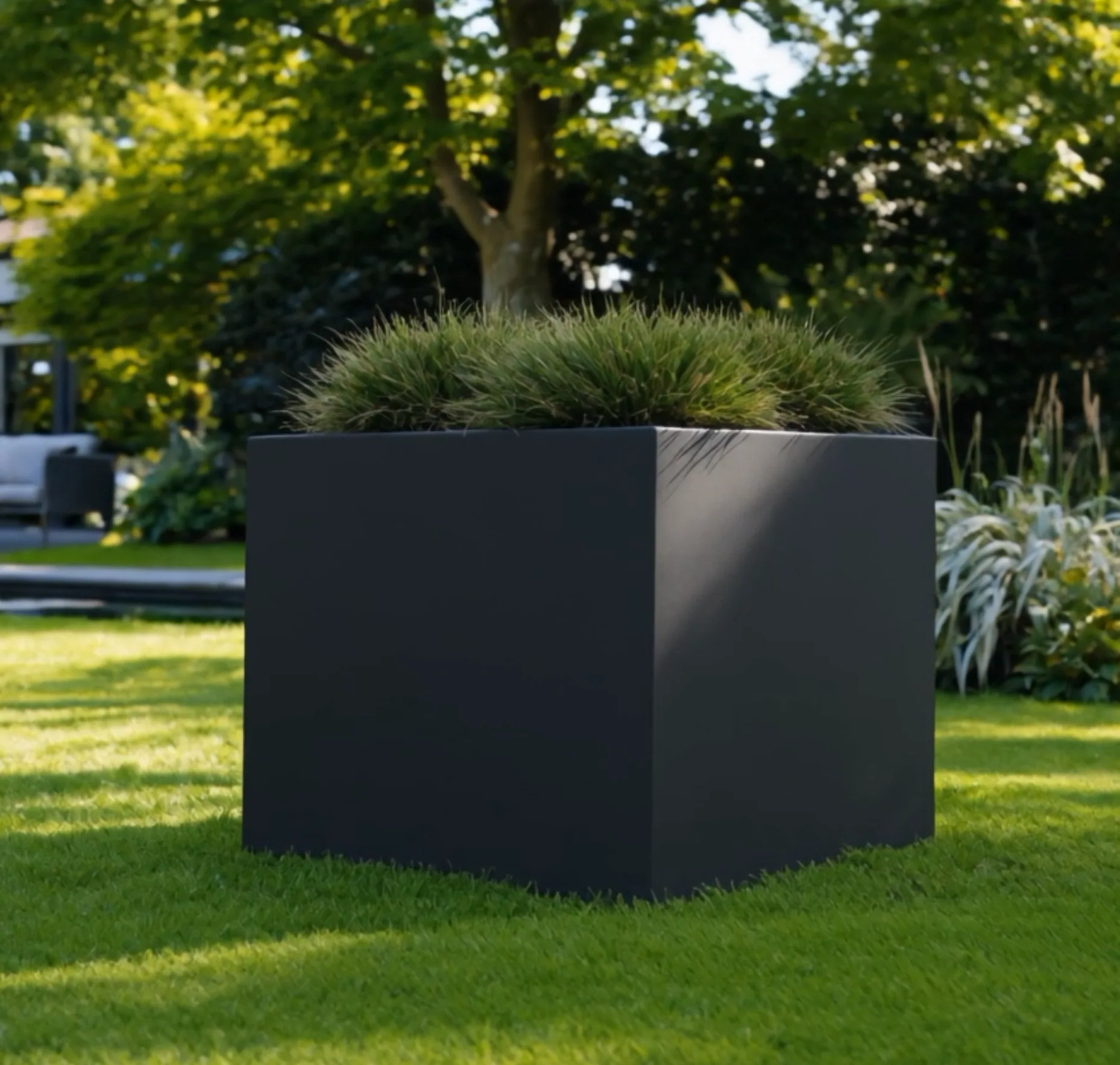
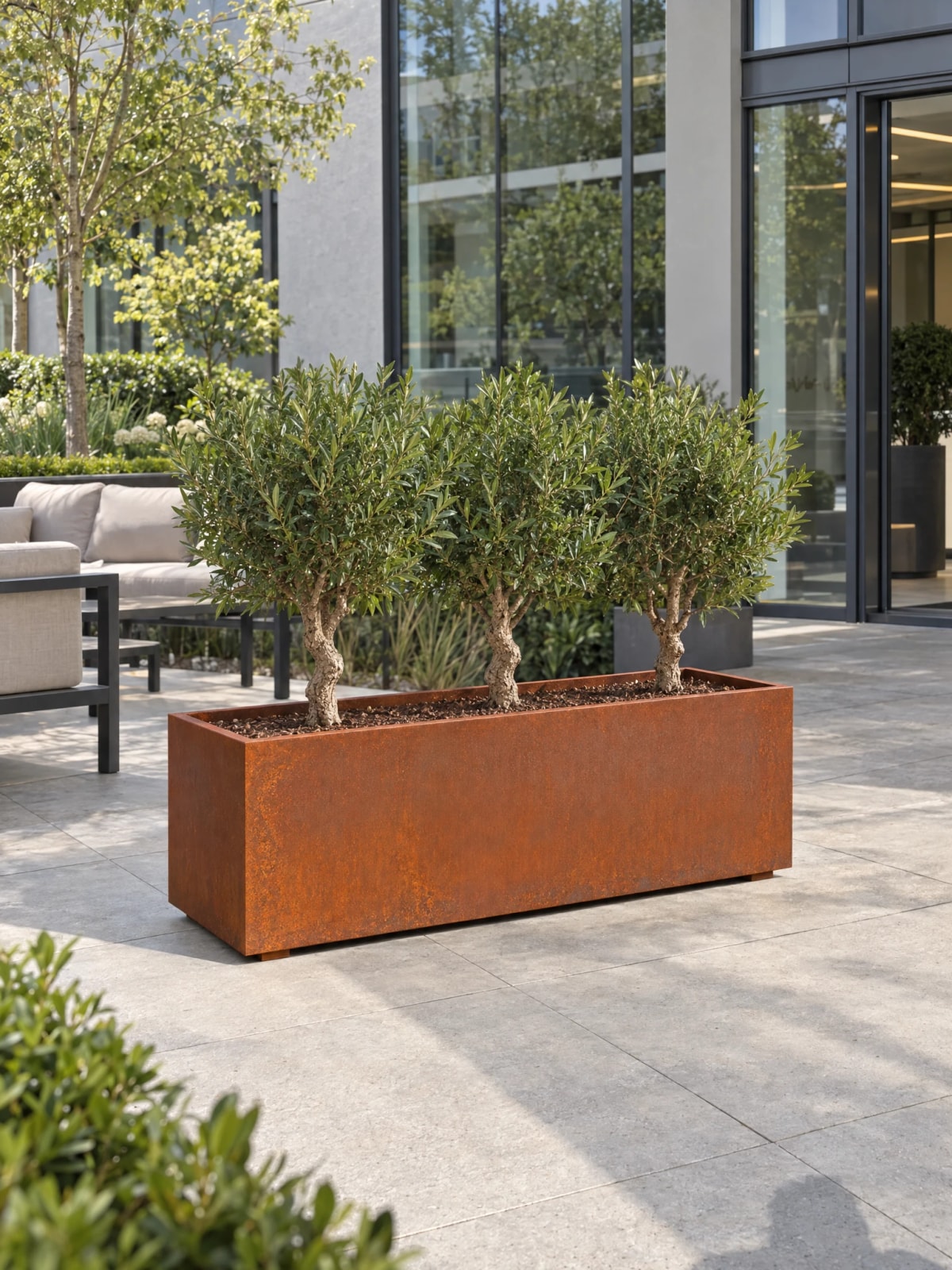
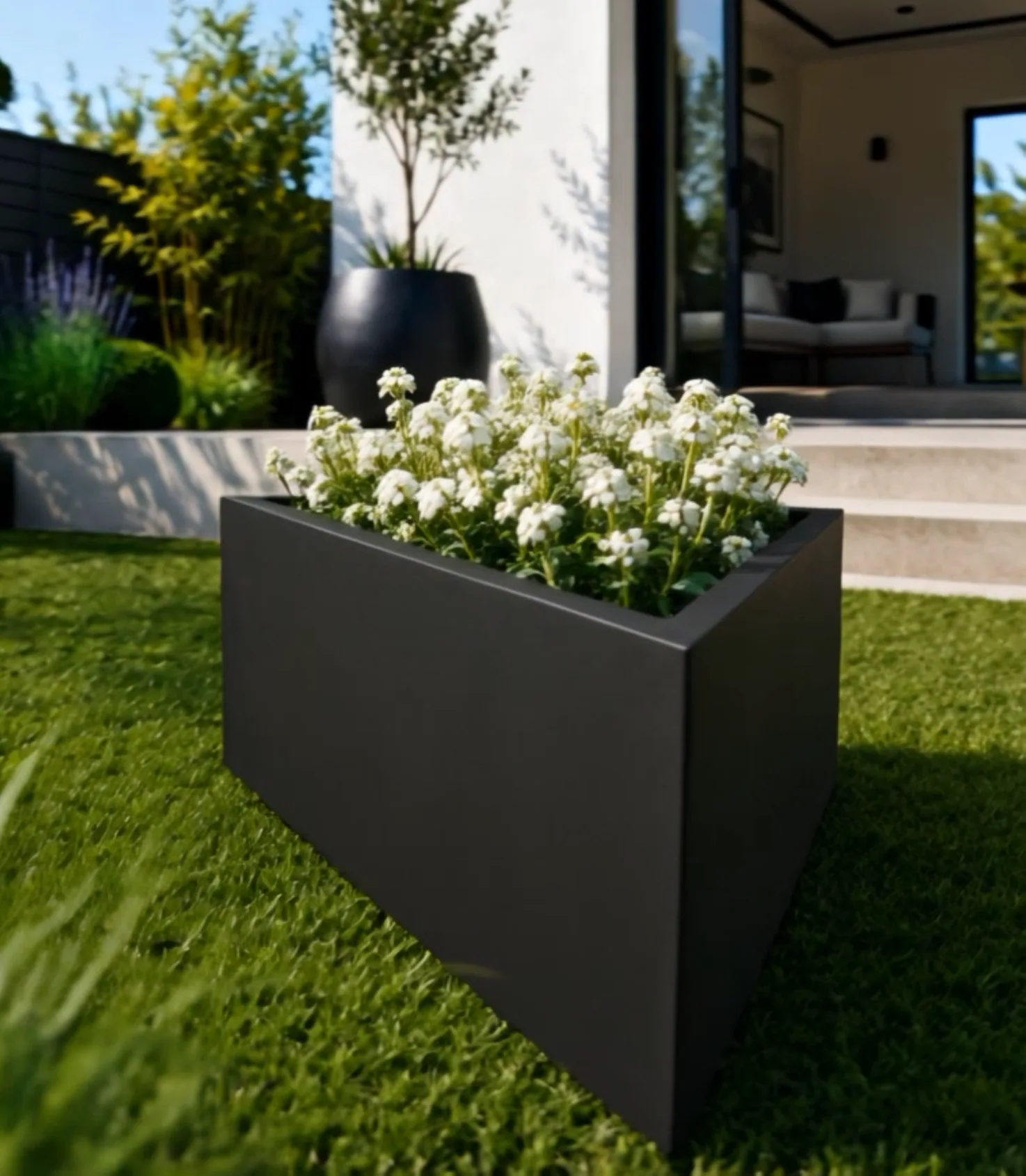
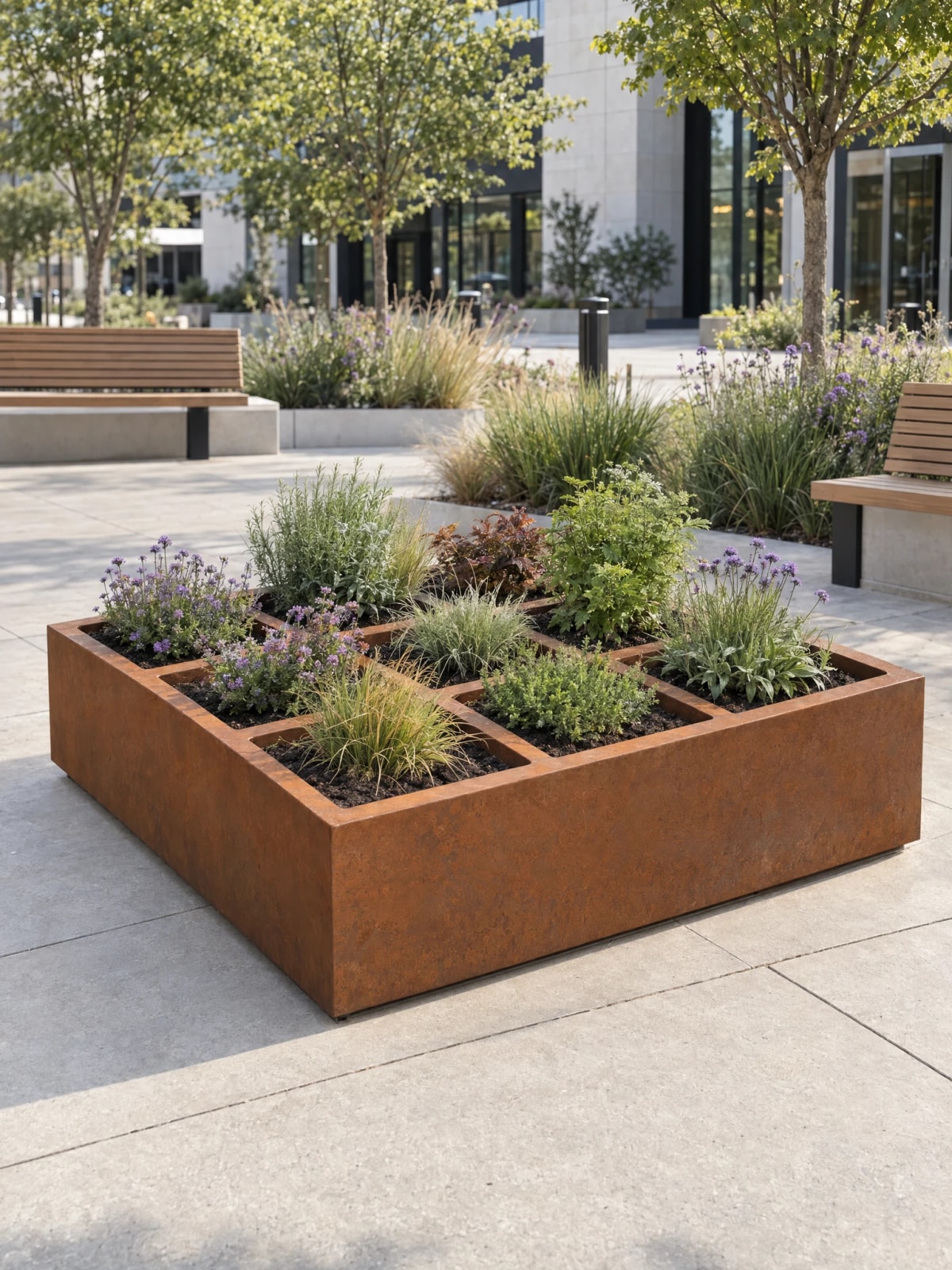
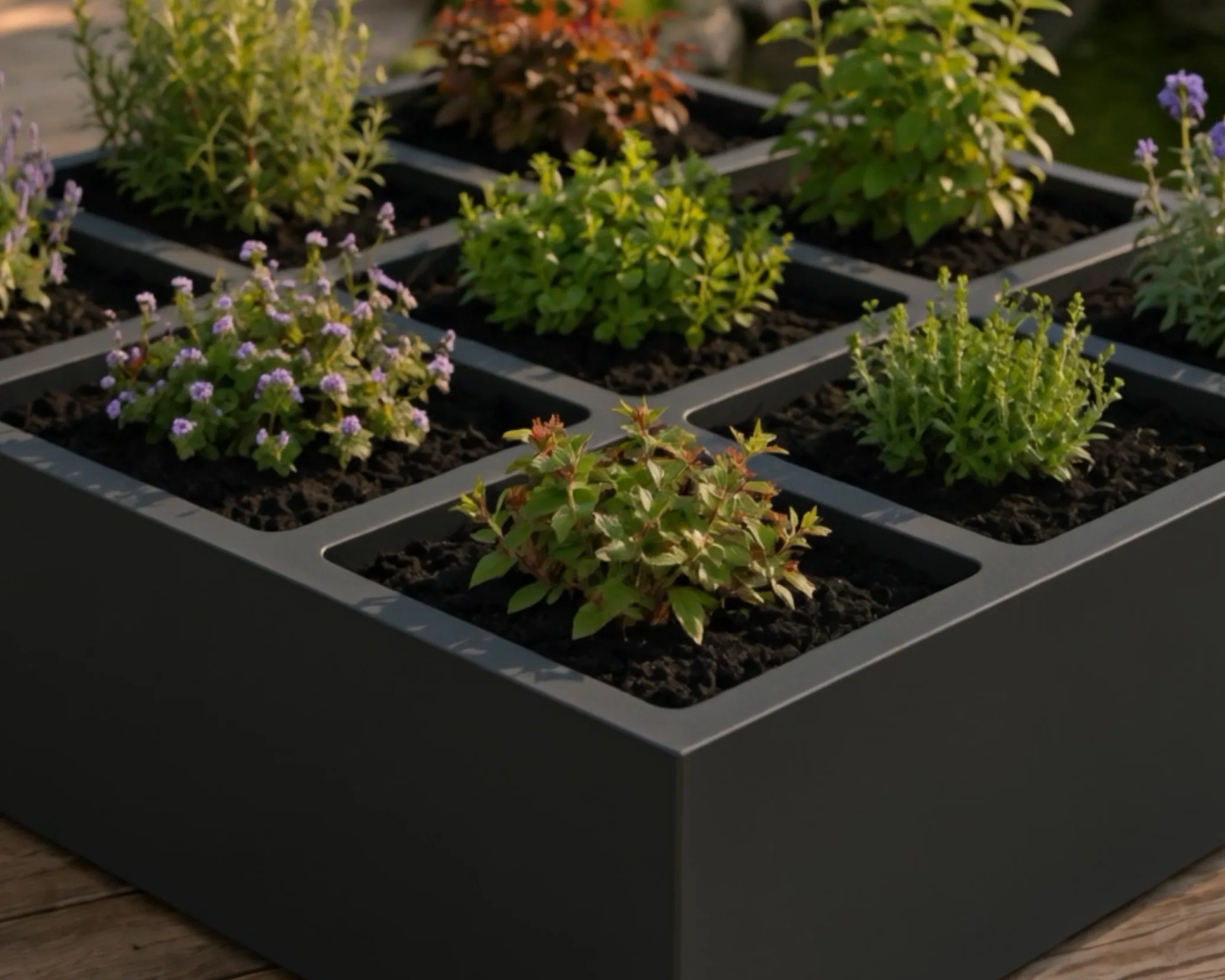
Each design appears twice, first in Corten steel, then in powder-coated aluminum: the Cybèle cube, the long Déméter trough, Thalie on legs, the triangular Iris and Maïa with its compartments.
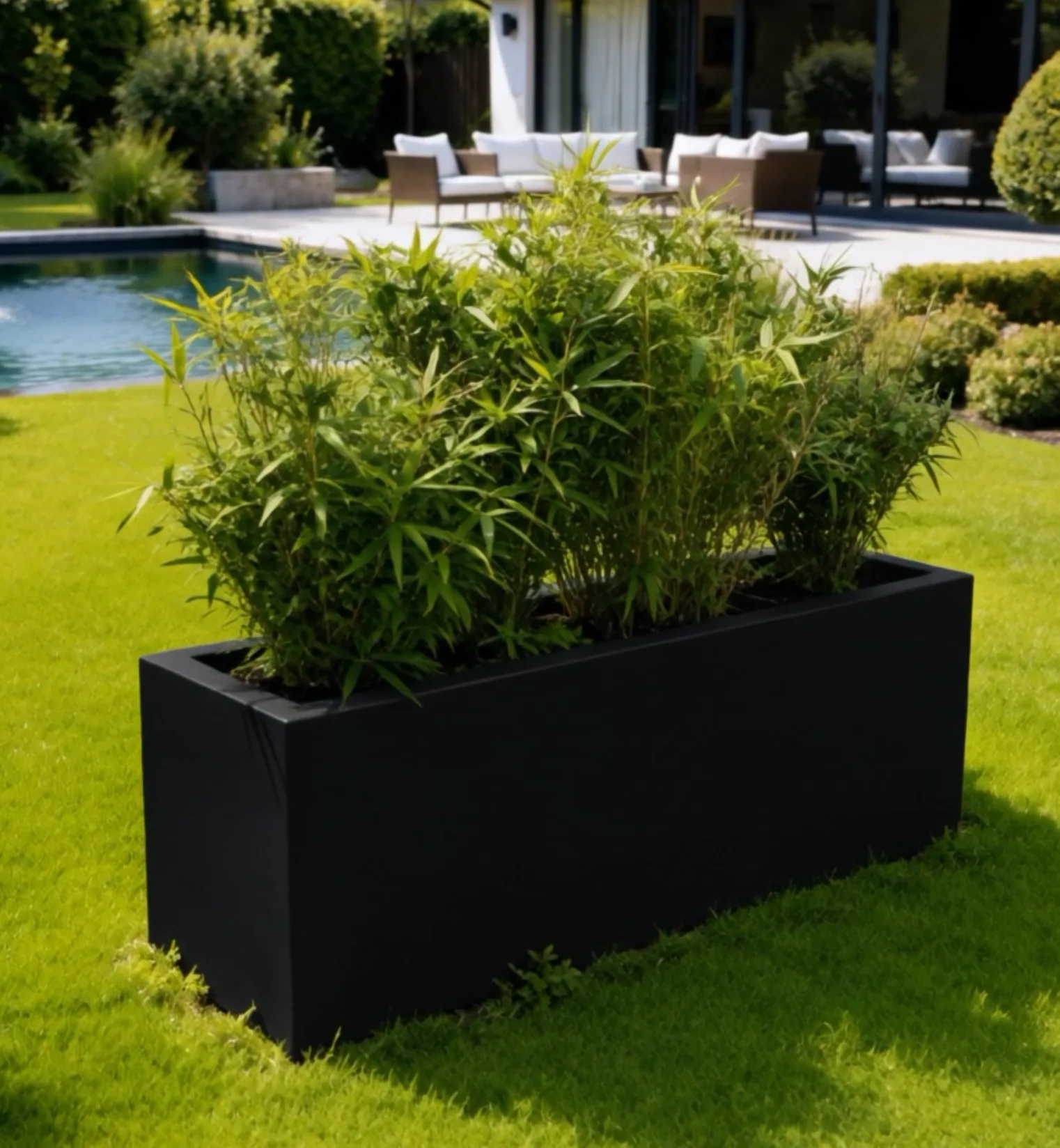
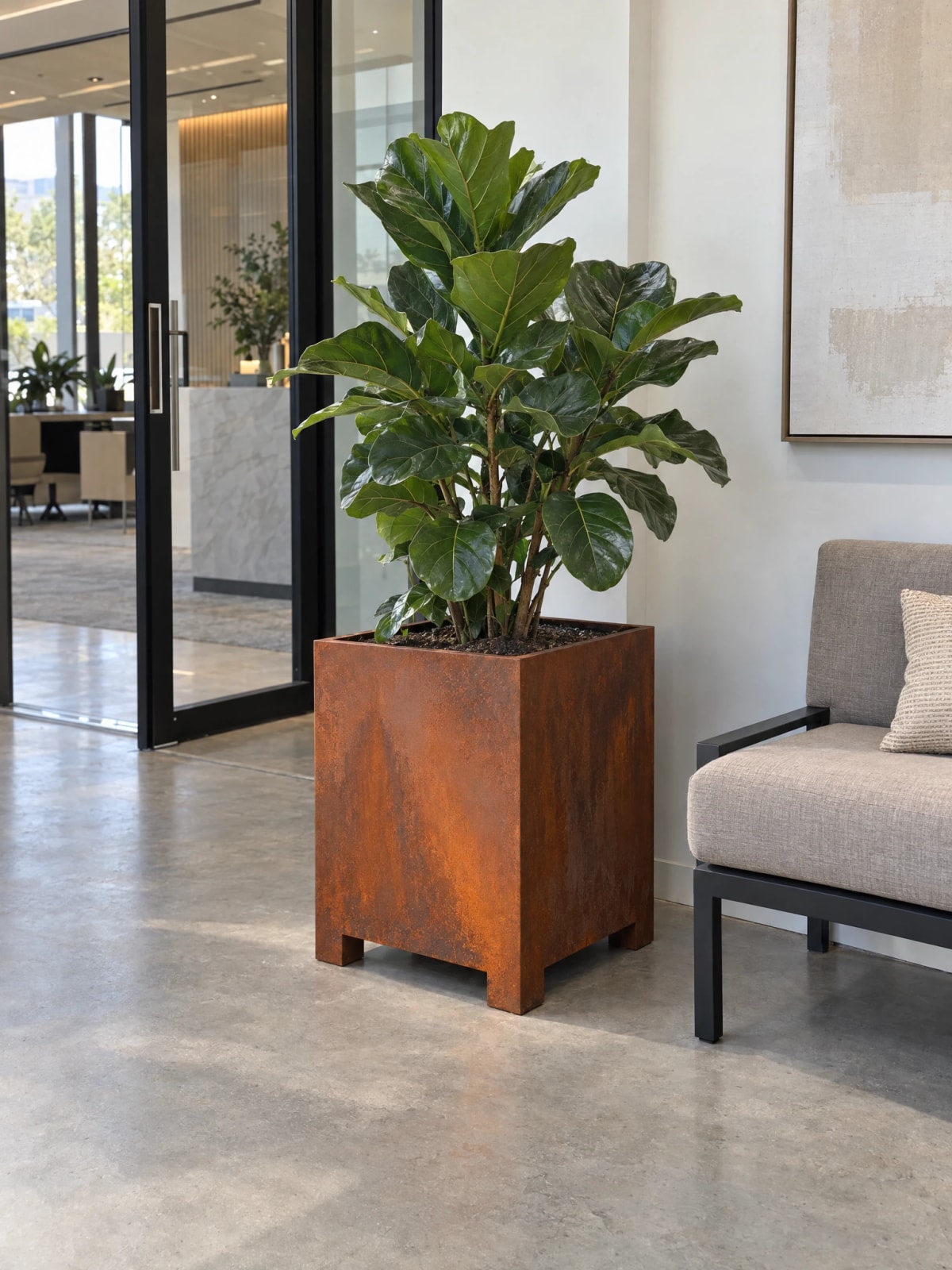
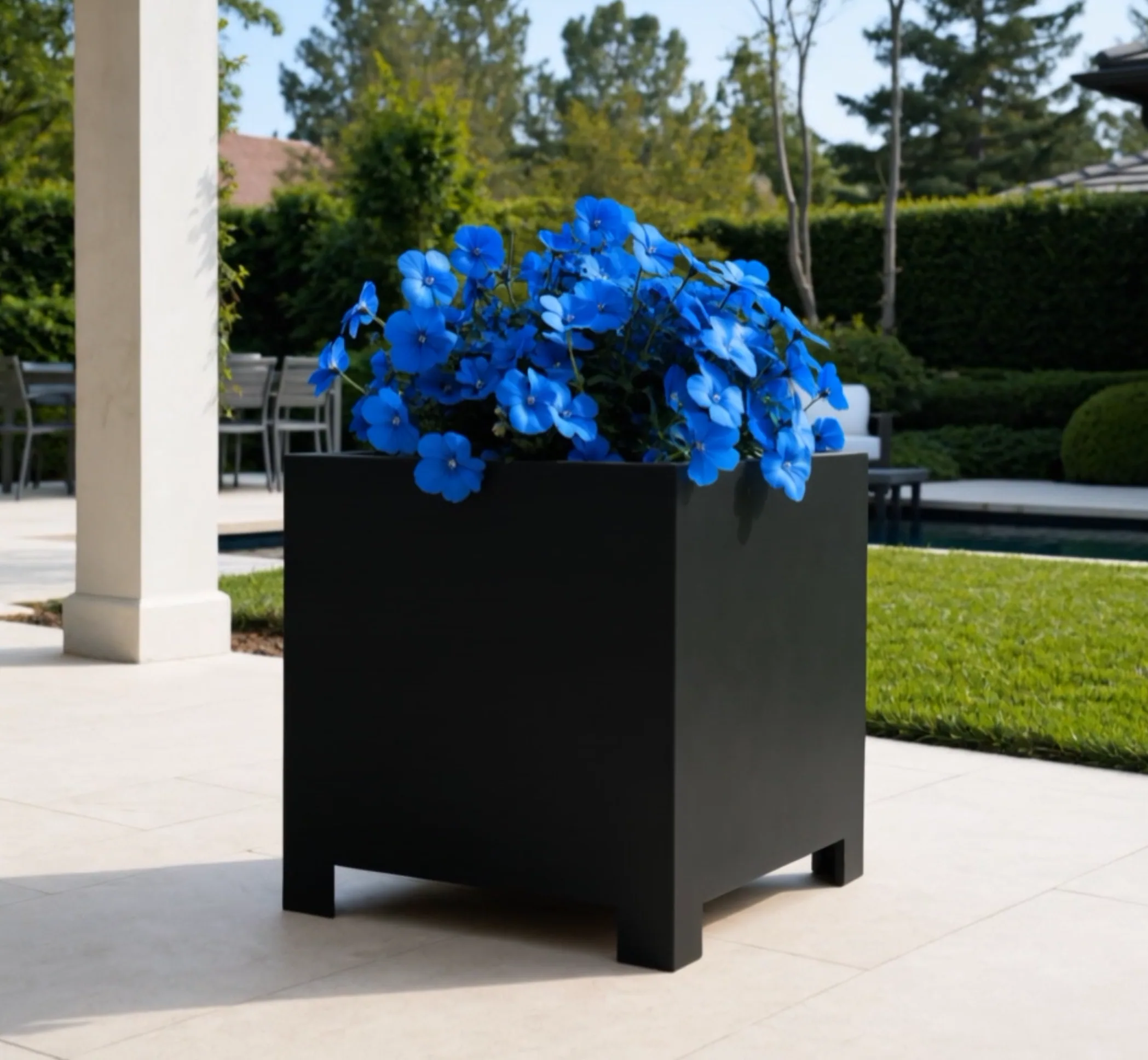
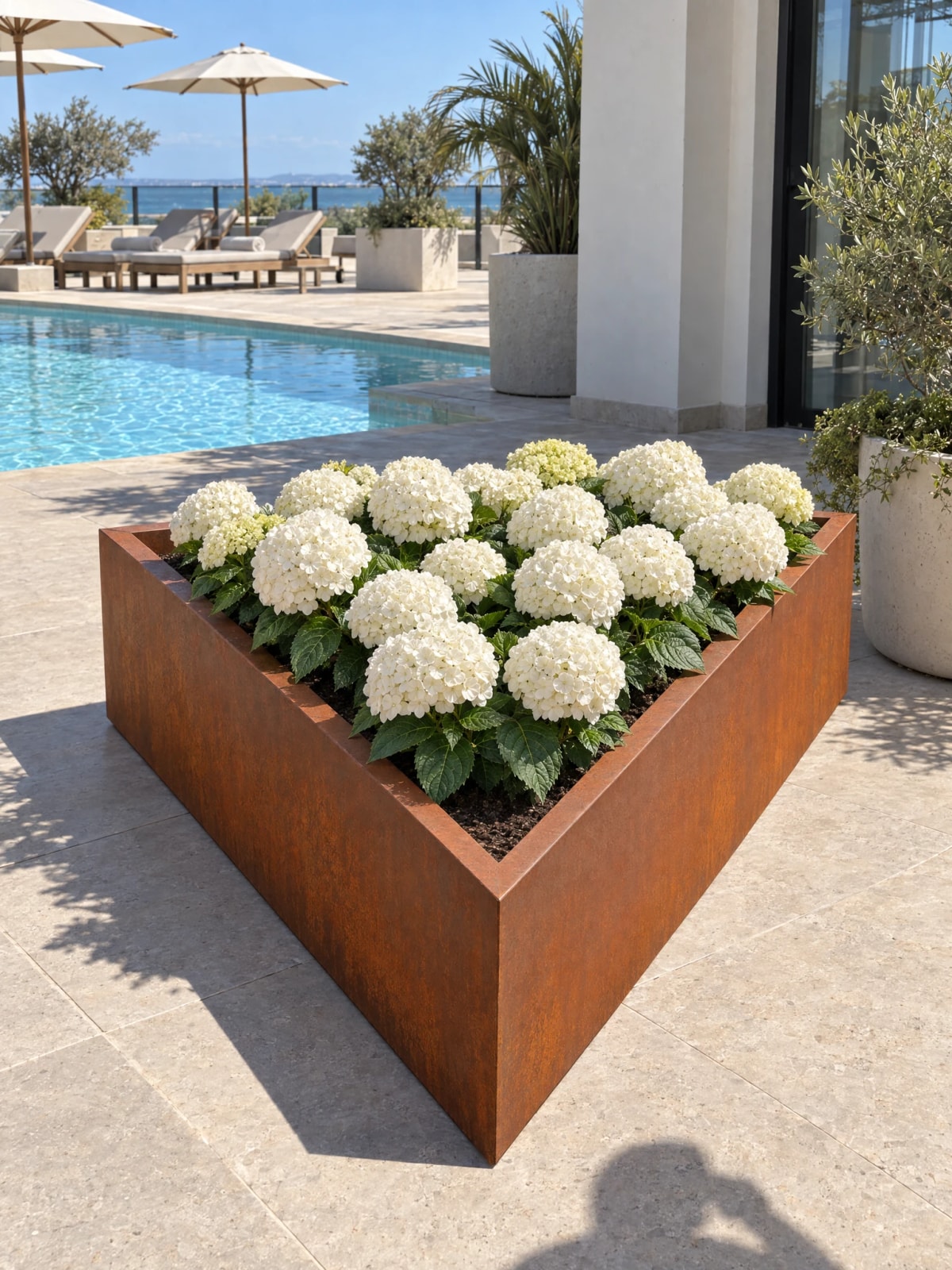
Decks, balconies and planters you rearrange
Where every pound counts, aluminum wins. A run of about 20 feet made of three Déméter troughs at 2000 × 500 × 600 mm (79 × 20 × 24 in) weighs 205.5 kg (453 lb) empty in Corten steel, against 106.5 kg (235 lb) in aluminum. A 16-inch Cybèle drops from 30 lb to 15 lb, light enough to move around the patio as the seasons change.
These are empty weights. Filled with potting mix and watered, a planter weighs far more than its metal. On a raised deck, a balcony or a rooftop, have a structural engineer or contractor confirm the load the structure can carry before you fill large planters. Our guide on how to choose a Corten steel planter is a reminder that it is the wet soil, far more than the steel, that weighs.
In the yard, on soil or a concrete pad, weight works the other way, in favor of Corten: a heavy run of troughs stays put in the wind and does not shift once planted.
A living patina or a RAL color
The choice starts with the look. Our Corten steel planters arrive with the signature Cortenys patina applied in the workshop, an earthy amber tone that keeps changing with the light and the seasons. There is nothing to paint: the patina is part of the piece.
In aluminum, the color is stable and yours to choose. Each design comes in eight RAL colors at the same price: white 9016, anthracite gray 7016, black 9005, blue 5001, yellow 1005, green 6018, red 3020 and orange 2004. Black sets off foliage, anthracite gray matches dark window frames and modern siding, and a bright color turns a planter into the focal point of a patio.
As for upkeep, powder-coated aluminum needs nothing more than an occasional wash. Corten steel needs no particular care either; only the surface it stands on calls for some thought, as we explain below.
Rust stains, pool decks and coastal yards
Untreated Corten steel can leave rust runoff, especially in its first months, on light concrete, pale pavers, limestone or a pool coping. The protective varnish we offer as an option on our five Corten designs greatly reduces these marks without ruling them out: even varnished, a Corten steel planter can still stain the deck or pavers. Set it on shims, small feet or a gravel strip; Thalie, on its legs, keeps an air gap under its base. Our guide to Corten steel care and rust stains covers prevention and cleanup.
Powder-coated aluminum does not rust, so it will not mark a light surface. It is the metal we recommend on a pool deck and right on the coast, where salt keeps the Corten patina from stabilizing. Our guide to Corten steel near the sea explains why.
Using Corten steel and aluminum in the same yard
Because every design exists in both metals, you do not have to pick one for the whole property. A row of Déméter in aluminum on the pool deck, a pair of Corten Cybèle cubes at the edge of the lawn: the shape carries through, and only the material changes with the exposure.
Keep the two metals from touching: where they meet and water can sit, slip a shim or a gasket between them. And if the roots need to reach the soil below, Rhéa and Gaïa, our bottomless planters, also come in both metals.
Choosing the metal for each spot
Start with where the planter will stand, then look at the budget.
- Balcony, rooftop, raised deck, a planter you will move: aluminum, roughly half the weight. Iris in aluminum weighs 13 lb in its smallest size.
- Pool deck, oceanfront yard, very light pavers or concrete: aluminum, with no rust runoff.
- A color to match a front door, siding or window trim: aluminum, in eight RAL colors.
- Yard, flower bed, lawn edge, a long run of planters: Corten steel, a little less expensive size for size and offered in far more sizes.
- A tall planter, above 800 mm (31 in): among these five designs, only Corten steel goes up to 1000 mm (39 in), on Cybèle, Déméter and Thalie.
- A material that weathers and gains character over time: Corten steel.
Cortenys
Frequently asked questions
Which metal planter works best on a balcony or a rooftop?
Aluminum, if weight is the main constraint: size for size it is about half as heavy as Corten steel (15 lb against 30 lb for a 16-inch Cybèle). Either way, have the load the structure can carry checked before you fill large planters.
Why is the aluminum version lighter when its sheet is thicker?
Because aluminum is a far less dense metal than steel. Cybèle, Déméter, Thalie and Iris in aluminum use 3 mm sheet, our Corten steel planters 1.5 or 2 mm, and the aluminum version is still 1.8 to 2.1 times lighter size for size.
How much more does an aluminum planter cost than a Corten one in the US?
Between 6% and 26% more in our US prices, for the twelve sizes offered in both metals: $2,870 against $2,700 for a 400 mm (16 in) Cybèle, or $5,980 against $5,090 for a 2000 mm (79 in) Déméter.
Will a metal planter stain my deck or patio?
Powder-coated aluminum leaves no rust runoff. Corten steel can mark light concrete or pale pavers, mostly in its first months; the optional protective varnish greatly reduces runoff without ruling it out, and even varnished the planter can still stain: set it on shims, small feet or gravel.
Do metal planters overheat plant roots in full sun?
Metal warms up in full sun, Corten steel and aluminum alike. For sensitive plants, line the inside walls with a thick landscape fabric or an insulating sheet, and always let water drain out at the bottom.
Are your metal planters available in colors?
Yes, in aluminum: eight RAL colors at the same price, from white 9016 to orange 2004, with anthracite gray 7016 and black 9005 in between. Corten steel has a single tone, that of its patina, which changes over time.
Do you sell galvanized steel planters?
No. Our metal planters are made from Corten steel or powder-coated aluminum, the two metals compared on this page. For planting straight into the ground, Rhéa and Gaïa have no base and come in both: see our Corten raised beds and our aluminum planters.
A particular project in mind?
A dimension, a finish, a word of advice. The House is by your side, with the care it brings to every one of its pieces.