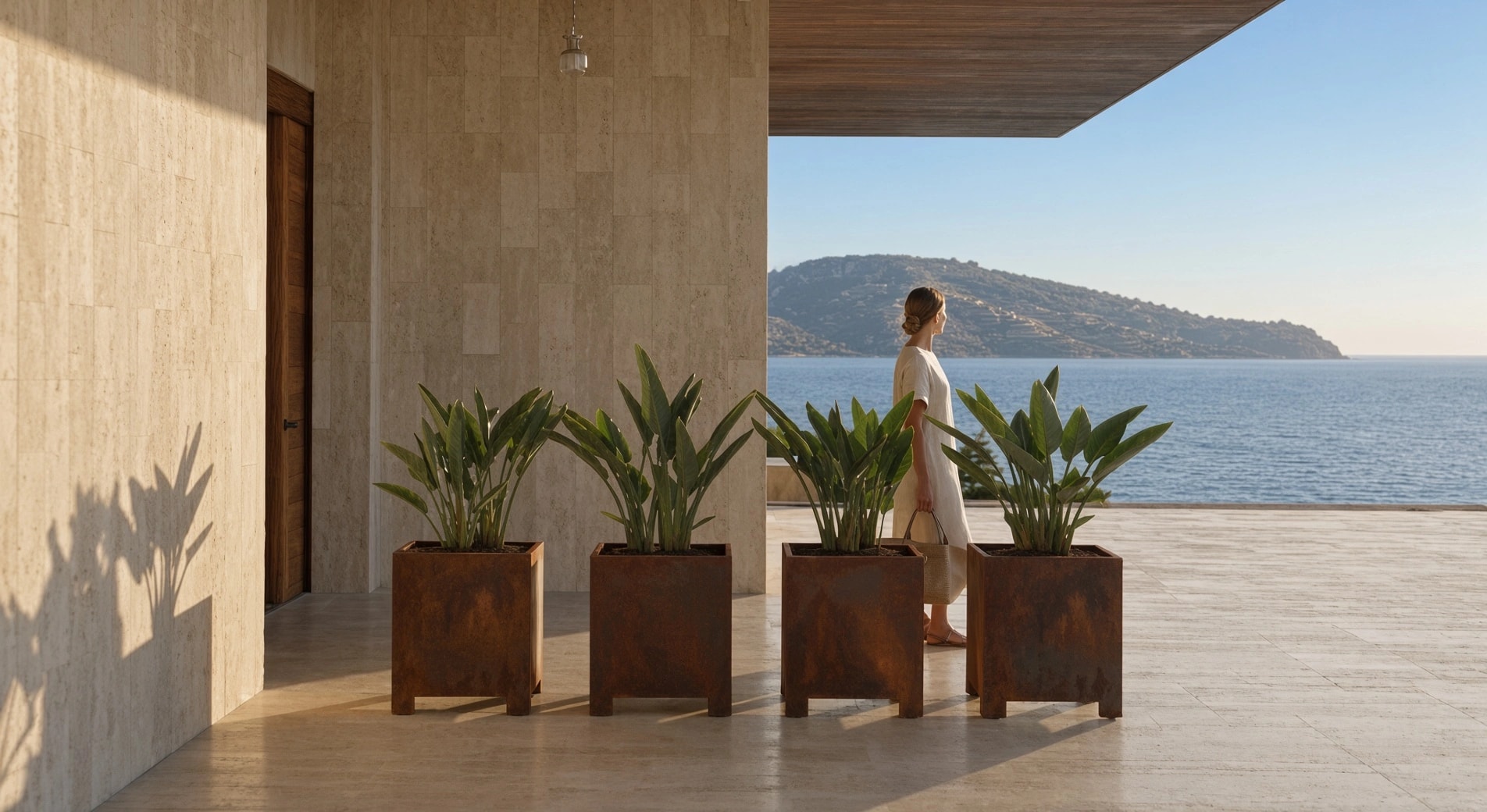
On paving, tiles or decking
Low Corten steel planters for the patio: corners, edges, on legs
On a patio or a balcony, you choose a planter by where it will stand (along an edge, in a corner, by the French doors, in the middle) and by the surface it must not stain. Our low formats, 300 to 600 mm high, keep the view open and weigh far less once filled, from Iris, the triangular planter that tucks into a corner, to Maïa and its herb compartments.
Which low planter for which spot on the patio?
One example format per spot, with the empty weight from the product page and the UK price in the base finish (our signature patina). For Iris, the size reads long side / each of the two equal sides × height.
| Spot | Model | Dimensions (mm) | Empty weight | Price |
|---|---|---|---|---|
| Corner | Iris | 1000 / 707 × 300 | 14.5 kg | £760 |
| Corner, deeper planting | Iris | 1200 / 848 × 500 | 26.6 kg | £900 |
| Patio edge, delicate surface | Thalie on legs | 1500 × 500 × 600 | 52.1 kg | £1,160 |
| Patio edge, hard-wearing surface | Déméter 2 mm | 1200 × 400 × 400 | 31.3 kg | £890 |
| Pair by French doors | Thalie on legs | 600 × 600 × 600 | 29.7 kg | £930 |
| Pair by French doors | Cybèle 2 mm | 500 × 500 × 500 | 21 kg | £800 |
| Herbs near the kitchen | Maïa with compartments | 800 × 800 × 300 | 33.5 kg | £900 |
| Island in the centre | Thalie on legs | 1000 × 1000 × 400 | 43 kg | £1,010 |
Laying out a patio: edges, corners, doors and centre
Start with a plan of the patio and the routes people take across it: planters go where nobody walks. Edges take a line of planters (Déméter or a rectangular Thalie, up to 2000 mm long), corners take a triangle, French doors a pair of squares, and a large patio can hold a low island in the middle.
- Corners: Iris, a right-angled isosceles triangle, sits snugly in the inside corner of a wall or balustrade; two Iris put together along their long sides make a square. 8 sizes, from 800 to 1400 mm on the long side, 300 or 500 mm high.
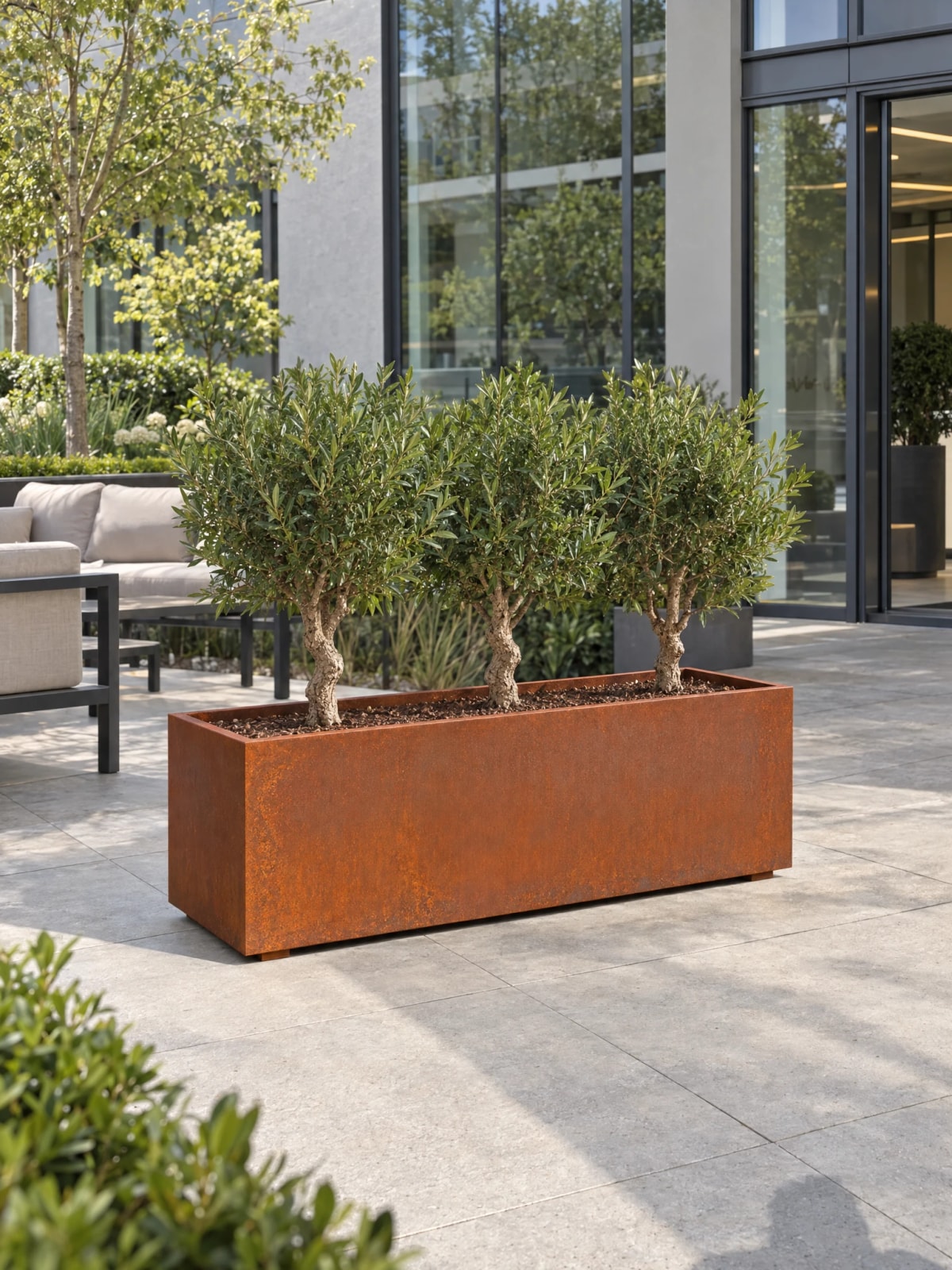
- Edges: Thalie comes in 1200, 1500 and 2000 × 500 × 600 mm; Déméter from 900 to 2000 mm long. A 1200 × 400 × 400 mm edging planter has an outside volume of about 190 L.
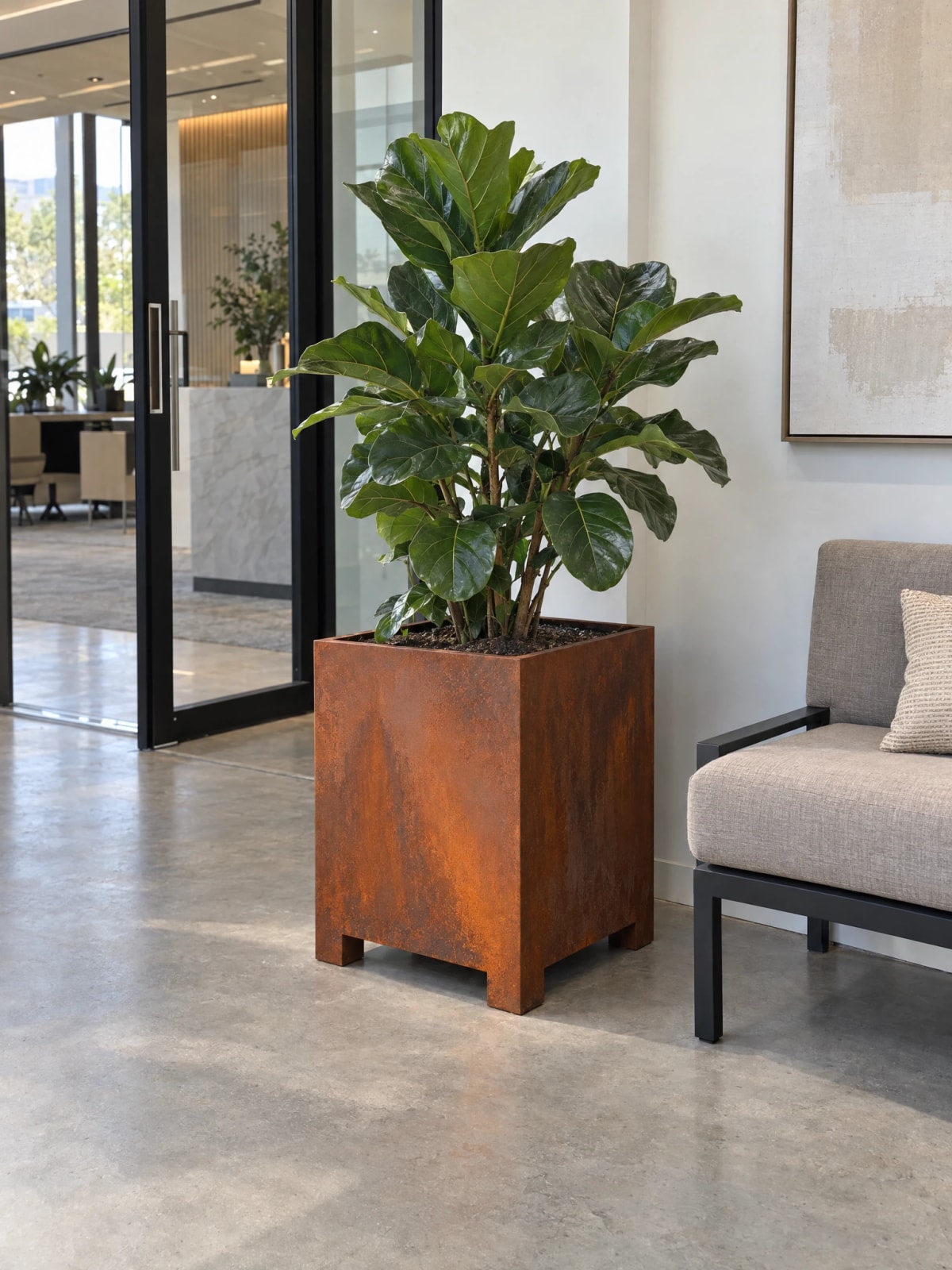
- Doors: two identical cubes, 500 or 600 mm square, frame a pair of French doors without getting in the way.
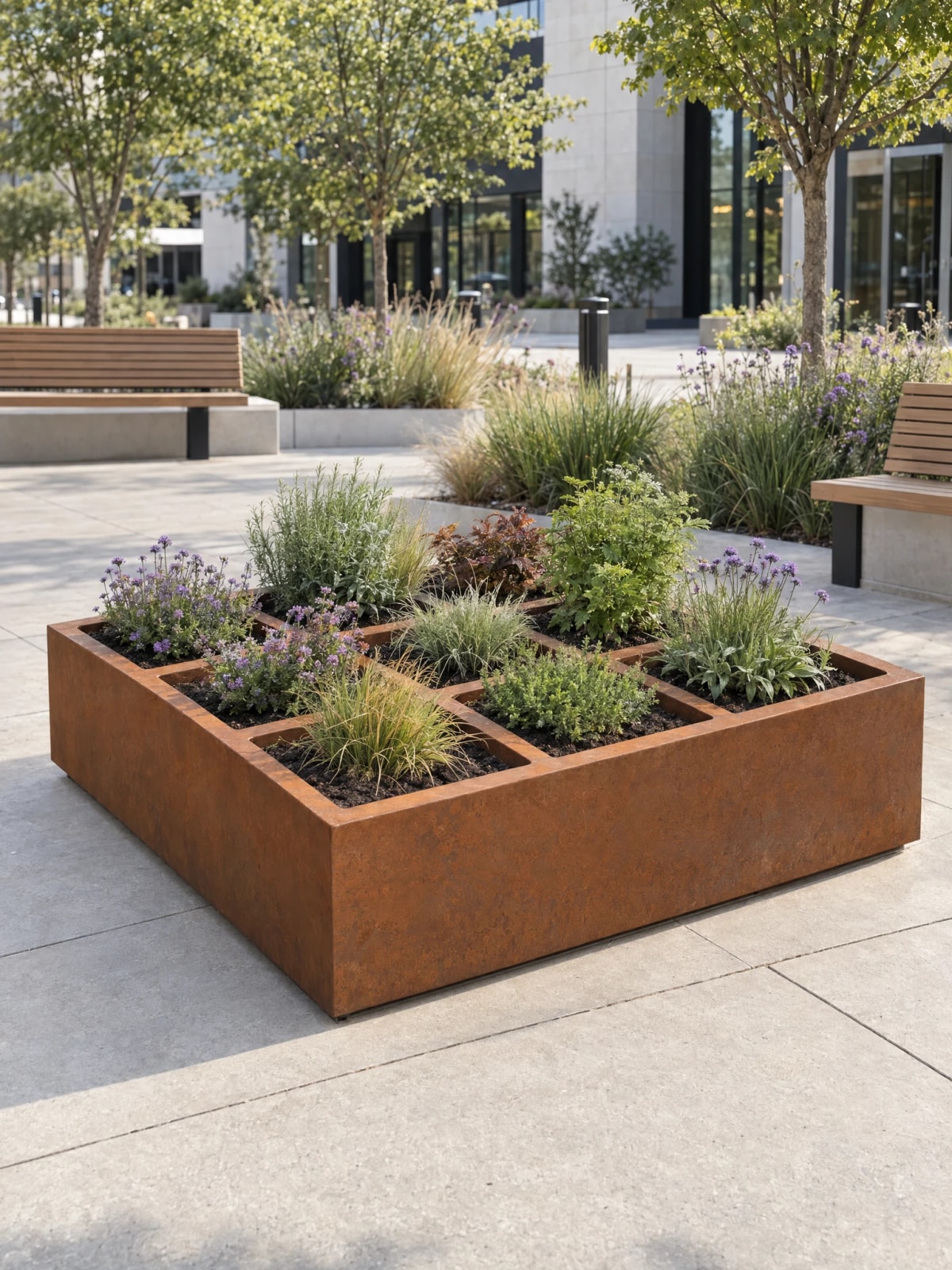
- Centre or dining area: Maïa, at 300 mm high, stays below the eye line of someone sitting down and keeps each herb in its own compartment.
Low planters
Our low planters for patios and balconies
Thalie comes first, because its four legs hold the planter clear of the ground; then Déméter for the edges, Maïa for herbs, Iris for corners and Cybèle for single plants or pairs.
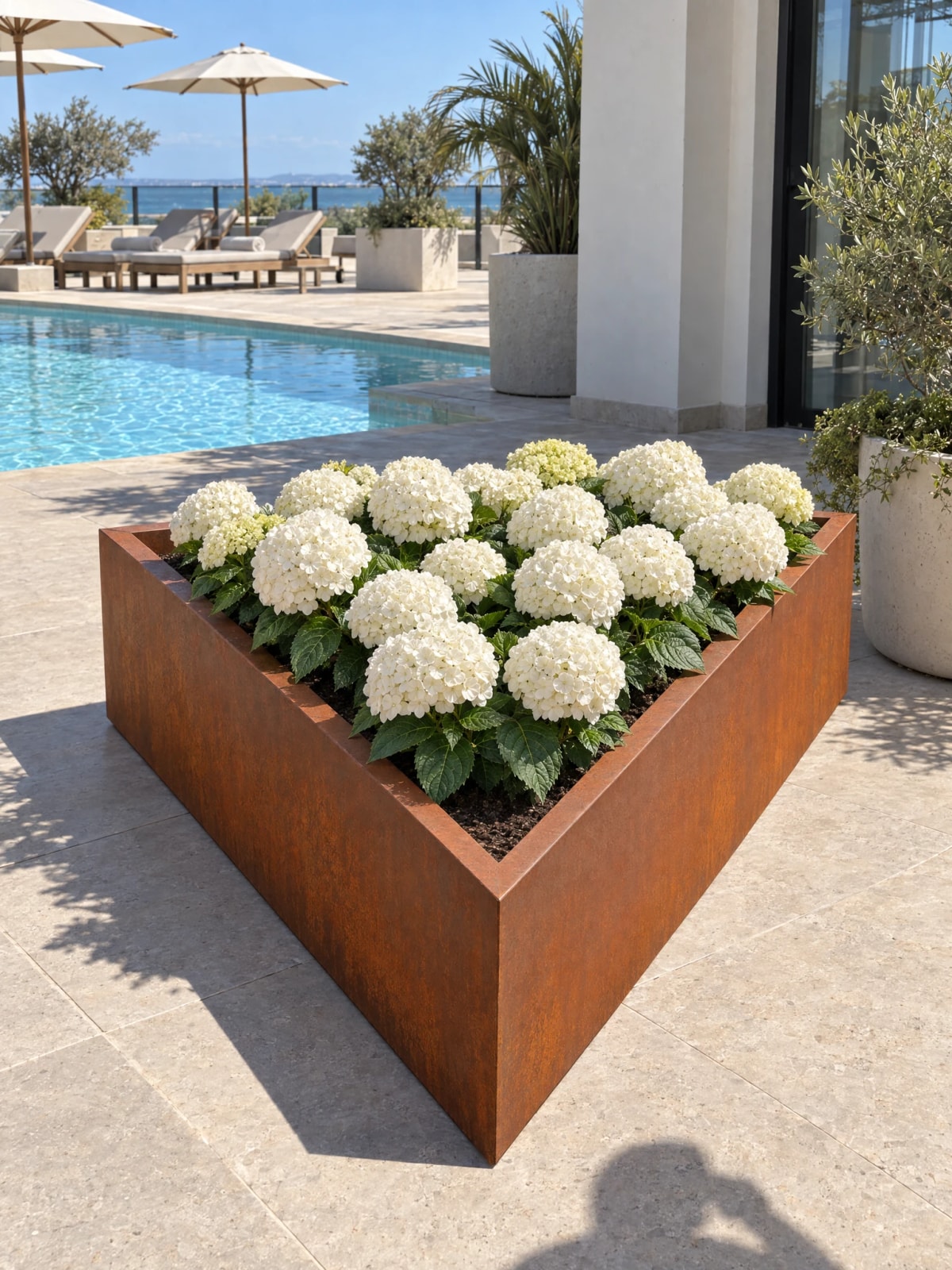
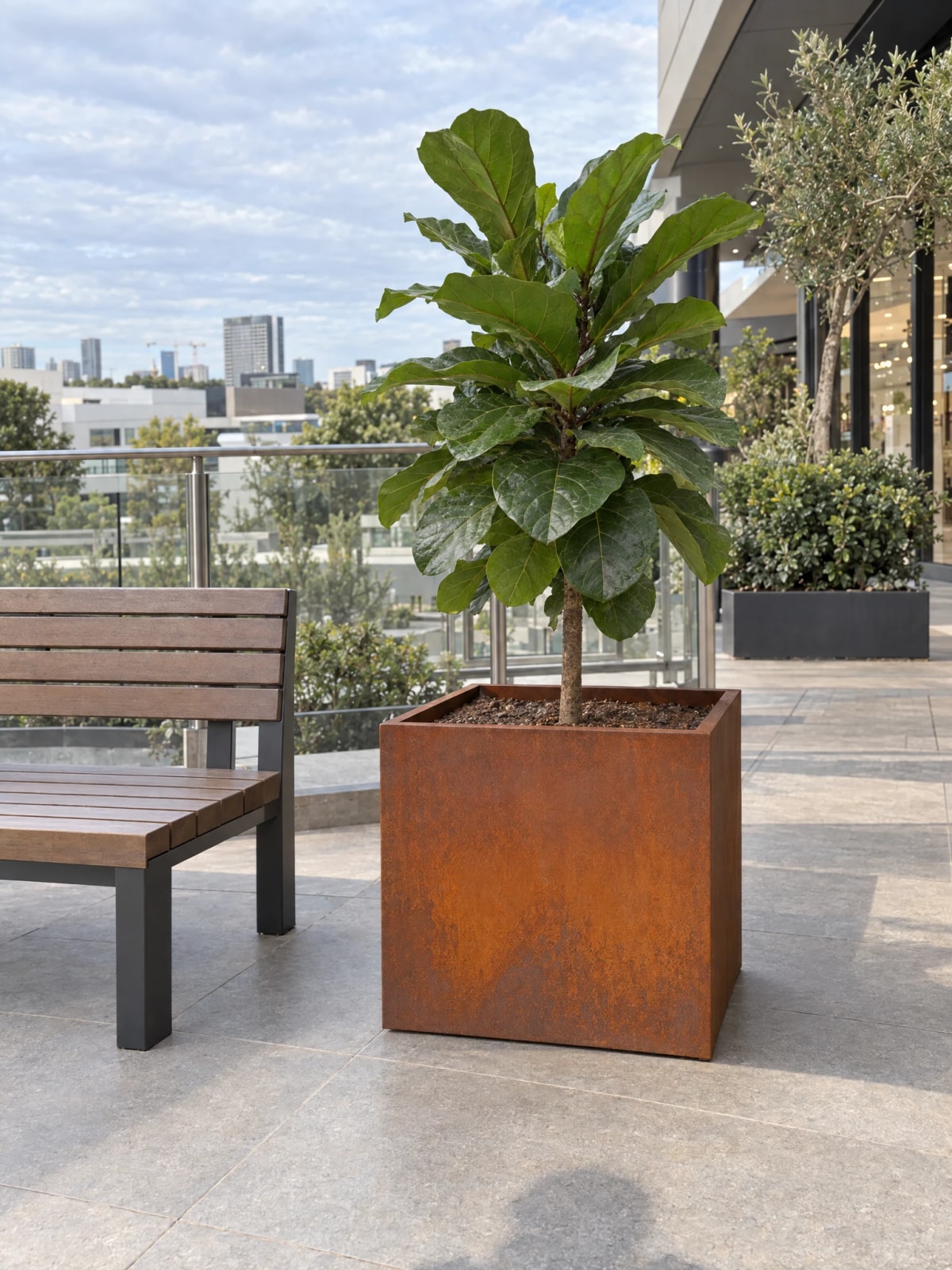
Low formats 300 and 400 mm high: volume, weight and price
A low planter keeps the view open and weighs less once filled. Iris and Maïa come 300 mm high, Cybèle, Déméter and Thalie 400 mm high. UK prices in our signature patina, empty weight from the product page, volume worked out from the outside dimensions (a maximum: take off the drainage layer and the gap below the rim).
On the same footprint, halving the height halves the soil: Déméter 1000 × 500 mm holds 200 L at 400 mm high, against 400 L at 800 mm. With moist compost at roughly 1 to 1.8 kg per litre, that is about 200 to 360 kg instead of 400 to 720 kg, planter not included. A low planter also dries out faster, so mulch the surface and water more often in summer.
- What grows well in 300 to 400 mm of soil (check with your nursery for a given plant): most herbs (thyme, chives, parsley, basil), salad leaves and strawberries, low perennials and ground cover, compact grasses, spring bulbs and succulents.
- A shrub or a tree needs more depth: see our tall Corten steel planters, our square Corten planters for a single tree, or our large Corten steel planters for a hedge or a bigger volume.
| Model | Dimensions (mm) | Volume (maximum) | Empty weight | Price |
|---|---|---|---|---|
| Iris, triangular | 800 / 565 × 300 | about 48 L | 11.5 kg | £740 |
| Cybèle 2 mm, square | 400 × 400 × 400 | 64 L | 13.7 kg | £740 |
| Cybèle 2 mm | 800 × 800 × 400 | 256 L | 32.1 kg | £890 |
| Maïa, with compartments | 800 × 800 × 300 | 192 L | 33.5 kg | £900 |
| Maïa | 1200 × 1200 × 300 | 432 L | 60.1 kg | £1,190 |
| Déméter 2 mm, rectangular | 1000 × 500 × 400 | 200 L | 30.0 kg | £870 |
| Déméter 2 mm | 2000 × 400 × 400 | 320 L | 47.5 kg | £1,020 |
Keeping rust off decking, tiles and stone
The signature Cortenys patina is applied in our workshop; water running down Corten steel can carry oxide with it and mark pale tiles, porous stone or timber decking. On a patio, protecting the surface matters as much as choosing the planter.
Thalie, standing on four built-in corner legs, keeps an air gap under its base. Under the other models, use small feet or rot-proof spacers to leave an air gap, or a saucer for a small format. A protective varnish is offered as an option on all five models (for example £950 instead of £900 for Maïa 800 × 800 × 300 mm), but even varnished, a Corten steel planter can still leave rust run-off and stain the patio, so these precautions remain necessary in either finish. Our Corten care and rust stain guide explains how to deal with a mark.
Rainwater, drains and wind on a patio or balcony
Before you set a planter down, find the fall of the patio and its drains: water leaving the planter should reach a drain without pooling underneath or running across a delicate surface. Turn the planter's outlets towards the fall, do not block them with a spacer, and leave a gap between two neighbouring planters.
Up high or on the edge of a roof, the wind acts on the plants more than on the planter. Choose supple plants (grasses, herbs, shrubs kept low) rather than tall, dense specimens, and in exposed spots prefer a wide base to a narrow column.
Ground-level patio, roof terrace or balcony?
On a raised patio, a roof terrace or a balcony, the weight of the planter, once planted and watered, must be checked before you buy: a structural engineer or builder who knows the building can tell you the acceptable load, and our guide on how to choose a Corten steel planter is a reminder that wet soil weighs far more than steel. If you are planting into the garden soil itself, see our bottomless Corten steel planters instead, and find every shape on our page of Corten steel planters.
For a tree on a patio, a round pot can be the better fit: our large Corten steel pots start at 800 mm across.
Cortenys
Frequently asked questions
How do I stop rust marks on decking or patio tiles?
Do not stand the planter flat on the surface: use Thalie's legs, spacers, small feet or a saucer, and steer the water towards a drain. The optional varnish greatly reduces rust run-off but does not rule it out: even varnished, a Corten planter can still stain decking or tiles, so keep those precautions in place.
What is the cheapest low Corten planter?
Two formats share the lowest price at £740: Iris 800/565 × 300 mm, triangular, and Cybèle 2 mm 400 × 400 × 400 mm, square. In a rectangle, Déméter 2 mm 1000 × 500 × 400 mm costs £870.
Is 300 mm deep enough for a herb planter?
For most herbs, yes: thyme, chives, parsley or basil are happy in 200 to 300 mm of well-drained soil. Rosemary and sage, which grow more vigorously, are more comfortable in 400 mm. Check each plant's needs with your nursery.
Which planter fits the corner of a patio?
Iris, a triangular planter whose right angle fits an inside corner. It comes 800, 1000, 1200 or 1400 mm on the long side, 300 or 500 mm high, from £740 to £960 in the base finish.
Why choose a planter on legs for a patio?
Thalie's four corner legs lift the planter off the ground: air circulates, water drains away underneath and the surface does not stay damp under the base. Thalie comes as a square from 600 to 1400 mm and as a rectangle up to 2000 mm.
Where does the water from a patio planter go?
It leaves the planter through its outlets, which you should locate on the format you choose, then has to follow the fall of the patio to its drains. Test it with a first watering before you plant, and keep the outlets clear of spacers and leaves.
Will wind blow a low Corten planter over on a balcony?
Once filled, a planter is heavy, and it is mainly the plant that catches the wind. On an exposed site, choose supple plants and planters with a wide base rather than narrow columns.
Will my balcony or roof terrace take the weight?
That depends on the structure, not just the planter. On a roof, a raised deck or a balcony, have a structural engineer or builder check it, giving them the dimensions, empty weight and soil volume of the format you have in mind.
A particular project in mind?
A dimension, a finish, a word of advice. The House is by your side, with the care it brings to every one of its pieces.