Cubes and squares
Corten steel square planters
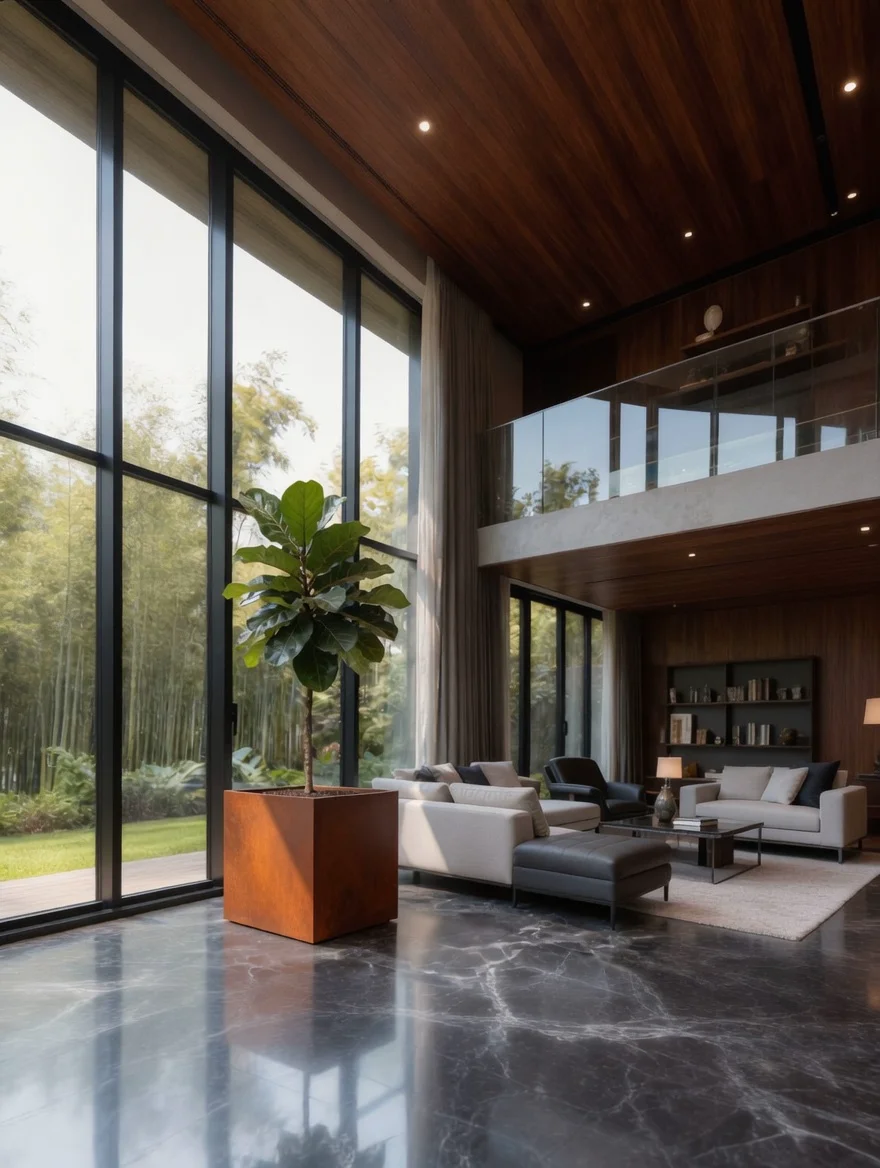
A square Corten planter gives a single plant a setting of its own (an olive, a lemon tree, a Japanese maple, clipped box) or, repeated, sets the rhythm of a patio or a roof terrace. Cybèle starts at 400 × 400 × 400 mm and goes up to 1400 mm a side.
Square planters size for size: Cybèle and Thalie compared
For squares as tall as they are wide (the 1200 mm square stops at 1000 mm high), the table shows what each model offers. Prices are for the base finish, our signature patina; the weight is the empty weight shown on the product page, and the volume is the outside volume.
At 400 mm the two Cybèle versions are only £10 apart (£740 and £750). From 800 mm a side the choice narrows to the 2 mm Cybèle, which sits flat, and Thalie, which stands on legs.
| Size (mm) | Outside volume | Cybèle 2 mm | Cybèle 1.5 mm | Thalie on legs |
|---|---|---|---|---|
| 400 × 400 × 400 | 64 L | £740 (13.7 kg) | £750 (13.7 kg) | not offered |
| 500 × 500 × 500 | 125 L | £800 (21 kg) | £820 (21 kg) | not offered |
| 600 × 600 × 600 | 216 L | £870 (29.6 kg) | £900 (29.6 kg) | £930 (29.7 kg) |
| 700 × 700 × 700 | 343 L | £960 (40 kg) | £990 (40 kg) | not offered |
| 800 × 800 × 800 | 512 L | £1,070 (52 kg) | not offered | £1,180 (54.7 kg) |
| 1000 × 1000 × 1000 | 1000 L | £1,400 (85.1 kg) | not offered | £1,430 (83.5 kg) |
| 1200 × 1200 × 1000 | 1440 L | £1,740 (105.4 kg) | not offered | £1,790 (103.7 kg) |
Choosing a square planter size for a tree or shrub
Start from the root ball of the plant as it comes from the nursery: the cube should be clearly wider and deeper, so that a layer of compost surrounds the roots and sits beneath them. A young olive or a citrus in its container settles well in a cube of 600 to 800 mm; a more mature specimen calls for 1000 mm a side or more. Think about growth as well: repotting a tree that stands in 500 kg of soil is not a simple job, so it is worth choosing the larger cube from the start.
Height is a matter of proportion as much as of roots. A low cube (400 mm) works as a plinth for a spreading plant; a tall square (800 to 1000 mm) lifts the foliage and gives a trailing plant room to cascade. Cybèle 2 mm covers both, from 400 to 1400 mm a side and from 400 to 1000 mm high. If the height matters more than the footprint, our tall Corten steel planters set out the column sizes.
- Cybèle 1.5 mm: 7 sizes up to 700 mm a side, including 400 × 400 and 500 × 500 mm columns standing 1000 mm tall.
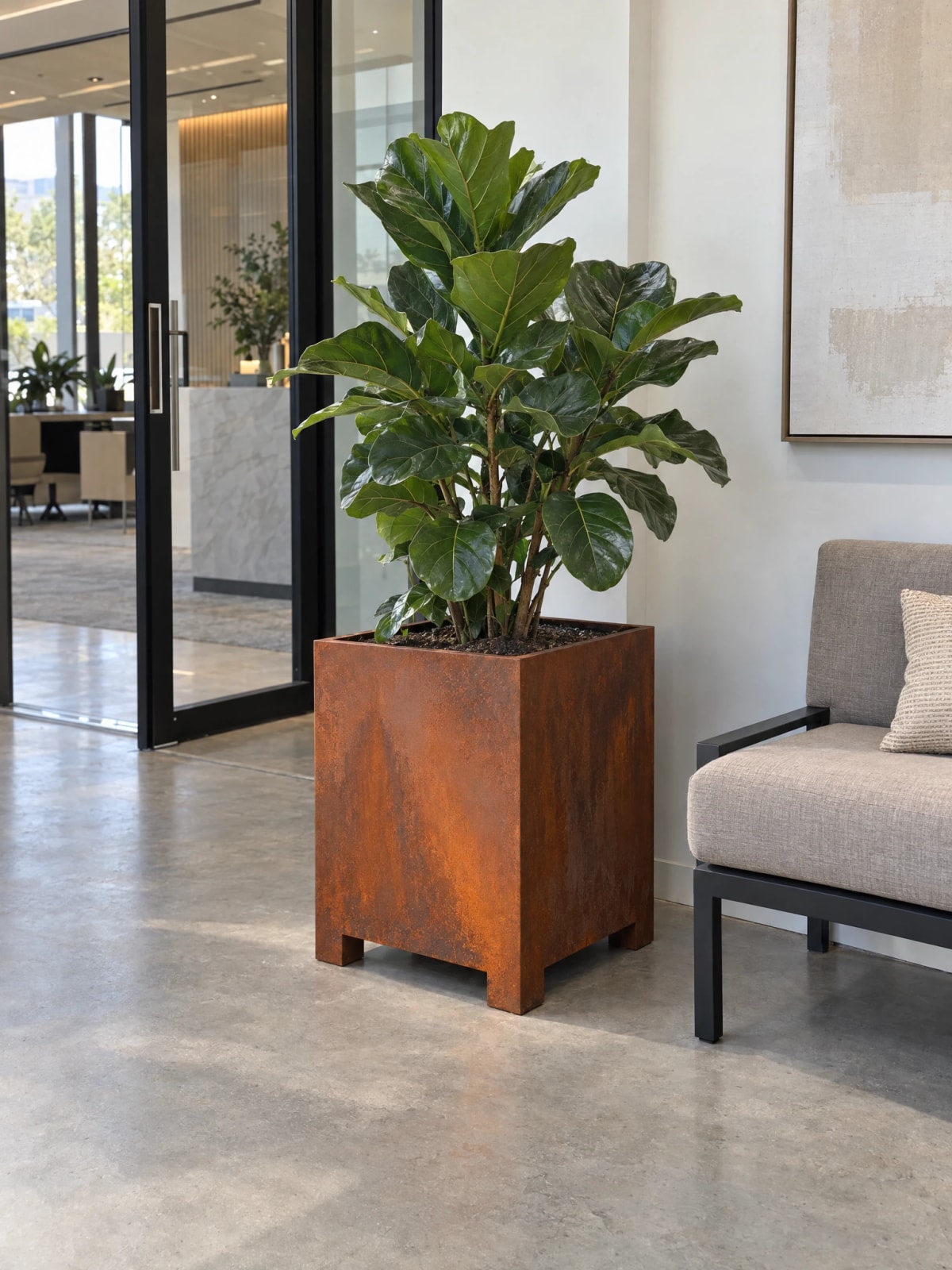
- Thalie: squares from 600 to 1400 mm a side on four corner legs, which lift the planter off the ground.
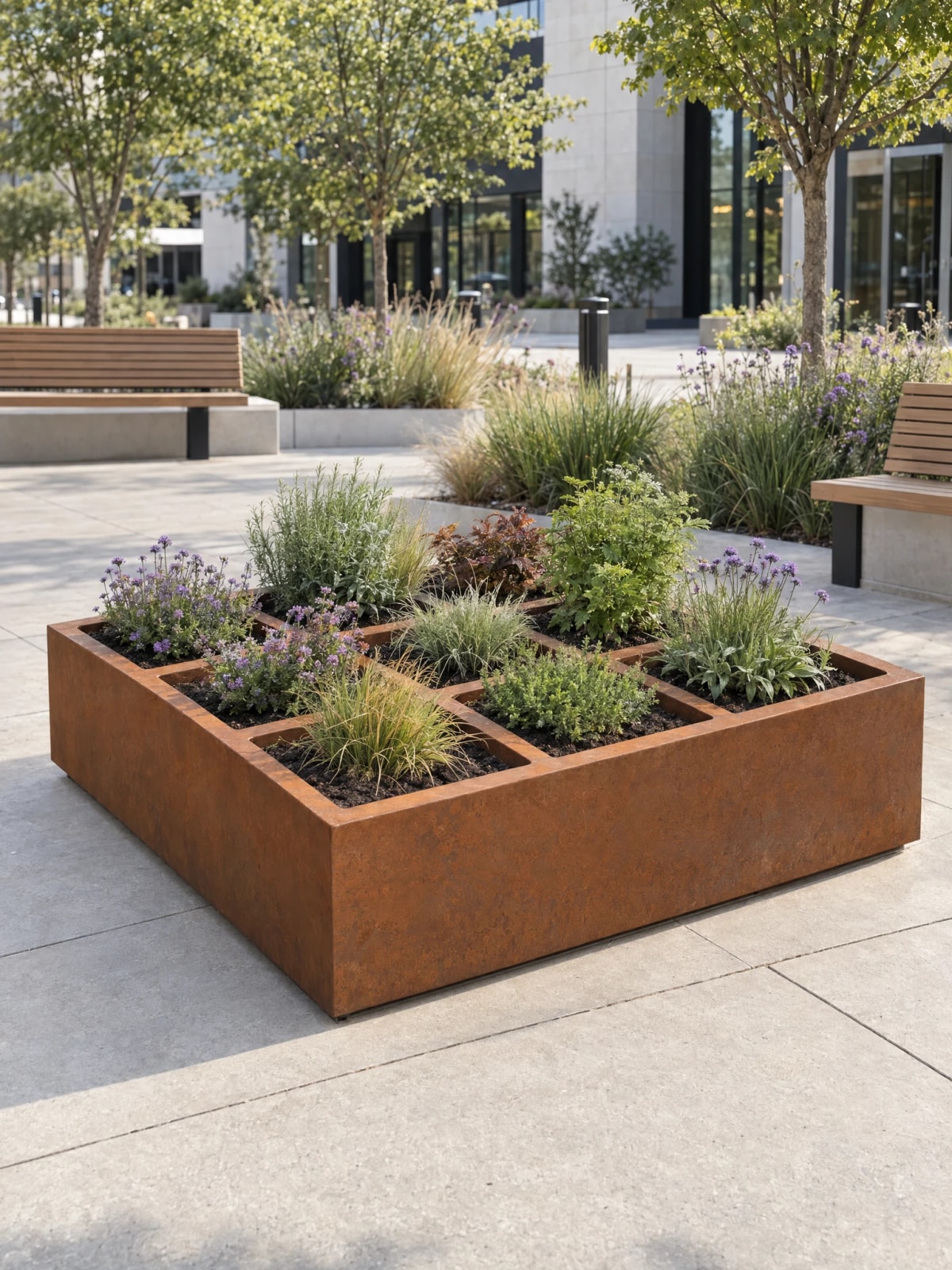
- Maïa: 800 × 800 × 300 mm (£900) or 1200 × 1200 × 300 mm (£1,190), divided into compartments to keep herbs, perennials or vegetables apart.
Square
The square planters in our collection
Cybèle in 2 mm steel (27 sizes) and in 1.5 mm steel (7 sizes), Thalie raised on four corner legs, and Maïa, a low square divided into compartments.
Square planters in pairs and rows: front doors, paths and patios
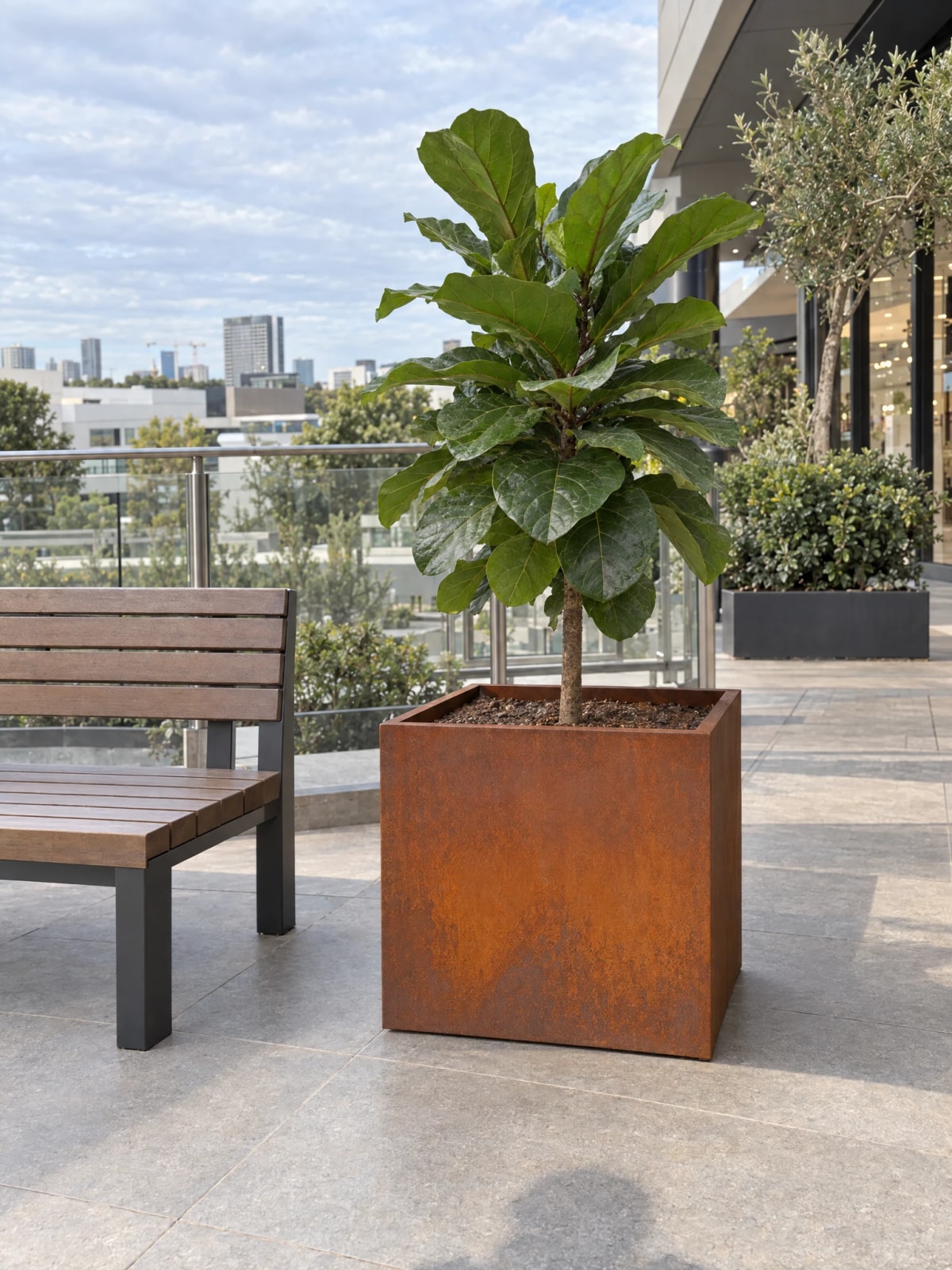
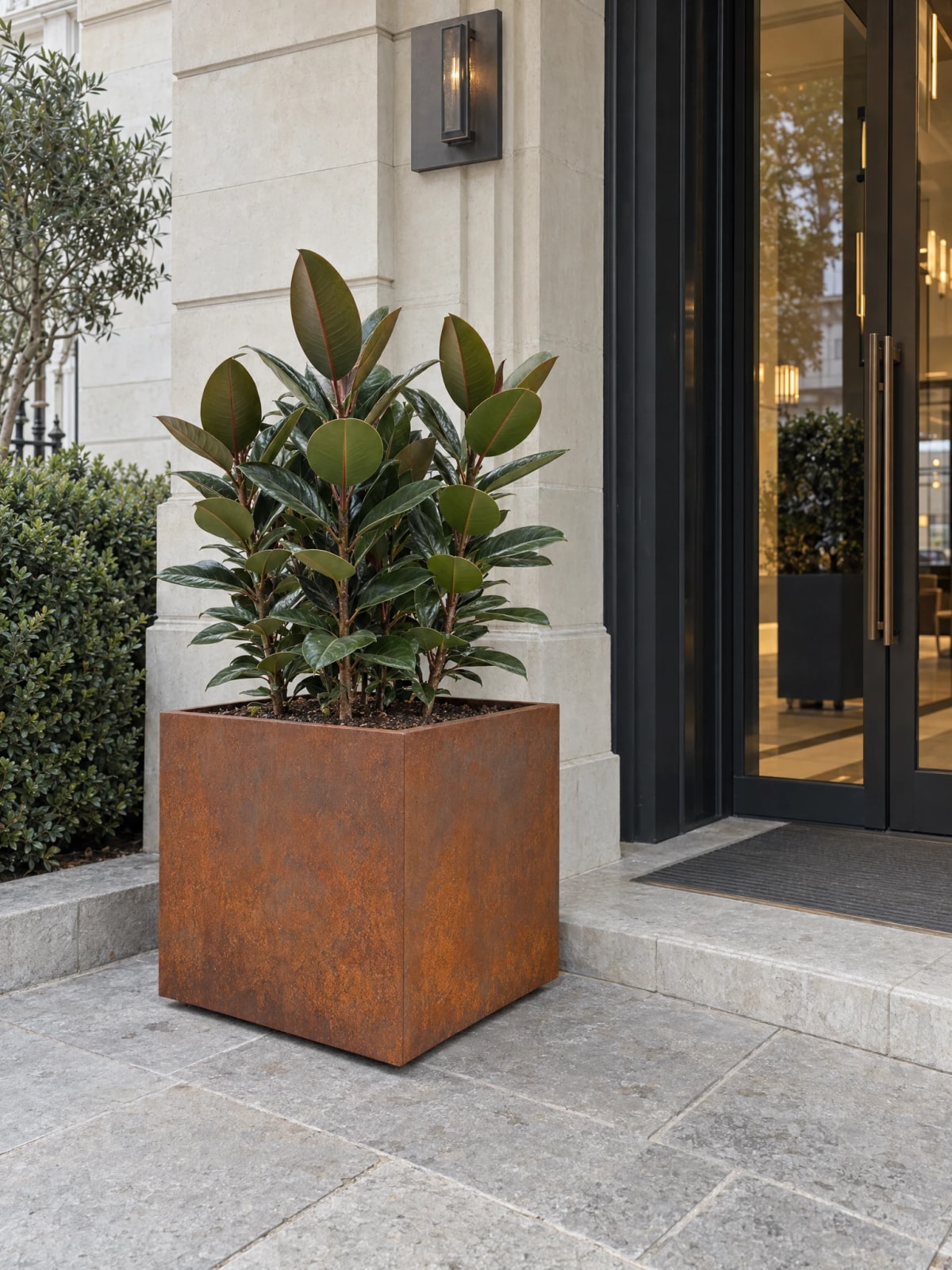
Two identical cubes either side of a front door, a gate or a flight of steps frame the way in. Choose a size in proportion to the opening: for a front door that is often 500 to 700 mm a side. In a row, repetition does the work: three, five or seven cubes of the same size, evenly spaced, give rhythm to a path or the edge of a patio better than a continuous line when you want to keep the view between the plants.
For a looser arrangement, combine two heights with the same footprint, for example 600 × 600 × 400 and 600 × 600 × 800 mm: the faces stay aligned and the change in level creates depth. In a small town garden, one generous cube placed off centre often gives more structure than several small pots. Line the planters up while they are empty: once filled, they will not move.
On a roof terrace or a balcony, remember that a filled cube weighs far more than its empty steel. Have the structure checked before choosing the larger sizes, and place the heaviest cubes where the structure is designed to carry them.
Patina, rust run-off and paving around a square planter
We apply the Cortenys signature patina in the workshop: each cube arrives already patinated, and its tones keep developing with exposure. Rainwater running down the four faces can leave a rust-coloured line around the planter on pale paving or stone, especially in the first months.
We offer a protective varnish as an option on all four models. The protective varnish greatly reduces run-off, but even varnished, Corten steel can still stain the floor: stand the cube on small feet, spacers or a saucer, surround it with a strip of gravel, or set it on a dark slab. Thalie, raised on its legs, limits contact between its wet base and the paving. Our guide to Corten steel care and rust stains goes through these precautions in detail.
Square, trough or bottomless: which Corten planter shape?
A square sets one plant apart; for a hedge or a continuous border, our Corten trough planters are the better fit. If the cube is to be planted straight into the ground, Rhéa keeps the square shape without a base, among our Corten steel bottomless planters. Squares of 1000 mm a side and more are compared on the page for large Corten steel planters, and every shape is set out across our Corten steel planters.
Cortenys
Frequently asked questions
What size of square planter does an olive tree need?
Choose a cube clearly larger than the root ball your plant comes in, in all three dimensions. For a young olive in a container, 600 to 800 mm a side and in height is a good starting point; a mature tree needs 1000 mm or more. Ask your nursery to confirm what the roots will need.
Cybèle 2 mm or Cybèle 1.5 mm: which square planter should I choose?
The 2 mm Cybèle comes in 27 sizes up to 1400 mm a side and costs less size for size (£740 compared with £750 at 400 × 400 × 400 mm). The 1.5 mm Cybèle comes in 7 sizes up to 700 mm, with a finer profile.
How does the Thalie square planter differ from Cybèle?
Thalie stands on four integrated legs that leave a gap beneath its base; Cybèle sits flat. Size for size, Thalie costs a little more, for example £930 compared with £870 at 600 × 600 × 600 mm.
How many square planters does it take to frame a front door?
One matching pair is enough, one on each side of the door. For a wide entrance or a flight of steps, two pairs of different heights (for example 600 × 600 × 600 and 600 × 600 × 800 mm) add depth without breaking the symmetry.
What are the compartments in the Maïa square planter for?
They divide the inside of the square into separate beds: each plant keeps its own soil, you water bed by bed, and you can replant one without disturbing the others. Maïa comes in 800 × 800 and 1200 × 1200 mm, both 300 mm high.
Is there a square Corten planter without a base?
Yes, Rhéa, for planting in contact with the garden soil. You will find it among our Corten steel bottomless planters. On a patio or on paving, choose a square with a base.
Can a varnished square Corten planter still mark a pale patio?
Yes. The protective varnish greatly reduces run-off, but even varnished, Corten steel can still stain the floor, so protect the paving in any case: spacers, a saucer, a strip of gravel or a dark slab under the cube. The varnished finish costs £910 instead of £870 for the 600 × 600 × 600 mm Cybèle 2 mm.
A particular project in mind?
A dimension, a finish, a word of advice. The House is by your side, with the care it brings to every one of its pieces.