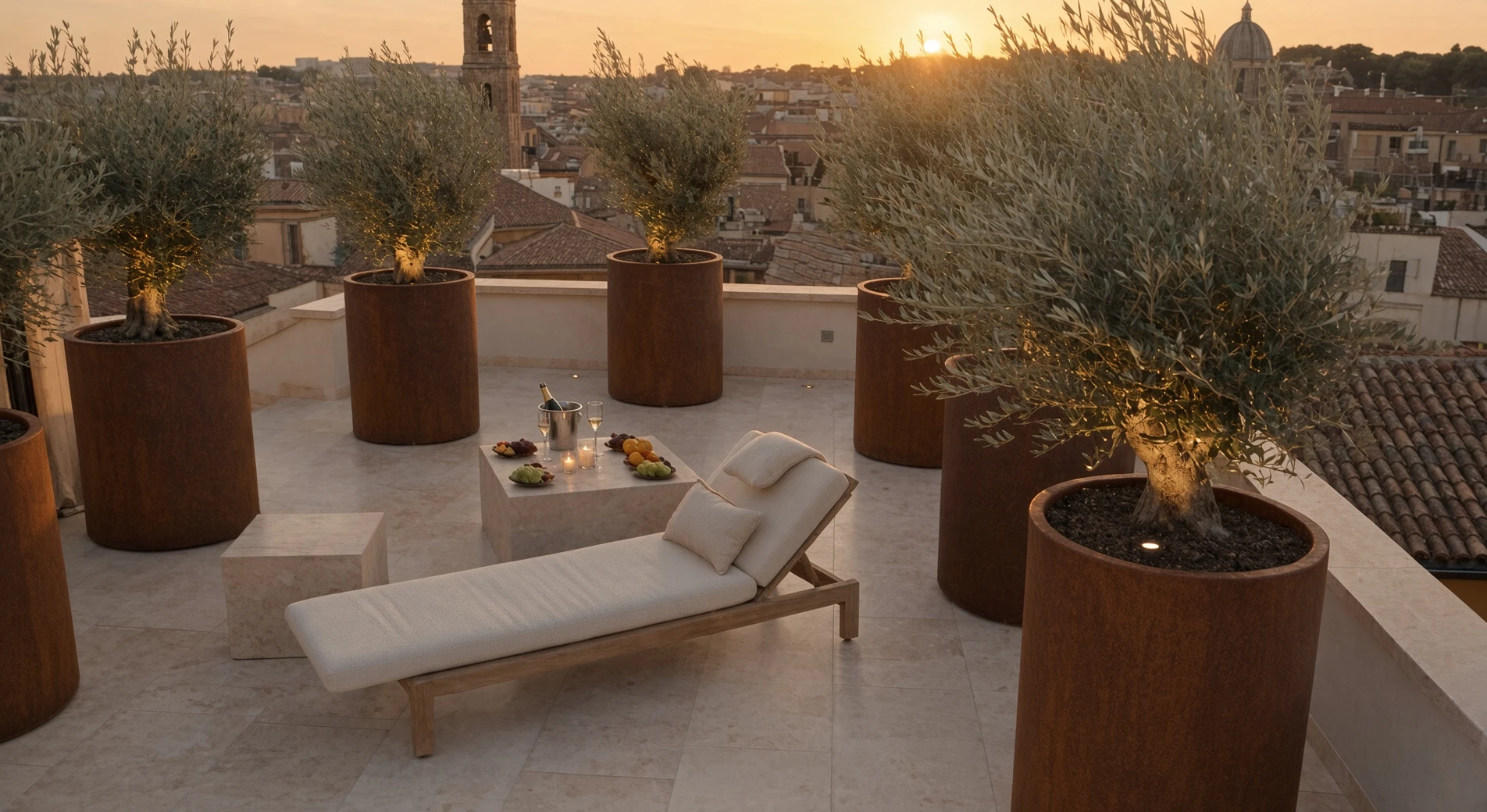
Round pots 800 to 1400 mm across
Large round Corten steel pots for an olive or another tree
For an olive, a citrus or a Japanese maple, our round Corten pots from 800 mm across hold up to about 1540 litres of soil. This page is about large round pots; for a rectangular or square planter box of the same scale, see our large planters.
Large round pots in Corten: diameters, soil volumes and UK prices
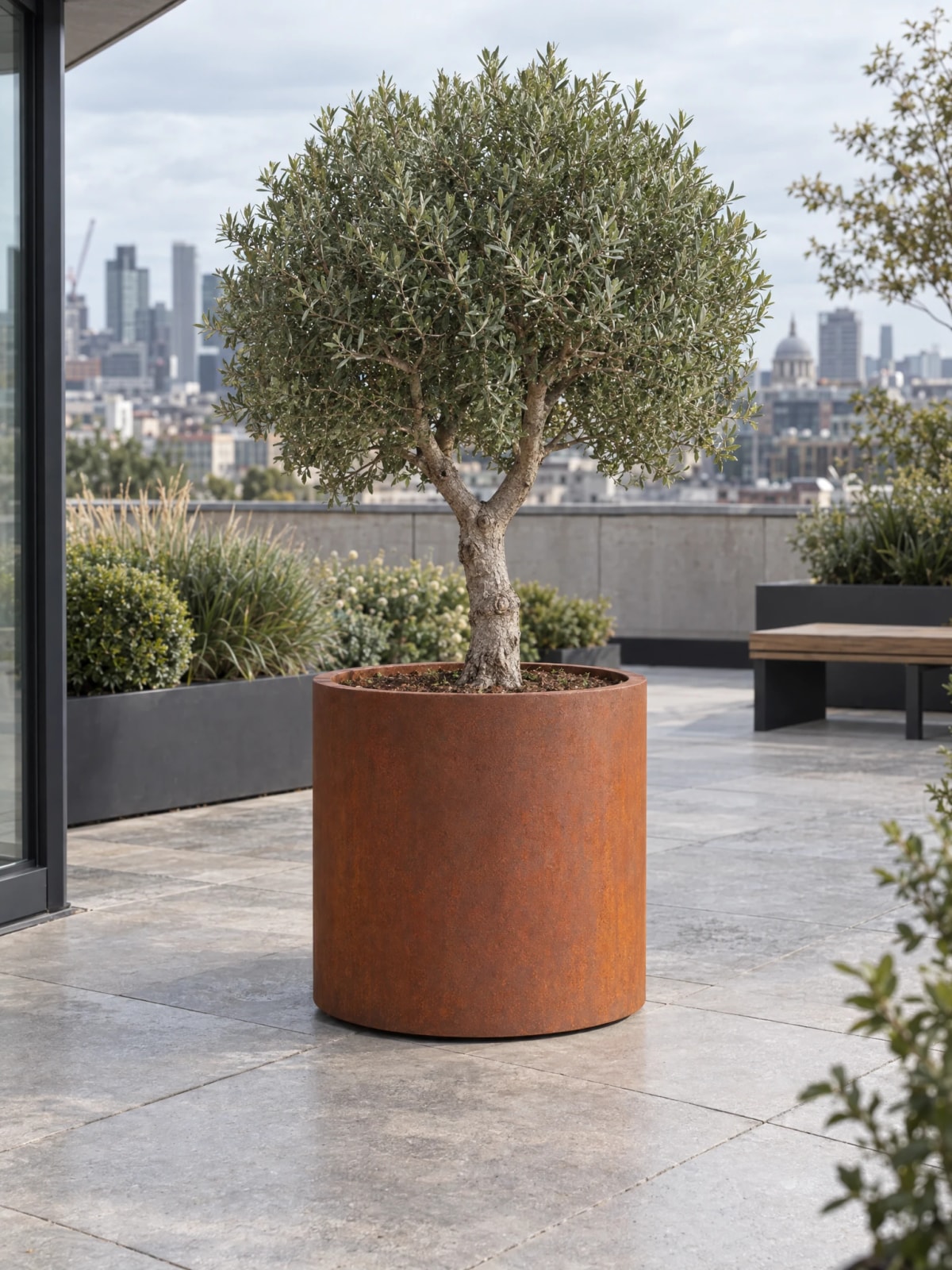
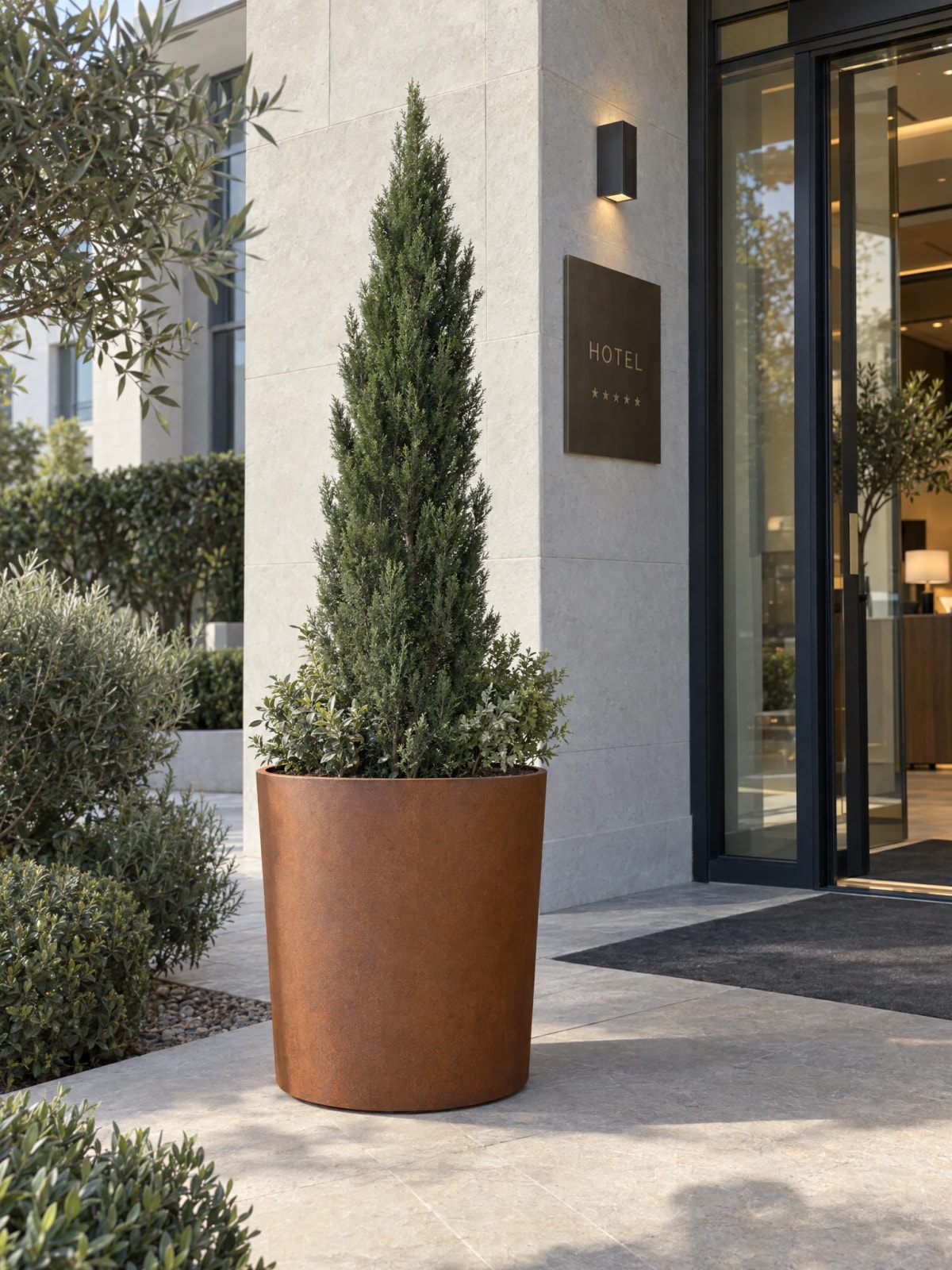
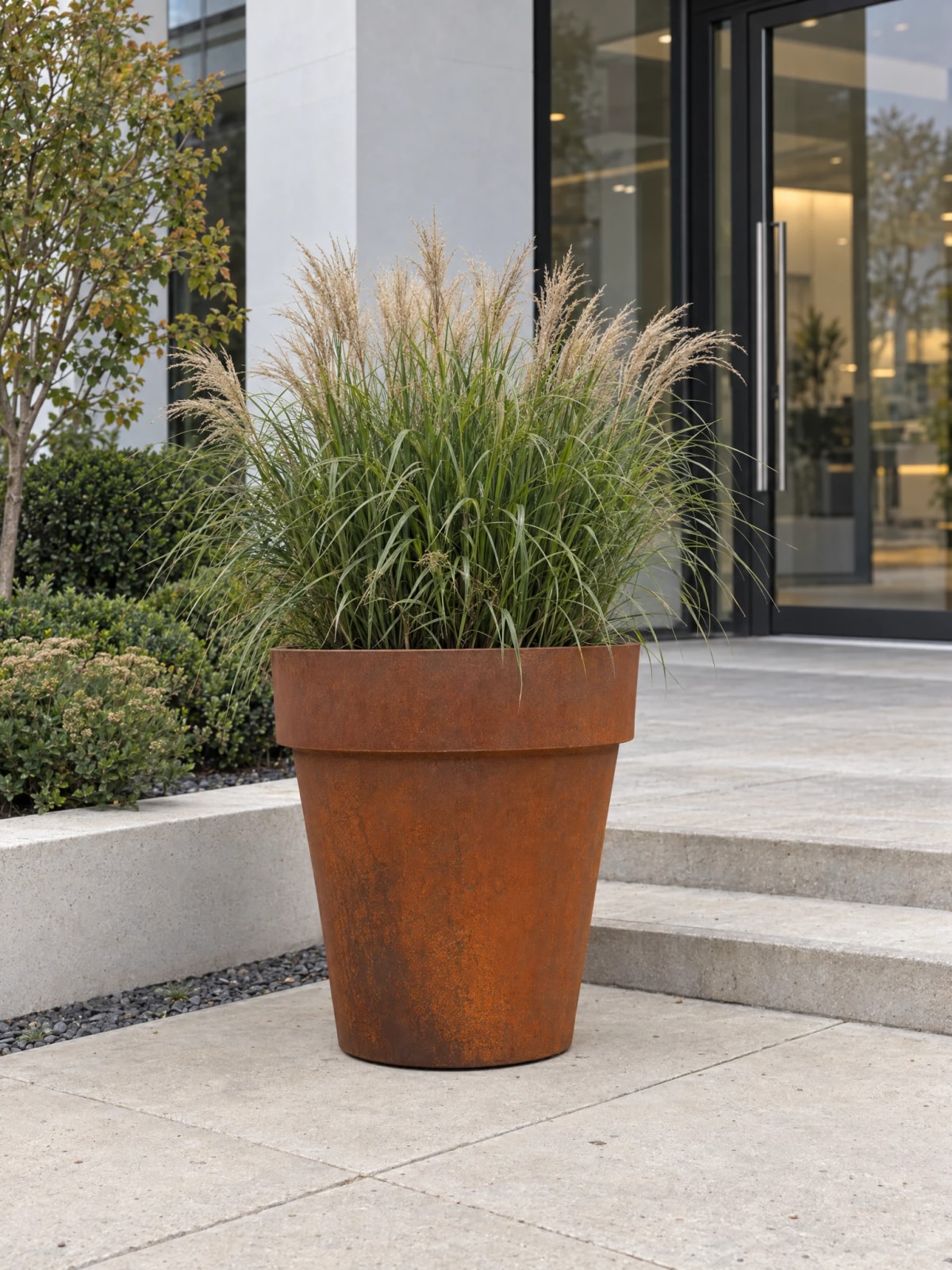
We call a pot large when it measures at least 800 mm across the opening. Three of our round models reach that size, all in 2 mm Corten steel: Callisto, a straight cylinder, from 800 to 1400 mm; Clio, a tapered pot with no rim, whose size reads top then bottom (800/600 means 800 mm at the top and 600 mm at the base), up to 1000 mm; and Calypso, a conical pot with a rim, up to 1000 mm. Each one comes 400, 600, 800 or 1000 mm high.
The soil volume is worked out from the outside dimensions, so it is a maximum: take off the drainage layer and the gap you leave below the rim for watering. For Calypso, whose narrower base is not given, we quote the volume of a cylinder of the same diameter, which the pot does not reach. Prices are UK prices in the base finish, our signature patina.
| Model | Ø × H (mm) | Soil volume (maximum) | Empty weight | Price |
|---|---|---|---|---|
| Callisto | 800 × 400 | about 200 L | 25.8 kg | £930 |
| Callisto | 800 × 800 | about 400 L | 41.4 kg | £1,120 |
| Callisto | 1000 × 800 | about 630 L | 54.3 kg | £1,340 |
| Callisto | 1200 × 800 | about 900 L | 68.2 kg | £1,500 |
| Callisto | 1400 × 600 | about 920 L | 69.3 kg | £1,510 |
| Callisto | 1400 × 1000 | about 1540 L | 96.7 kg | £1,840 |
| Clio | 800/600 × 800 | about 310 L | 34.1 kg | £1,100 |
| Clio | 1000/800 × 800 | about 510 L | 45.9 kg | £1,260 |
| Clio | 1000/750 × 1000 | about 600 L | 52.6 kg | £1,420 |
| Calypso | 800 × 800 | under 400 L | 35.7 kg | £1,120 |
| Calypso | 1000 × 1000 | under 785 L | 55.0 kg | £1,450 |
Which diameter of large pot for which tree or shrub?
Choose the diameter for the plant it will become, not for the root ball you take home from the nursery. Repotting out of a 1000 mm pot means lifting several hundred kilos of soil and roots, so it pays to size up from the start. The figures below are a guide only: check the needs of a particular species with your nursery.
Height matters as much as width. A tree anchors itself better and stands up to the wind better in 800 to 1000 mm of soil; the 400 mm formats suit shallow-rooted shrubs and wide, low plantings. For bamboo, pick a clump-forming variety rather than a running one.
- Ø 800 mm, 600 to 800 mm high (300 to 400 L): a young olive, a citrus, a Japanese maple, tall ornamental grasses.
- Ø 1000 mm, 800 to 1000 mm high (500 to 785 L): an established olive, a more mature maple, a small multi-stemmed tree, a clump of bamboo.
- Ø 1200 to 1400 mm (up to 1540 L): a tree that is meant to stay put for years, or a specimen underplanted with ground cover.
Large pots
Our large round Corten steel pots
Callisto, Clio and Calypso also come in smaller diameters: each card shows the model's starting price across all its sizes, while the table gives the prices of the 800 mm and wider formats only.
Filled weight: put the pot in place before you plant it
Empty, a large pot weighs from 22.9 kg (Clio 800/700 × 400 mm) to 96.7 kg (Callisto 1400 × 1000 mm); it is the soil that changes everything. Depending on the mix and how wet it is, moist compost weighs roughly 1 to 1.8 kg per litre, and your soil supplier can give you the exact figure. A planted Callisto 1000 × 800 mm therefore weighs well over half a tonne, and a 1400 × 1000 mm comes to roughly 1.6 to 2.9 tonnes, pot included. On a balcony, a roof terrace or a suspended floor, have a structural engineer or builder check the load before you order.
Set the pot down empty and level, and only fill it once it is in its final spot: once planted, it will not be moved by hand again. Check the route to the garden in advance, as a 1200 or 1400 mm pot will not go through an ordinary front door, and in a terraced house the hallway is often the narrowest point. For a citrus that comes indoors for the winter, choose a smaller size or a wheeled plant caddy rated for the load.
Drainage and frost in a large round Corten pot
Before filling, find out where the water will leave the base: without a free outlet, hundreds of litres of soil stay waterlogged and the roots suffocate, which matters all the more in a wet British winter. Our product pages do not describe the base of every format, so ask us before you plant, and do not drill the steel without checking with us first. Our guide on how to choose a Corten steel planter covers the other points to settle before you buy.
A 2 mm steel wall does not insulate: in winter, the mass of soil is what protects the roots, and the wider the pot, the longer the heart of the root ball stays frost-free. In colder parts of the country, choose hardy species, line the inside of the wall with a damp-tolerant insulation before you fill, and mulch the surface.
Patina and rust run-off at the foot of a large pot
Every pot arrives with the signature Cortenys patina, applied in our workshop. A large pot takes a lot of water, and the excess that runs down the outside carries oxide with it: plan a bed of gravel, dark paving or pot feet around and under it so that the water can drain away. Our Corten care and rust stain guide explains how to deal with a mark.
The protective varnish offered as an option on Callisto, Clio and Calypso greatly reduces this run-off but does not rule it out: even varnished, a Corten steel pot can still mark the paving or patio beneath it, so protect the ground in every case. On the large formats it adds a little to the price, for example £1,440 instead of £1,340 for Callisto 1000 × 800 mm.
Large round pot, smaller pot or square planter box?
For a medium-sized plant or a pair of pots by the front door, diameters of 350 to 600 mm are enough: see our full range of round Corten steel planters.
If your space calls for a rectangular or square shape rather than a round one, our large Corten steel planters page covers the big boxes: troughs up to 2000 mm long and squares such as Cybèle 2 mm, up to 1400 × 1400 mm. To ring a tree planted in open ground with steel, see our bottomless Corten steel planters. Near the sea, our aluminium planters are the better choice, as our guide to Corten steel near the sea explains.
Cortenys
Frequently asked questions
How wide does a Corten pot have to be to count as large?
We keep the term for pots at least 800 mm across the opening. Ours run from Callisto 800 × 400 mm at £930 to Callisto 1400 × 1000 mm at £1,840.
What size pot does an olive tree need?
A Ø 800 mm pot 600 to 800 mm high takes a young olive; an established tree will be more comfortable in Ø 1000 mm or wider, and one meant to stay put for years in 1200 or 1400 mm. At the same diameter, Callisto's straight cylinder holds the most soil, which suits an upright tree. If you would rather have a square planter, the Cybèle cube goes up to 1400 mm wide. Ask your nursery to confirm how much root room the tree will need.
How much compost does it take to fill a large round pot?
For a cylinder, multiply π by the radius squared, then by the height, all in decimetres: the result is in litres. A Callisto 800 × 800 mm holds about 400 L at most, a 1200 × 800 mm about 900 L. Clio's tapered shape holds less: about 310 L in 800/600 × 800 mm. Beyond a few hundred litres, a bulk bag of compost is easier than small sacks.
What does a large round Corten pot weigh once planted?
Empty, from 22.9 to 96.7 kg depending on the size. Filled with moist compost it reaches several hundred kilos, and more than a tonne for the largest Callisto formats. Have a balcony or roof terrace checked before you buy.
Can a large Corten pot stay outside through a British winter?
Yes. It is the roots that need protecting, because a 2 mm wall does not insulate. In colder areas, insulate the inside of the wall before filling, keep the drainage free and choose hardy plants.
A particular project in mind?
A dimension, a finish, a word of advice. The House is by your side, with the care it brings to every one of its pieces.